- Rising oil and bunker fuel prices boost freight costs across metals supply chains
- Higher logistics and energy costs support steel, scrap, and coal prices
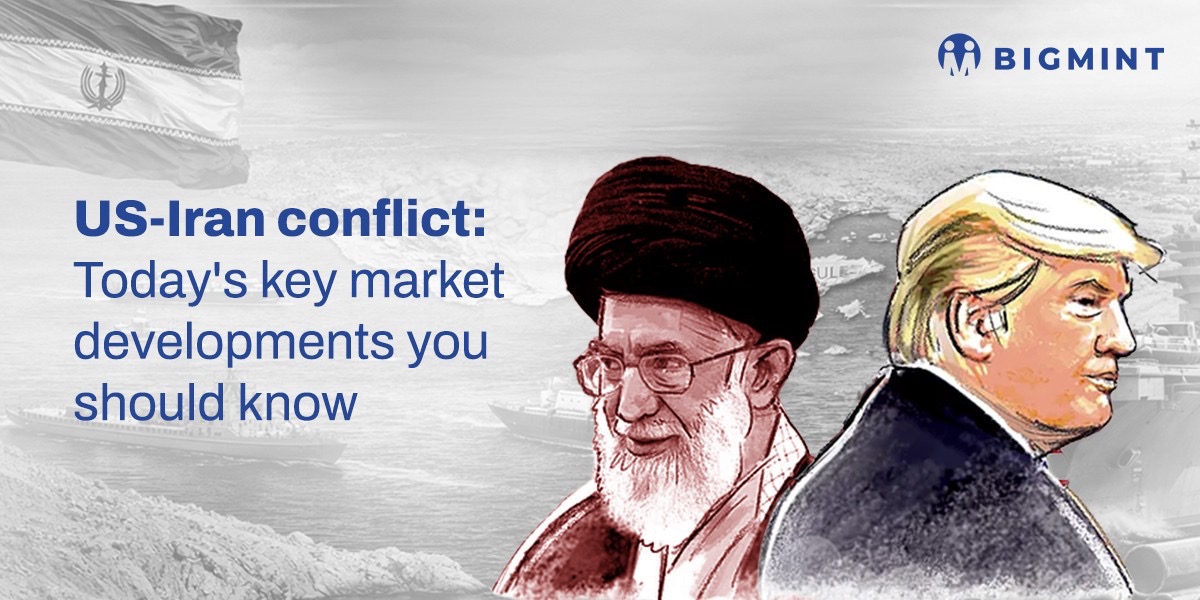
How will the ongoing conflict in the Middle East affect the global metals markets? As the US-Israel and Iran war escalates, BigMint presents a lowdown of the impact of this geopolitical conflict on the Indian metals, raw materials and energy markets:
The escalating conflict involving the US, Israel, and Iran has triggered a sharp energy driven cost shock across global commodity markets. Very low sulphur fuel oil, the primary marine fuel used by commercial vessels, has more than doubled in price from around $515 per tonne in late February to about $1,116 per tonne by 9 March, sharply increasing shipping costs for bulk commodities and metals.
Brent crude oil futures, however, eased to around $92/bbl on 10 March after the sharp rally seen earlier in the week, as markets reacted to expectations of a possible diplomatic resolution. Shipping companies continue to impose war risk premiums and reroute vessels away from areas near the Strait of Hormuz. Because bunker fuel typically accounts for 40 to 60 percent of a vessel’s operating costs, the surge in fuel prices is rapidly feeding into higher freight rates across metals and raw material trades.
The increase in shipping costs is now moving through the metals supply chain. Markets from scrap and stainless steel to aluminium and coal are seeing rising landed costs as freight and insurance premiums climb. A key risk for commodity markets remains the possibility of disruptions to tanker traffic through the Strait of Hormuz. While current movements reflect rising costs rather than supply losses, any interruption to shipping could tighten energy and metals supply chains globally.
Steel
The escalation between the US, Iran, and Israel is reinforcing a cost push cycle in global steel markets as energy prices rise, freight rates increase, and raw material costs strengthen. Europe remains particularly vulnerable because of its heavy reliance on imported LNG. Rising energy costs and persistent inflation are weighing on industrial demand, particularly in the automotive and manufacturing sectors.
China exports around 25 to 30 million tonnes of steel annually to the Middle East. Disruptions to regional trade routes could force Chinese mills to redirect shipments to Southeast Asia or domestic markets, increasing supply pressure in alternative export destinations and intensifying competition in regional steel markets.
Indian steel exports to the Middle East have slowed as uncertainty around freight rates, vessel availability, and insurance costs disrupts trade flows. India typically exports around 60,000 to 70,000 tonnes of steel per month to the region, but several export cargoes remain at ports or plant locations as exporters wait for clarity on shipping conditions.
Domestic steel prices remain firm, and despite concerns around gas supply disruptions, no immediate production cuts have been reported by major Indian steelmakers. Market participants indicated that the current gas supply situation is unlikely to affect production in the near term, although prolonged conflict could push energy costs higher.
In the near term, steel markets are likely to remain driven primarily by energy costs and freight volatility rather than direct disruptions to production or raw material supply.
Stainless steel
The conflict is influencing India’s stainless steel market through energy supply disruptions and logistics challenges. Government directives limiting LNG supply have begun affecting rolling and heating operations across stainless steel mills. Producers estimate that production schedules have been disrupted by roughly 10 to 15 percent in some facilities. Supply tightness is feeding into prices.
One major stainless steel coil producer has raised prices effective 9 March. Prices for 304 and 304L grades have increased by INR 7,000/t while 316 and 316L grades have risen by INR 10,000/t. JT grades have also increased by about INR 3,500/t. Freight costs are rising sharply across regional trade routes. Shipping rates from Southeast Asia have nearly doubled in recent weeks.
Freight from Malaysia has increased from around $60/t to about $110/t while container freight from Thailand has risen from roughly $1,100 to $2,200 per container. Because of these uncertainties many buyers have paused import deals due to concerns over shipment delays and further freight increases.
Ferrous scrap
The conflict has lifted prices in the imported scrap market across South Asia as freight costs increase and shipping routes face growing uncertainty. Shredded scrap prices heard around $365 to $380/t CFR South Asia in late February have moved up to about $390 to $400/t across major regional buying markets. Recent trades for EU origin shredded scrap delivered to Pakistans Port Qasim have been reported around $400 to $405/t CFR, with some suppliers quoting offers above $410/t amid tightening availability. The increase is being driven largely by higher freight costs linked to disruptions in the Gulf region.
Escalating tensions between Iran and Israel have continued to disrupt shipping routes and logistics across the Middle East, pushing freight rates higher and delaying cargo movements. Freight costs remain elevated after rising sharply to around $60 to $65/t, while uncertainty around the Suez Canal route and Gulf ports has further constrained shipment visibility. Another potential risk lies in Iran’s role as a major exporter of direct reduced iron. Any disruption to these shipments could force electric arc furnace steelmakers in the region to increase scrap consumption, tightening global scrap availability and supporting prices.
As of 10 March, India’s domestic ferrous scrap market continued to display firm sentiment, supported by rising imported scrap offers, elevated freight costs, and persistent geopolitical tensions in the Middle East. Domestic scrap prices in the Mumbai market were heard around INR 34,000 to 34,100/t, slightly higher than the INR 33,900/t level assessed earlier, reflecting tightening supply expectations and improved sentiment across the secondary steel sector.
Semis and secondary long steel
Secondary steel markets in India are responding to rising raw material costs. Sponge iron prices have increased across major regions as buying activity improves and coal prices strengthen. Thermal coal costs have risen amid disruptions in global energy markets, increasing production costs for sponge iron manufacturers, and the impact is spreading gradually through the steel value chain.
Billet and rebar prices have strengthened as mills attempt to pass through higher input costs to finished steel products. Trade volumes in the induction furnace segment have also improved as mills cautiously resume procurement despite uncertainty in global markets. In the near term secondary steel prices are likely to remain supported by rising energy and raw material costs even though underlying demand conditions remain moderate.
Non-ferrous metals
Aluminium
As of 10 March 2026 LME aluminium was trading around $3,330/t, down roughly 2% d-o-d, while inventories at LME registered warehouses declined slightly to 454,625 t, a drop of about 0.5%. Prices eased as investors booked profits following comments from US President Donald Trump suggesting the possibility of a quick resolution to the Middle East conflict. Despite the dip in LME prices, both imported and domestic aluminium scrap prices remain elevated. High freight rates and war risk surcharges continue to create logistical challenges, making buyers cautious and slowing procurement activity.
Some secondary aluminium producers are operating at roughly half capacity due to logistical disruptions and uncertainty around scrap availability. BigMint’s bi-monthly assessment of ADC12 shows offers at around INR 275,000 to 280,000/t for 30 day payment terms, while OEM buyers are bidding slightly lower at INR 265,000 to 270,000/t across Delhi, Pune, and Chennai.
On the export front, the Middle East conflict is also affecting automobile shipments. A consignment of around 2,000 Hyundai cars bound for Gulf destinations may be rerouted back to Chennai port due to uncertainty around navigation through the Strait of Hormuz and Red Sea routes.
While export disruptions are a concern automobile companies expect the overall impact to remain limited as domestic vehicle demand remains strong. A larger risk could emerge from potential LPG supply disruptions. Current LPG stocks cover around 15 to 20 days, and any prolonged shortages could force temporary factory shutdowns, reducing downstream demand for aluminium components including ADC12.
Copper
Copper prices on the London Metal Exchange and in the domestic northern market in India increased both d-o-d and w-o-w, with the benchmark LME contract trading around $12,960/t. Unlike aluminium and crude oil the conflict has had limited direct impact on copper fundamentals because the Middle East represents a relatively small share of global copper supply.
However escalating tensions between Iran and Israel have increased logistical uncertainties for shipments moving through the Strait of Hormuz. Higher freight rates and war risk surcharges have made buyers more cautious.
Zinc
Zinc markets are also being influenced primarily through energy and logistics channels rather than direct supply disruption. LME zinc prices remained volatile near $3,350/t while rising crude oil prices have increased concerns around freight and energy costs.
SHG zinc ingot prices in India rose by INR 1,000/t d-o-d to around INR 329,000/t ex-Mumbai reflecting higher replacement costs. Zinc smelting is energy intensive, consuming roughly 3.9 to 4.1 MWh of electricity per tonne, meaning rising power and fuel costs could support prices. However adequate domestic supply and stable inventories have limited the immediate impact on the physical market.
Coal and energy
Energy markets remain the most direct transmission channel through which the conflict is affecting metals markets. South African thermal coal prices at Indian ports increased d-o-d amid tight portside availability and firm freight levels. According to BigMint’s assessment ex-Paradip RB2 (5,500 NAR) rose by INR 300/t to INR 12,200/t while RB3 (4,800 NAR) remained stable at INR 10,600/t. Higher freight rates and limited portside availability continue to support prices.
Freight and logistics
Freight markets have become one of the most immediate pressure points across commodity supply chains. Escalating tensions between Iran and Israel have disrupted shipping routes across the Middle East, pushing freight rates higher and delaying cargo movements. Fuel typically accounts for 40 to 60 percent of a vessel’s operating costs, meaning the surge in bunker prices is quickly translating into higher freight rates across bulk commodity trades.
Market participants say activity has slowed as freight markets adjust to the sudden cost spike, with bunker prices rising rapidly and many shipping players adopting a wait-and-watch approach before fixing vessels. For metals markets these logistics disruptions are raising landed raw material costs and increasing supply uncertainty. Prolonged conflict or disruption to shipping through the Strait of Hormuz could push freight costs higher and sustain volatility across global metals and energy markets.
Leave a Reply