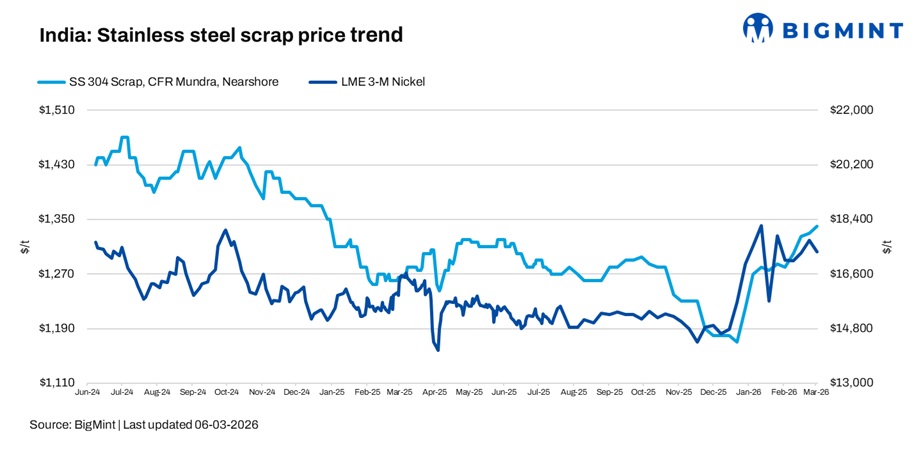
- Strong dollar and alloy costs support scrap prices
- Geopolitical tensions raise freight costs, disrupt imports
India’s stainless steel scrap market remained firm in the week ended 6 March, with mills maintaining cautious procurement amid global geopolitical tensions and a strong dollar. Buyers largely preferred domestic scrap due to better cost economics, although overall trade volumes remained limited.
BigMint assessed domestic 304-grade scrap increasing by INR 1,000/t w-o-w at INR 120,000/t DAP Delhi. With major mills were buying INR 124,000-125,000 /t for 304 scrap and INR 227,000-228,000/t for credit-based payment. Nearshore-origin 304 scrap inched up by $10/t to $1,340/t CFR Mundra. While Far East region trades were heard at around $1,325-1,330/t.
According to market sources, inventories are likely to remain under pressure as imports are being affected by geopolitical tensions, with shipping lines increasing freight costs.
Global updates
European stainless steel scrap prices rose sharply in the week to 5 March, with 304 scrap assessed at $1,240/t CIF Rotterdam, up $80/t w-o-w, amid tight supply and aggressive mill buying. Mills increased procurement to secure inventories ahead of the 30 June EU steel safeguard deadline and fears of future shortages. Meanwhile, higher freight costs from the Middle East limited imports. Indonesian 10% Ni NPI also strengthened to $139/mtu FOB, up $4/mtu w-o-w.
BigMint’s scrap assessments
- Nearshore-origin SS 316 scrap (loose): $2,635/t, up by $35/t w-o-w.
- Nearshore-origin SS 201 scrap (loose): $690/t, up $5/t w-o-w.
- Nearshore-origin SS 430 scrap (loose): $620/t, steady w-o-w.
- SS 316 scrap, DAP Delhi: INR 224,000/t, up INR 1,000/t w-o-w.
- SS utensil scrap, DAP Delhi: INR 69,000/t, up by INR 1,000/t w-o-w.
Outlook
India’s stainless steel scrap market is likely to remain firm in the near term. Ongoing geopolitical tensions are affecting shipping lines and logistics costs, while a strong dollar and rising raw material input prices may continue to support scrap values. At the same time, import volumes are expected to remain subdued this month, which could further tighten supply in the domestic market.
Leave a Reply