- Indonesian output cuts, Russian rail disruptions drive supply concerns
- High prices, elevated freight costs, muted coal demand limit imports
Mysteel Global: Global seaborne coal shipments to China, the world’s largest coal consumer, showed signs of a modest recovery from recent lows, reflecting renewed interest among some Chinese buyers as tightening supply concerns lifted market sentiment, Mysteel learned.
According to Mysteel’s monitoring data, total seaborne shipments of all coal types bound for China reached 4.36 million tonnes during February 16-22, up 14.6% from the one-month low of 3.81 million tonnes recorded a week earlier.
The volume, however, remained 9.7% lower than in the corresponding lunar period last year. Meanwhile, the 14.6% weekly increase was smaller than the 16.1% gain recorded in the same period a year earlier, suggesting that trading activity has yet to fully recover.
Market sources said that Chinese coal importers were cautious about building inventories ahead of the Chinese New Year holiday (February 15-23), as downstream demand was not expected to rebound immediately after the break.
After the holiday, although some coastal power plants released moderate restocking demand for seaborne coal, trading firms were generally less active. Higher coal prices and elevated freight rates have pushed up purchasing costs, sources added.
Global thermal coal prices have been rising since mid-January, directly increasing costs for Chinese buyers. A key driver was growing concern over Indonesian supply after the country’s Ministry of Energy and Mineral Resources (ESDM) announced plans to cut 2026 coal output to around 600 million tonnes from 790 million tonnes in 2025, as Mysteel Global reported.
Many Indonesian miners have held back spot exports as Jakarta has yet to finalize production quota approvals, raising concerns over supply stability for the second to fourth quarters.
The ripple effect has since been reflected in Australian coal prices, which were firmly supported as buyers shifted away from tighter Indonesian supplies.
For instance, Mysteel assessed Indonesian 3,800 kcal/kg NAR coal at $59/tonne FOB Kalimantan on February 27, up $9.5/t from a month earlier. Australian 5,500 kcal/kg NAR coal was assessed at $86.1/t FOB Newcastle, rising $11.5/t over the same period.
Supply concerns were further amplified by disruptions to Russian exports. Three railway derailments in Russia this month interrupted eastbound coal shipments, while unusually heavy ice conditions in the Gulf of Finland — with thickness reaching 30-50 cm — disrupted cargo flows from key Baltic terminals. Although the ice mainly affected coal shipments to India and Turkey, it nevertheless strengthened overall supply concerns, market sources said.
Mysteel learned that reduced availability of prompt-delivery cargoes led some Russian miners to withhold sales, despite subdued Chinese buying interest and limited transactions.
Offers for Panamax shipments of Russian 5,500 kcal/kg and 4,600 kcal/kg NAR coal were quoted at $90/t and $70/t CFR China including VAT, respectively. At ports along the Yangtze River, traders also raised offers for Russian coal amid rising costs, with 5,500 kcal/kg NAR coal quoted at Yuan 755/tonne ($110.1/t) CIF including VAT on February 28.
Higher freight rates have also added to costs for Chinese coal importers. As of February 27, the Panamax freight rate from Samarinda in East Kalimantan, Indonesia, to China rose to $7.4/t, up $1.1/t from a month earlier, Mysteel data showed.
Despite rising costs, expectations of subdued coal consumption — coupled with forecasts of warmer weather across most parts of China — have largely discouraged large-scale replenishment in the seaborne market. In addition, some Chinese power utilities are scheduled to conduct maintenance in March, further weakening the demand outlook, sources noted.
Mysteel’s survey of 493 Chinese coal-fired power plants nationwide showed that their daily coal consumption averaged 3.88 million tonnes during February 20-26, up just 0.7% from the previous week.
In 2026, China’s total coal imports are expected to decline slightly, amid softer domestic demand and potential output cuts by major global coal producers attempting to underpin prices, market insiders predict.
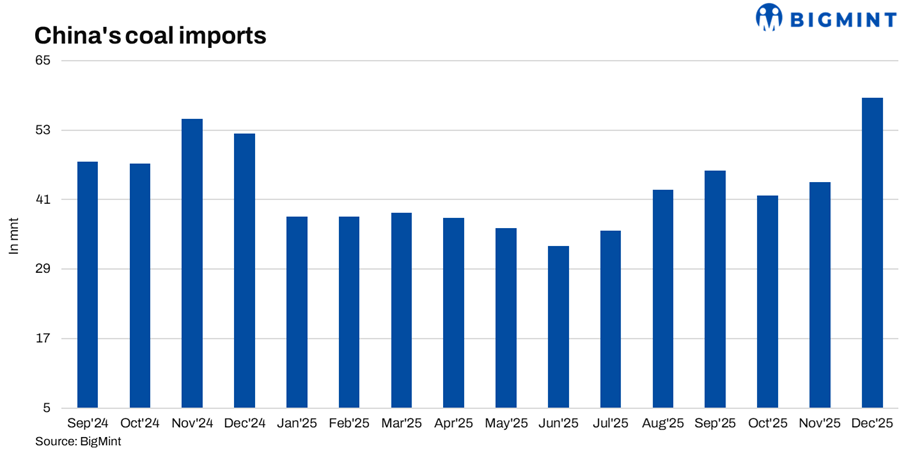
China’s coal and lignite imports declined 9.7% on year to 490.27 million tonnes in 2025, marking the first drop in three years, according to data from the General Administration of Customs.
Note: This article has been written in accordance with a content exchange agreement between Mysteel Global and BigMint.
Leave a Reply