- Domestic scrap remains preferred feedstock
- European tightness offers external price support
India’s stainless steel scrap market moved in a narrow band in the week ended 27 February, with mills maintaining measured procurement amid moderate finished steel offtake. Buyers largely preferred domestic scrap due to better cost economics, though overall volumes remained thin.
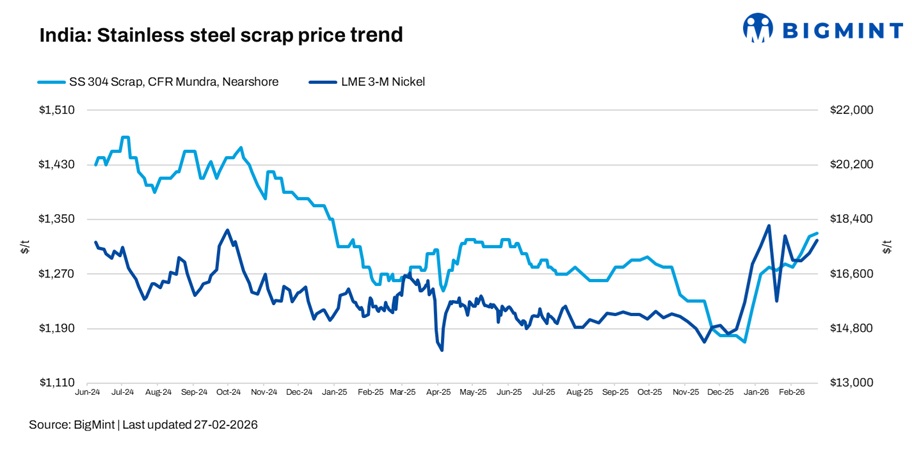
BigMint assessed domestic 304-grade scrap steady week-on-week at INR 119,000/t DAP Delhi. Nearshore-origin 304 scrap inched up by $5/t to $1,330/t CFR Mundra. A north India-based mill said imports were currently unviable, while an eastern buyer noted that limited domestic lot sizes required selective imports at $1,330-1,340/t to meet melt shop requirements.
Domestic market anchors sentiment
Despite firm global cues, Indian mills refrained from aggressive restocking. Market participants indicated that while domestic scrap is cheaper, supply fragmentation prevents bulk coverage in a single transaction, keeping import enquiries active but cautious.
Other grades reflected stability with a firm undertone. Nearshore SS 316 scrap (loose) rose $15/t to $2,600/t, while SS 201 and SS 430 held at $685/t and $620/t, respectively. Domestic SS 316 scrap increased INR 1,000/t to INR 223,000/t DAP Delhi; utensil scrap remained at INR 68,000/t.
Global cues provide background support
In Europe, 18-8 (304) scrap rose EUR 20/t to EUR 1,160/t CIF Rotterdam amid tight availability and precautionary mill buying. In China, stainless producers accelerated scrap procurement post-Lunar New Year, supported by firm production plans and constrained nickel ore supply from Indonesia.
On the alloy front, LME three-month nickel closed at $17,720/t on 26 February, down 3% week-on-week, while Indonesian 10% Ni NPI strengthened to $135/mtu FOB.
Outlook
India’s stainless scrap market is expected to remain stable in the near term. Domestic cost competitiveness will continue to anchor buying decisions, while firm overseas scrap prices and alloy costs may prevent any sharp downside.
Leave a Reply