- Clean energy is driving incremental growth
- Peak demand and power trading show strong underlying momentum
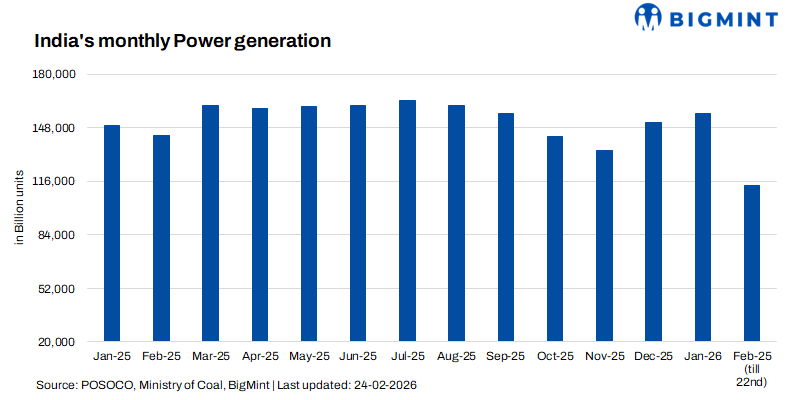
India’s electricity data for the first 22 days of February 2026 shows that the country’s power demand is still growing. Total electricity generation increased slightly compared with the same period last year. But the big change is not the total number -it is where the electricity is coming from. Renewable energy and nuclear power are growing fast, while coal use has fallen a little.
Total power generation grew slightly
Between February 1-22, 2026, India generated 113,598 million units (MU) of electricity. During the same period in 2025, generation was 112,022 MU which grew by 1576 MU y-o-y. This means electricity production grew by about 1.4%. So demand is still increasing, but not very fast.
Clean energy is driving growth
The biggest change is in the fuel mix.

Renewable energy grew the most. It increased by more than 22%. Nuclear power also grew strongly. Together, these two sources added much more electricity than coal lost. This shows that India’s power system is changing. New demand is being met more by clean energy than by coal.
Peak power demand is rising
Even though total generation grew only a little, the maximum daily demand increased clearly. The average peak demand met during 1-22 Feb’26 stood at 242,908 MW, compared to 232,315 MW in the corresponding period last year, reflecting a year-on-year growth of 4.6%.
This is important. Higher peak demand usually means factories, offices, and cities are using more electricity during busy hours. That suggests economic activity is still strong.
Power trading has increased a lot
Electricity trading on the power exchanges has grown very fast. During 1-22 Feb’26, traded electricity volumes reached 3,462,019 MWh, up significantly from 2,276,798 MWh recorded in the same period last year, marking a 52% year-on-year increase.
This big jump shows that companies and utilities are buying and selling more power in the market. It also shows that the system needs more balancing because renewable energy changes with weather.
What this means for the economy
The data sends a clear and consistent signal about the broader economy. India’s growth trajectory remains intact, with electricity demand continuing to expand rather than contract. Peak power consumption has risen, and activity in short-term power markets has become more dynamic, indicating stronger real-time balancing needs and commercial participation.
What has shifted is not the level of demand, but the composition of supply. Incremental power requirements are no longer being met predominantly by coal. Instead, renewable energy and nuclear generation are contributing a larger share of the additional capacity, reflecting structural changes in the country’s energy mix rather than any slowdown in underlying economic momentum.
Conclusion
India’s electricity system is not losing momentum; it is undergoing a structural transition. Overall demand continues to expand at a measured and steady pace, reflecting sustained economic activity rather than volatility. At the same time, clean energy capacity is scaling up rapidly, reshaping the generation mix and reducing the marginal reliance on conventional thermal sources.
Parallel to this shift, power markets are becoming more active and liquid, indicating greater commercial sophistication and improved real-time balancing mechanisms. In practical terms, the economy continues to advance, but it is increasingly powered by a cleaner and more diversified electricity base.
Leave a Reply