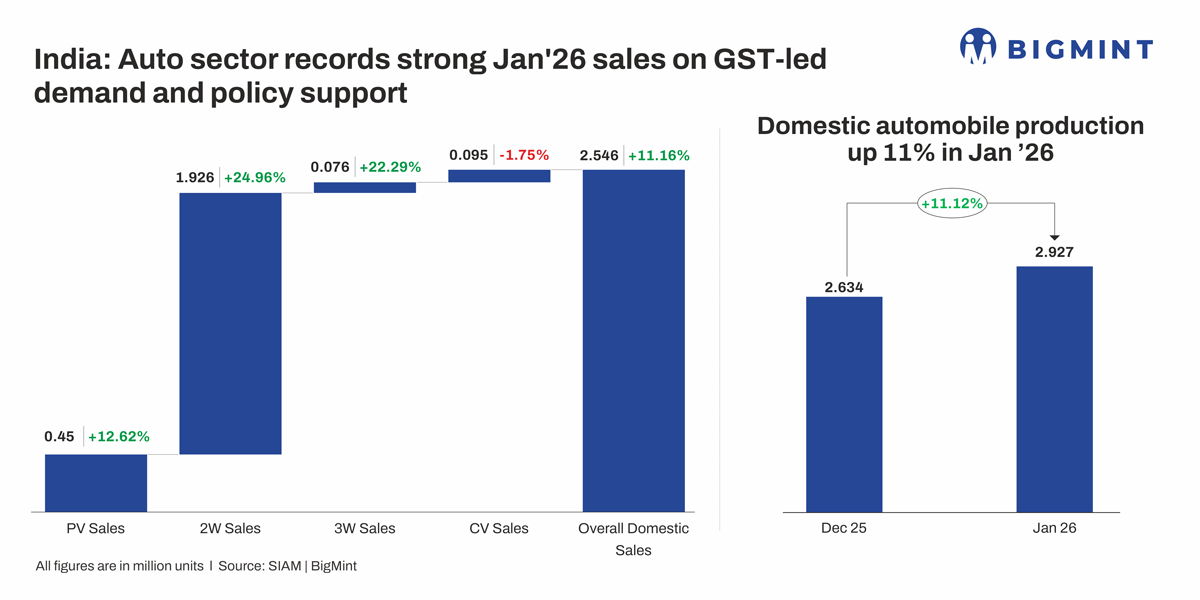
- Overall domestic automobile sales rose 21.3% sequentially
- Strong rural demand and GST cuts boosted sales
India’s automobile sector recorded strong sequential growth in January 2026, as per SIAM OEM data. Passenger vehicle sales increased 12.62% m-o-m to 449,616 units from 399,216 units in December 2025. Two-wheeler sales rose sharply by 24.96% m-o-m to 1,925,603 units from 1,541,036 units. Three-wheeler sales advanced 22.29% m-o-m to 75,725 units compared to 61,924 units in the previous month.
Commercial vehicle (CV) sales declined marginally by 1.75% m-o-m to 95,000 units from 96,695 units in December 2025. Overall domestic sales grew robustly by 21.30% m-o-m to 2,545,944 units from 2,098,871 units.
Total production increased 11.16% m-o-m to 2,927,394 units from 2,633,506 units in December 2025, while registering a 14.95% y-o-y rise compared to 2,546,643 units in January 2025, indicating sustained manufacturing momentum across segments.
Retail sales surge over 34% m-o-m in Jan’26
Meanwhile, FADA’s retail data for January 2026 reflected strong sequential momentum across most vehicle categories. Passenger vehicle sales surged 35.24% m-o-m to 513,475 units from 379,671 units in December 2025. Two-wheeler sales jumped 40.70% m-o-m to 1,852,870 units from 1,316,891 units.
Three-wheeler sales remained largely flat, declining marginally by 0.50% m-o-m to 127,134 units from 127,772 units. CV sales rose sharply by 27.75% m-o-m to 114,320 units from 89,486 units. Tractor sales were broadly stable, dipping 0.21% m-o-m to 114,759 units from 115,001 units.
Overall retail sales increased 34.19% m-o-m to 2,722,558 units from 2,028,821 units in December 2025.
Meanwhile, total sales registered a robust 34.19% m-o-m increase and an 18.80% y-o-y growth, rising to 2,722,558 units in January 2026 compared to 2,028,821 units in December 2025 and 2,291,621 units in January 2025, indicating healthy demand traction across segments.

Passenger Vehicles, Two-Wheelers, and Three-Wheelers recorded their highest-ever January sales in 2026, posting strong double-digit growth across segments compared to January 2025. This surge was driven by sustained consumer demand, improved vehicle affordability following GST rate reductions, and better inventory levels at dealerships, allowing OEMs to fulfill orders efficiently. Industry reports confirm that passenger vehicles, two-wheelers, and three-wheelers all achieved record monthly volumes, reflecting broad-based demand across urban and rural markets.
The positive start to the year was further supported by rural consumption, festival-linked purchases, and robust demand for commercial vehicles fueled by improving freight activity. Structural tailwinds, including initiatives announced in the Union Budget 2026 to strengthen India’s manufacturing base, coupled with ongoing policy incentives and new model launches, are expected to provide long-term benefits and sustain medium-term growth in the sector. Analysts highlight that the January performance is not just seasonal but indicative of underlying market resilience.
Impact on aluminium ADC12 alloy
Firm conditions in the automobile sector continue to lend support to India’s aluminium ADC12 alloy market, given its extensive application in automotive die-casting components. Sustained production across passenger vehicles, two-wheelers and commercial vehicles has underpinned steady demand for lightweight aluminium alloys, even as market participants navigate evolving pricing dynamics and raw material constraints.
According to market participants, OEM-grade ADC12 offers in late February were quoted at INR 258,000-261,000/t in Delhi and Pune, while in Chennai, offers were heard at INR 263,000-265,000/t, with a few suppliers quoting levels as high as INR 270,000/t (30-day payment terms). However, OEM bids across regions largely remained capped at INR 258,000-260,000/t, reflecting continued resistance to higher settlement levels.
Outlook
India’s automobile sector is expected to maintain steady growth momentum, supported by resilient domestic demand, improving rural consumption, and continued policy-led manufacturing expansion. Although short-term fluctuations may occur due to inventory adjustments or supply-side constraints, the overall outlook remains constructive.
This is likely to keep automotive-linked aluminium demand, particularly for ADC12 alloy used in die-casting applications, firm in the near term, with prices expected to stay stable and gradually trend higher as vehicle production normalises and scrap availability remains tight.
Leave a Reply