- Lebanon adopts EU MRL standards for rice imports
- Export volumes stable, compliance risks may affect trade
India has advised rice exporters to exercise caution in shipping consignments to Lebanon after the country aligned its pesticide residue limits with those of the European Union, tightening quality compliance requirements.
The Agricultural and Processed Food Products Export Development Authority (APEDA) said it received a 22 January communication from Lebanon’s Ministry of Agriculture establishing specific import conditions for rice in line with the EU Maximum Residue Levels (MRLs). Exporters have been advised to implement risk mitigation measures or refrain from shipping consignments exceeding EU thresholds.
Market reports indicate that some imported rice consignments were rejected over the past year due to pesticide residues beyond permitted limits, although APEDA clarified that no formal notification has been received from Lebanese authorities.
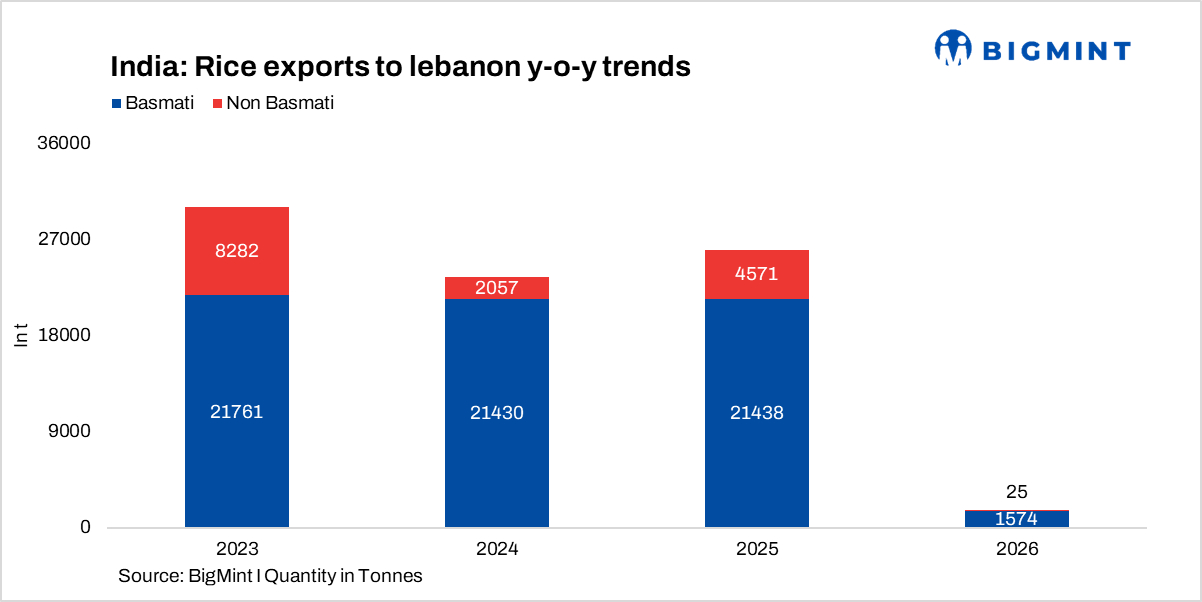
In CY25, India exported 21,438 t of basmati rice to Lebanon, largely unchanged from 21,430 t in the corresponding period last year, indicating stable demand for the premium variety despite evolving regulatory norms, as per data maintained by BigMint.
Non-basmati shipments, however, rose sharply to 4,571 t from 2,057 t a year earlier, marking a 122% increase y-o-y. The growth suggests improving acceptance of Indian non-basmati grades in the Lebanese market, even as exporters face tighter compliance requirements under EU-aligned residue standards.
Leave a Reply