- Inventory drawdowns signal supply stress
- Aluminium use set to touch 106.8 MT in 2026
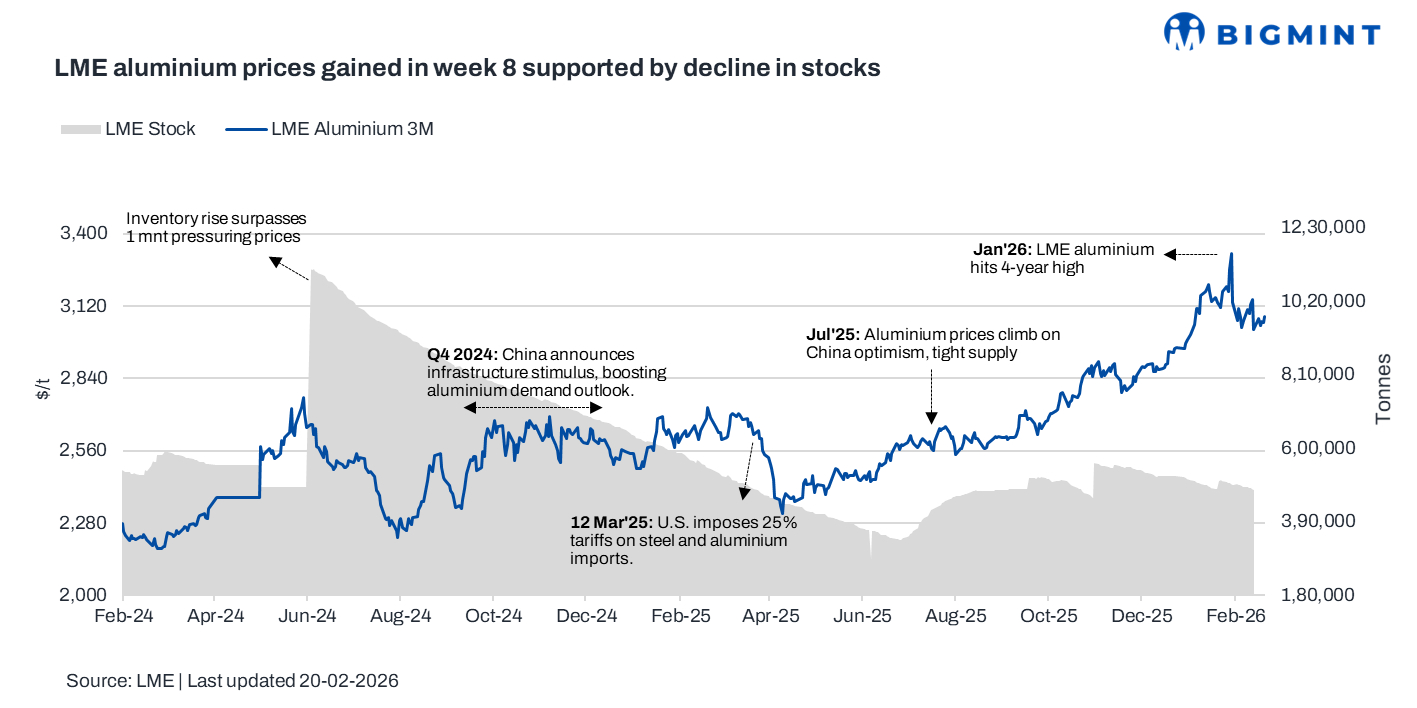
Benchmark aluminium prices on the LME rose 1.68% in the week ended 20 February 2026. LME aluminium remained mostly stable, edging marginally higher w-o-w amid tight visible inventories, robust near-term demand cues from China and Japan, and lingering supply-side concerns that have underpinned market confidence.
Pricing, inventory trends
LME aluminium prices averaged $3,057/t in the week ended 20 February, rising by $51/t or 1.68% w-o-w. The week began at around $3,028/t, firmed mid-week to $3,061/t, and settled at $3,079/t by the close.
Meanwhile, LME aluminium inventories declined by 1.3% w-o-w to 475,550 tonnes, down from 481,550 tonnes in the previous week.
Factors impacting prices
LME aluminium prices gained w-o-w as structural supply constraints continued to underpin market resilience. With global aluminium markets tightening and less flexibility to absorb shocks, prices remained supported even after touching a four-year high, reflecting confidence in the underlying fundamentals.
A key driver has been China’s near-peak output under its 45 mnt production cap, alongside declining exchange inventories, which have limited incremental supply and reinforced bullish sentiment.
Additionally, global aluminium consumption is projected to rise from 96.92 MT in 2023 to 106.8 MT in 2026, driven by transportation (28%), construction (22%), packaging and electrical demand. Electric vehicles, renewable energy, AI data centres and infrastructure spending underpin structural growth. China leads consumption at ~56 MT, followed by the United States, India and Europe.
Outlook
LME aluminium is likely to trade in the $3,050-$3,100/t range in the coming week, with price direction hinging on exchange stock movements. A drop in inventories below 470,000 t could trigger a push towards recent highs, while persistent US dollar strength may restrain upside. China’s 45 mnt production cap and firm Japanese spot demand should continue to cushion downside risks, keeping the market structurally tight.
Leave a Reply