- Rising freights, MEP keep offers on the higher side
- Rupee recovers, exporters scramble to protect margins
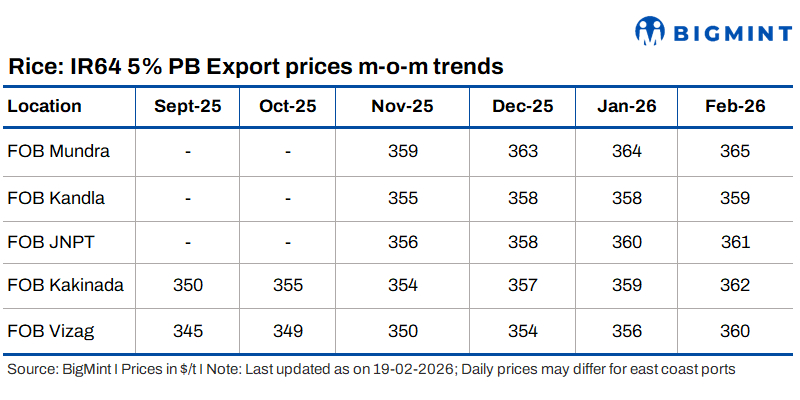
Indian rice exports are on a high, pulling up prices in tandem. Data maintained with BigMint reveals that over the last four months, export offers for the benchmark non-basmati IR-64 5% par-boiled (PB) variety, across three key ports, have been showing an uptrend.
The FOB Mundra price rose almost 2% from $359/tonne (t) in November 2025 to $365/t in February 2026. Similarly, FOB Kandla was up over 1% to $359/t ($355/t) and FOB JNPT rates by 1.4% to $361/t ($356/t) in the period under review.
Interestingly, prices have been up across both container and bulk cargoes. The numbers are not sharply up, but, importantly, they record an uptrend.
Why are rice export offers up?
Strong export demand: A strong export demand has pushed up offers. In fact, export demand for non-basmati rice grains has been rising ever since India lifted the export ban on non-basmati exports in September 2025. In fact, sources indicate that there has been an increase in exports by around 25% since the ban was lifted. Strong demand has been seen from Africa (especially Benin, Cameroon, Ivory Coast, and Djibouti) which is the largest consumer of India’s non-basmati grains, as well as Bangladesh. It may be recalled, in 2023, India had temporarily restricted non-basmati rice exports.
Rising freights: Rice freight rates from India have risen sharply due to the Red Sea crisis, causing over a 30% increase in container costs and delays, as per some sources. Increased freights are pushing up export offers. Data maintained with BigMint reveals that freights on most rice exporting sectors have been up over the last two months or even from the beginning of 2026. Freights to Kenya and Madagascar were up by $9/tonne (t) to $49/t in the second week of February this year compared to the first week of January. On the Somalia route, freights rose $5-6/t to $44/t and on the UAE sector by $2-6/t to $9-14/t in this period.

Export restrictions & duties: While some restrictions were eased, lingering export duties (for instance, 10% on parboiled rice) and a minimum export price (MEP) of $490/t for white rice continue to keep price floors high.
Stronger rupee: A strengthening Indian rupee has made export offers higher in dollar terms, as exporters receive fewer rupees per dollar, pushing them to raise prices to maintain margins. The rupee had lost ground by around 4.7% in 2025. After averaging 90.732 in January 2026 it gained to 90.698 in February.
Outlook
With export demand, especially from African, firm, India’s rice exports look well-supported. This can keep offers propped up in the near term. If the INR remains on the stronger side then this can also keep offers supported.
Leave a Reply