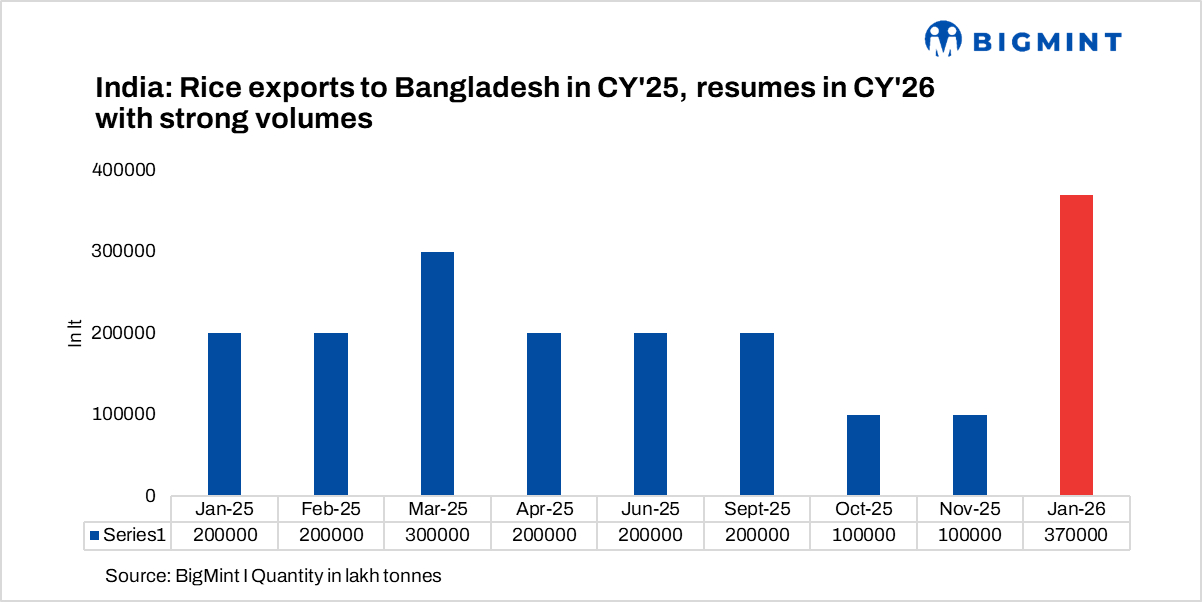
- Strong inflows from India in Jan’26 stabilise availability
- Basmati leads export flows, land ports dominate trade
Bangladesh’s rice import activity has picked up sharply, as the government pushes duty-free procurement to contain domestic prices and strengthen near-term availability. Recent inflows underscore Dhaka’s reliance on cross-border supply, particularly from India, amid tight local stocks and steady consumption demand.
India exported about 370,000 tonnes (t) of rice to Bangladesh in January 2026, almost doubling from around 200,000 t in the year-ago period, as per data maintained by BigMint. Basmati accounted for 310,000 t in January 2026, while roughly 60,000 t of non-basmati varieties were procured by Bangladesh. The shipment mix indicates stronger demand for premium varieties than affordable staple grades. In CY’26, a significant share of cargo — approximately 300,000 t — has entered Bangladesh through Ghojadanga Port. The dominance of land ports highlights their logistical advantage for short-haul trade and faster market replenishment.
Import momentum builds at land ports
Trade flows have intensified at Benapole Land Port, where import activity increased over the past 8-10 days. Port officials reported that about 2,100 t of parboiled non-basmati coarse rice entered Bangladesh within six working days, highlighting a steady replenishment cycle through truck-based logistics.
Shipments arriving between 27 January and 17 February were routed through 58 trucks across 15 consignments, handled by importers such as Haji Musa Karim & Sons and Bhuiyan Enterprise. The consistent arrival pattern reflects a calibrated procurement strategy rather than bulk stockpiling, suggesting a focus on maintaining pipeline inventory.
Policy support and price stabilisation
The government’s decision to allow duty-free imports has become a key intervention to cool domestic prices and ensure supply continuity. Customs authorities have been instructed to prioritise clearance of rice consignments to shorten turnaround time and speed up distribution into wholesale and retail channels. The landed cost of imported rice, estimated near INR 50/kg for non-basmati varieties and equivalent to prevailing spot prices of approximately BDT 65-70/kg, is helping moderate domestic price escalation and maintain market balance. Officials expect the policy to sustain market stability through the first quarter, especially as domestic supply remains tight.
Trade flows expand under import approvals
Government approvals are reinforcing import momentum. On 18 January, Bangladesh authorized 232 importers to bring in a combined 200,000 t of rice, with deliveries scheduled through early March. This follows earlier inflows, including around 6,128 t shipped via Benapole between August and November last year.
Market participants view these approvals as a signal of continued reliance on imports to manage supply-demand gaps, particularly for coarse and non-basmati grades.
Leave a Reply