- Low demand, cautious buying continue to dominate sentiment
- Proposed import curbs in Nigeria may weigh on Indian exports
India’s rice export vessel freight market remained mixed during the week ended 11 February 2026, with bulk rates from the east coast staying under pressure on several Africa-bound routes, while containerised movements from the west coast remained largely stable with selective firmness despite a broadly bearish market tone.
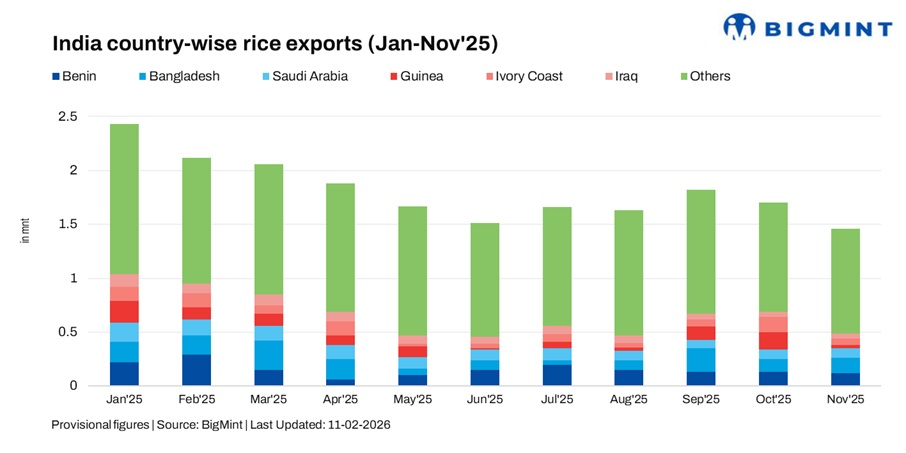
Market participants described sentiment as weak due to low demand and cautious buying interest, even as Africa remained the key destination supporting India’s rice export flows.
A source said, “The rice market is still the same. No demand. Demand should have already picked up in January, but it has not because of unstable forex and government intervention in not releasing paddy.”
East coast: Bulk freights mixed amid selective Africa demand
Bulk shipments from the east coast, particularly Kakinada, remained operationally active. However, spot freights showed mixed trends, as charterers delayed fresh coverage amid limited buying interest and uncertain demand visibility.
One source added that there is demand for the Conakry and Cotonou market at the moment, but not much demand for traditional markets such as Lome and Abidjan — all in West Africa.
Market participants noted that while select West African destinations continued to show demand, overall enquiries remained insufficient to lift broader bulk freight sentiment meaningfully. Buyers remained cautious and preferred hand-to-mouth procurement due to unstable forex conditions and weak downstream consumption trends.
“Exports are slow as compared to last year but will pick up in the coming months from Kandla and Kakinada,” another source stated. This is because new export orders
West coast: Container freights remain stable on tight supply
On the container side, freights from Mundra and JNPT remained stable, supported by carrier-side pricing discipline and limited availability on certain destination lanes. While some routes witnessed minor corrections, overall container freight relaxation remained limited.
“Container freights are still approximately the same. There is no relaxation, as carriers have increased prices due to limited availability and rising oil-linked costs,” said one source.
Market participants highlighted that container freight stability continues to be influenced by equipment availability constraints and bunker-linked cost pressure, preventing downside despite muted export demand.
Route-wise updates

Meanwhile, according to a few market participants, rates may vary by around 5-10%, subject to bunker adjustment factors (BAF) and currency adjustment factors (CAF).
Baltic freight index reflects bearish sentiment
The Baltic Dry Index (BDI) fell 0.7% (13 points) d-o-d to 1,882 points on 10 February, driven by weaker Capesize rates, while the Baltic Supramax Index (BSI) rose 0.8% (9 points) to 1,123 on stable regional demand.
West Africa policy developments add uncertainty
Policy developments in West Africa are emerging as an additional risk factor for India’s rice demand outlook. According to recent reports, Nigeria is considering shutting rice import windows after a policy review indicated that increased imports have contributed to surplus conditions and negatively impacted local farmers’ profitability.
The move is aimed at protecting domestic producers and stabilising local prices, which could potentially reduce import appetite from the region and add uncertainty to near-term trade flows into West Africa. This is significant as Africa remains India’s largest demand anchor for non-basmati exports, and any tightening in import policy could influence cargo flow patterns and vessel demand dynamics across key destinations.
Medium-term outlook supported by logistics upgrades
At the same time, India’s continued push to improve logistics efficiency, including port upgrades, multimodal connectivity, and rail freight improvements, is expected to support agricultural exports structurally over the medium term, even if near-term freight sentiment remains cautious.
Outlook
India’s rice export vessel freights are expected to remain broadly stable with a softer bias in the near term, as weak demand, forex volatility, and domestic supply-side constraints continue to weigh on buying interest. Bulk freight sentiment on the east coast may remain capped due to selective Africa enquiries, with Nigeria’s import policy signals adding further uncertainty to West African procurement.
On the west coast, container freights are likely to stay relatively supported, as carriers maintain pricing discipline amid limited slot availability and bunker-linked cost adjustments. While market activity remains slower compared to last year, participants expect demand to gradually improve in the coming months, particularly from Kandla and Kakinada, which could lend marginal support to forward freight sentiment.
Leave a Reply