- Iron ore mining capacity scaling up from 2.35 mnt to 6 mnt
- Captive solar capacity to increase from 165 MW to 540 MW
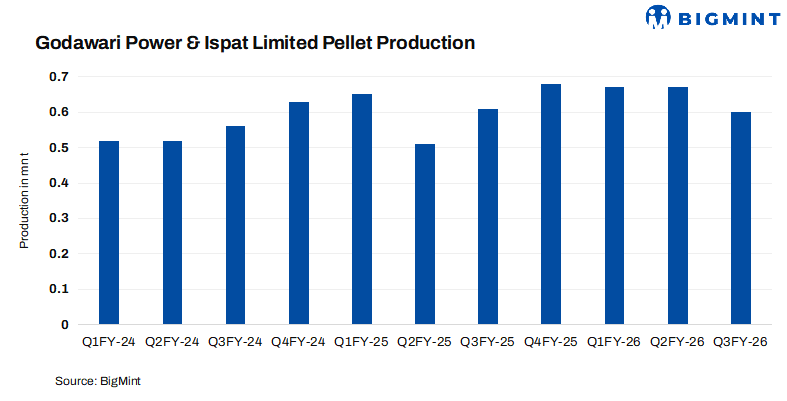
Godawari Power and Ispat Limited (GPIL), a leading steelmaker in central India, witnessed a 10% decrease in pellet production at 603,350 tonnes (t) in Q3FY’26 against 667,200 t in Q2. This was declared during the company’s Q3 results recently. The company’s pellet production stood at 1.94 million tonnes (mnt) in 9MFY’26, an increase of 10% y-o-y, while sales rose 17% to 1.18 mnt in 9MFY’26 compared to 1 mnt in the year-ago period.
Iron ore production in Q3 was at 789,787 t, up by 22% q-o-q, However, iron ore production increased by 27% y-o-y in 9MFY’26 to 2.08 mnt.
Management reaffirmed FY’26 iron ore production guidance of 3 million tonnes (mnt), with 69% of mining volumes and 65% of pellet production already achieved as of 9MFY’26.
Investors’ call highlights
Financial performance
EBIDTA down q-o-q: The company’s consolidated EBITDA was recorded at INR 230 crore in Q3, a 12% drop as against INR 260 crore in the last quarter.
PAT falls y-o-y: GPIL’s profit after tax (PAT) fell 11% to INR 143 crore in Q3 from INR 161 crore in Q2. Profitability declined due to pellet plant accident in October 2025, while lower realisations from intermediate and finished steel products further weighed on overall performance.
Sales, production guidance
Average pellet sales realisation inches up: GPIL’s average sales realisation stood at INR 9,855/t in Q3, edging up by 5% from INR 9,364/t in Q2. The increase in pellet sales realisations in Q3 was driven by improved price realisation for higher-grade pellets, supported by firmer demand from steelmakers and a tighter supply environment during the quarter.
Accelerating transition to renewable energy, decarbonisation: The company’s green energy initiative focuses on expanding captive solar power capacity significantly to reduce energy costs and carbon intensity, including scaling solar capacity from 165 MW to 540 MW, integrating battery energy storage systems for efficient power usage, and supporting its long-term target of achieving net-zero carbon emissions by 2050. The dashboard for CBAM (Carbon Border Adjustment Mechanism) and GHG emissions monitoring has been implemented and is currently operational, with access restricted to a limited set of users.
Update on capacities, projects
- Iron ore mining capacity expansion: The company has received environmental clearance to expand iron ore mining capacity at the Ari Dongari mine from 2.35 mnt/year to 6 mnt. Mining volumes are expected to reach 5 mnt in FY’27, with full capacity utilisation targeted in FY’28, significantly improving raw material security and cost efficiency.
- Beneficiation plant: A 5.4 mnt crushing and beneficiation plant has received both Environmental Clearance and Consent to Establish. The plant will enhance ore quality for captive pellet production and is expected to be commissioned by Q2FY’27.
- Pellet capacity expansion: An additional 2 mnt pellet plant was commissioned in December 2025, taking total pellet capacity from 2.7 mnt to 4.7 mnt. Management expects 90% utilisation from FY’27, supporting both captive and merchant sales.
- Downstream value-addition: The 0.7 mnt CRM complex project is progressing well with land acquisition completed, equipment orders finalised, and bank funding tied up. Construction will begin in April 2026, with commissioning targeted for March 2027.
- Solar power capacity expansion: The company is expanding its captive solar capacity from 165 MW to 540 MW, a more than 3x increase, to support power requirements across mining, steel, pellet, and CRM operations. The project will be executed in phases between FY26-FY27.
- Integrated logistics strengthening: The company has acquired four railway rakes to ensure timely evacuation of pellets and expand sales beyond the Raipur market. The scheme offers a 10% freight discount for 15 years, improving logistics efficiency and lowering transportation costs.
Leave a Reply