- Freight-led dispatches show strong start to 2026
- Northern and southern hubs remain central to national rice logistics
Transportation of rice via rail in India has begun on a firm note in 2026, with January rake volumes reaching about 3.27 million tonnes, notably higher than the same month last year at roughly 2.20 million tonnes. The sharp year-on-year rise indicates steady domestic demand and continued reliance on rail logistics for bulk grain evacuation from surplus northern states to consumption centres.
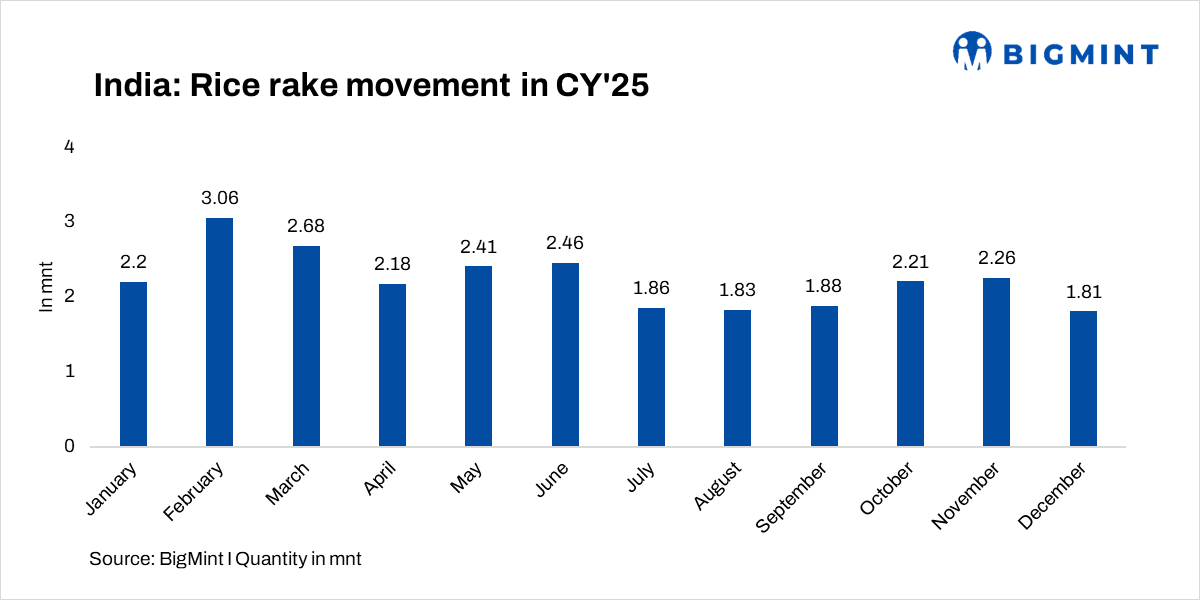
Overall rake movement in 2025 stood at around 26.84 million tonnes, reflecting sustained intra-country trade flows driven by procurement, redistribution, and public distribution system requirements.
Northern loading belts remain dominant
Punjab continued to lead as the primary loading state, accounting for more than 7.57 million tonnes of rice dispatches, underscoring its role as the backbone of Food Corporation of India procurement and inter-state grain transfers. Thanajur emerged as the top loading station at approximately 0.48 million tonnes, highlighting the growing role of southern logistics nodes in balancing seasonal supply chains.
Northern Railway handled the largest share of movement at nearly 8.94 million tonnes, while the Firozpur division alone accounted for about 3.80 million tonnes, reflecting concentrated grain evacuation corridors from procurement regions.
Southern consumption centres anchor unloading
On the demand side, Karnataka ranked as the leading unloading state with more than 5.43 million tonnes, signalling strong consumption and redistribution requirements. Kakinada New Goods Complex was the top unloading station at roughly 1.19 million tonnes, reinforcing the importance of coastal and southern logistics hubs for onward movement and distribution.
The Food Corporation of India remained the dominant consignee and consignor, handling more than 22.9 million tonnes, indicating that public procurement and welfare distribution continue to shape national rice flows.
Monthly movement pattern reflects procurement cycle
Monthly rake movement in 2025 showed a procurement-driven pattern, with February (about 3.06 million tonnes) and March (around 2.68 million tonnes) marking peak evacuation following kharif arrivals. Dispatches moderated through the monsoon months, with July and August falling to roughly 1.86 million tonnes and 1.83 million tonnes respectively, before recovering in October and November amid festival-led consumption and redistribution needs.
The strong January 2026 movement suggests early pipeline replenishment and sustained institutional demand, particularly from public stockholding agencies and bulk buyers.
Logistics intensity supports market stability
Rail-based rice movement remains a key indicator of domestic supply chain health, reflecting both procurement strength and consumption demand. Higher rake deployment and wagon utilisation, nearly 478,000 wagons and over 10,600 rakes, point to an active logistics environment supporting market stability.
With northern surplus regions continuing to supply southern and coastal consumption belts, freight corridors are expected to remain active in the coming months. The early uptick in 2026 movement signals stable availability and orderly distribution rather than supply stress, reinforcing the view that India’s domestic rice balance remains well supported by procurement, stockholding, and structured evacuation.
Leave a Reply