- Domestic zinc prices rally on producer-led hikes
- Downstream alloy costs rise; buying stays need-based
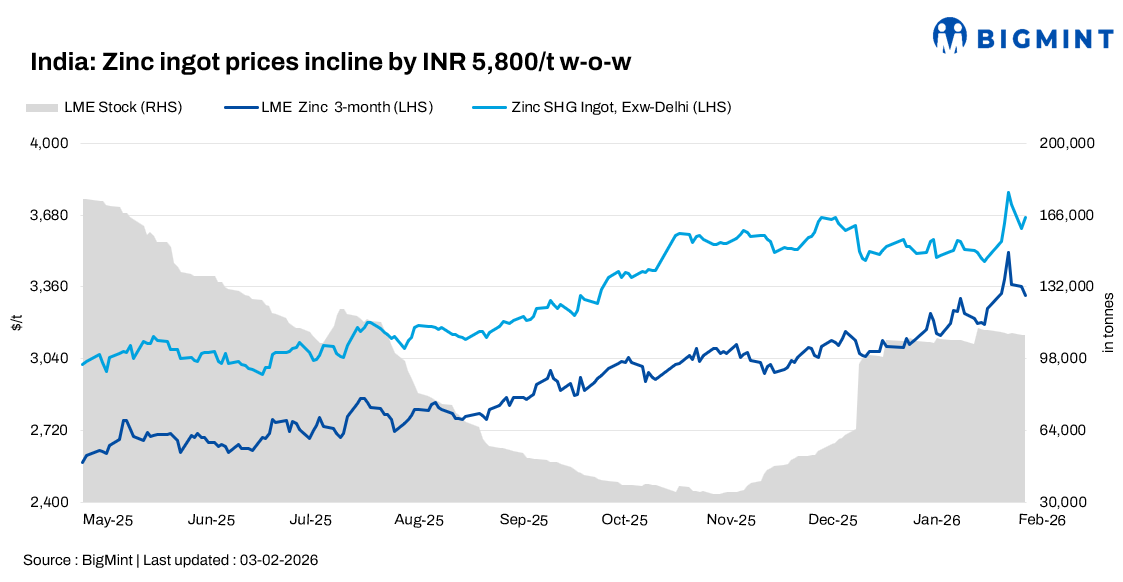
India’s zinc ingot (99.995%) prices jumped sharply by INR 5,800/t week-on-week to INR 331,800/t ex-Delhi on 4 February, supported by higher global benchmarks, firm domestic producer offers, and improved physical market sentiment, BigMint assessments showed. Despite the sharp rise, buying activity remained largely requirement-driven as consumers absorbed higher costs cautiously.
The uptrend was reinforced after Hindustan Zinc Limited (HZL) raised its zinc ingot prices by INR 9,500/t ($104/t) on 2 February to INR 353,000/t ($3,852/t) ex-Chanderiya, tracking strength in London Metal Exchange (LME) prices and a firmer near-term outlook. Market participants noted that the magnitude of the hike tightened spot availability, lending further support to secondary market prices.
In the spot market, special high-grade (SHG) zinc ingots were offered around INR 332,000/t ex-Mumbai, up INR 7,000/t w-o-w. However, price dispersion across origins widened. Australian-origin zinc premiums softened by $20-30/t to about $220/t over LME on a CFR JNPT basis, easing replacement costs marginally. Even so, Australian-origin material in north India was quoted as high as INR 345,000/t ex-Delhi, up INR 3,000/t w-o-w.
Rising zinc prices fed through to the downstream alloy segment. A Delhi-based alloy manufacturer said Zamak 3 prices rose to INR 340,000-341,000/t and Zamak 5 to INR 345,000-346,000/t ex-works, reflecting elevated raw material costs.
India: Coated flat steel prices edge up on cost support
Indian coated flat steel prices rose marginally w-o-w on 29 January 2026, supported by higher flat steel substrate prices and improved trade enquiries. GP, PPGI, and BGL prices increased by INR 600–700/t ex-Mumbai despite regionally mixed demand. Firm HRC and CRC prices pushed up replacement costs, enabling mills to maintain offers at elevated levels amid selective buying.
Korea Zinc to commercialize Next-Gen Battery Material (Composite Copper Foil)
Korea Zinc signed an MOU with Taesung and Neo Battery Materials Korea at its Onsan smelter to jointly develop composite copper foil for drones and robots, a lighter, lower-copper next-generation battery current collector with high density and safety advantages over conventional copper foil. The partners will work on material optimization, cell and stack testing, and prototype batteries and devices. The global composite copper foil market is forecast to grow from US $6.88 bn in 2023 to $10.18 bn by 2032.
Outlook
Zinc prices are expected to remain firm in the short term, supported by strong global cues and producer pricing discipline, though sustained demand will hinge on downstream alloy and galvanising sector offtake.
Leave a Reply