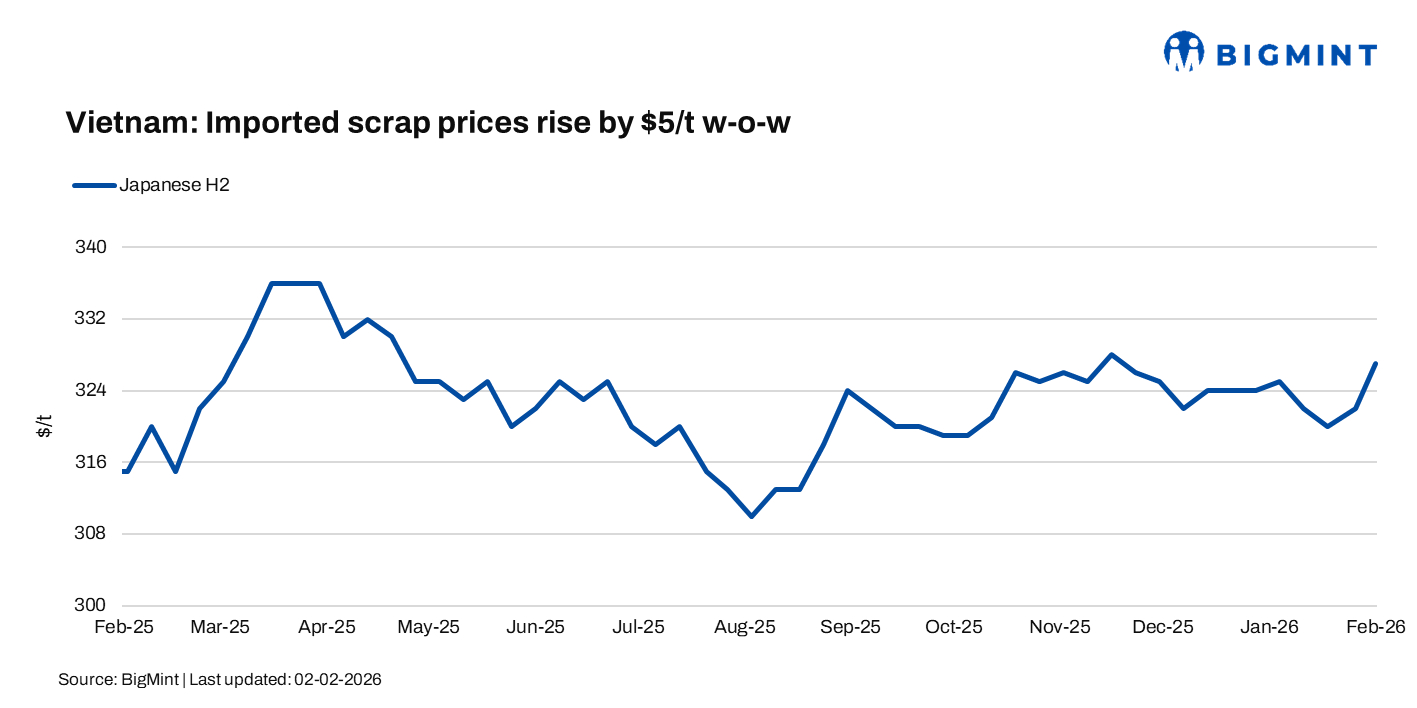
- Vietnam buying cautious ahead of holiday slowdown
- Japan scrap exports pivot toward Vietnam, Bangladesh
Vietnam imported scrap prices firmed on yen-led cost support on 2 February, with Japanese H2 and US-origin HMS gaining w-o-w, while buying stayed cautious ahead of the Lunar New Year. Japan’s scrap exports rose on stronger Southeast Asian demand, led by Vietnam, even as India and South Korea reduced imports.
Weekly assessments
- Japanese H2 scrap was at $327/t CFR Vietnam, up by $5/t w-o-w.
- Japan’s H2 scrap at JPY 44,800/t ($291/t) FOB Tokyo Bay, down JPY 400/t ($3/t) w-o-w.
- US-origin HMS 80:20 bulk stood at $347/t CFR Vietnam, up by $5/t w-o-w.
Vietnam scrap prices firm on yen-led support
Vietnam’s import market for Japanese H2 scrap strengthened in late January, supported by currency movements. Offers were heard at $330-335/t CFR toward month-end, with competitive levels up $5/t w-o-w. Bids improved to around $325/t CFR, and tradable values were assessed at $327-328/t. A Vietnam-based trader stated that yen appreciation lifted replacement costs, lending upward pressure to prices.
Despite firmer indications, spot activity remained measured as currency volatility prompted some exporters to hold back offers. Ahead of the Lunar New Year, most Vietnamese mills adopted a wait-and-see approach, limiting aggressive buying, although restocking activity was reported at normal levels.
In the deep-sea market, US-origin HMS 80:20 offers were heard at $350/t CFR Vietnam, unchanged w-o-w, while bids rose to $338/t CFR, up $3/t, reflecting slightly firmer buying interest.
Domestically, HMS scrap (3-6 mm) bids in northern Vietnam were heard at VND 9,500/kg delivered to mills, excluding VAT, supported by firm local demand.
Scrap exports from Japan rise on stronger demand from Vietnam, Bangladesh
Japan’s total ferrous scrap exports reached 5.48 million tonnes (mnt) in CY’2025, marking a 19% rise y-o-y, driven by stronger overseas demand, particularly from Southeast Asia. While shipments to traditional buyers such as South Korea and India declined, exports to Vietnam increased notably.
Vietnam emerged as a key growth market, with ferrous scrap imports rising 22% y-o-y to 5.47 mnt, supported by robust steel demand and higher scrap usage in EAF-based production.
Bangladesh significantly ramped up bulk ferrous scrap purchases from Japan in 2025, with imports jumping about 132% y-o-y to 1.44 mnt, compared with 0.62 mnt in 2024. The surge reshaped the country’s supplier mix, as Japan emerged as the largest bulk scrap supplier at around 1.5 mnt, overtaking the US. Shipments from the US eased to 1.35 mnt, followed by Singapore and Australia.
Market participants said Bangladeshi mills became more selective in their buying, stepping into the bulk market only when cargo quality, delivery schedules, and pricing aligned with workable margins. While interest in bulk scrap improved, mills continued to tread carefully, as finished steel prices remained sensitive and profit margins stayed under pressure.
South Korea‘s imports declined sharply by 22% y-o-y to 1.45 mnt, weighed down by weak construction activity, lower steel production, and cautious mill procurement amid price uncertainty.
Outlook: East Asian ferrous scrap prices are likely to hold firm but trade within a narrow range, helped by JPY-driven cost support and steady buying from Vietnam and Bangladesh. That said, pre-Lunar New Year caution and softer demand from India and South Korea should restrain any sharp upside, keeping the market balanced between costs and real buying interest.
Leave a Reply