- Demand growth concentrated during non-solar hours
- Flexibility, not fuel supply, is key constraint
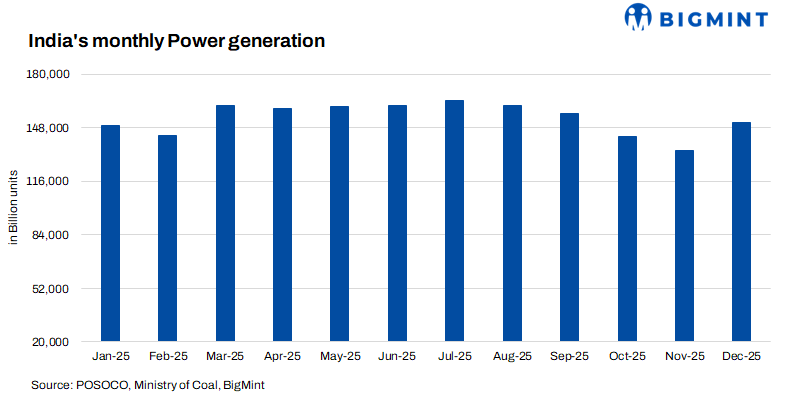
India’s power market in the first 10 days of January 2026 reflects a system that is structurally stronger than a year ago, yet increasingly governed by time-of-day dynamics. Total power generation rose y-o-y, renewable energy expanded its share in the generation mix, and average spot electricity prices declined compared with early January 2025. However, intraday price volatility intensified, driven primarily by rising evening peak demand occurring after solar generation fades.
Peak demand now approaches 239 GW and consistently materialises in the evening hours, exerting disproportionate influence on price formation on the Indian Electricity Exchange (IEX).
1. Generation growth and structural change
During 1-10 January, total electricity generation increased by nearly 6% y-o-y. Coal continued to provide system stability, but the most significant structural shift came from renewable energy. Renewables recorded close to 19% y-o-y growth, making them the single largest contributor to incremental generation. This growth materially altered the merit order during daylight hours, reducing the frequency with which coal sets prices in the day-ahead market.

2. Demand evolution and dominance of evening peak
While generation growth has been robust, demand growth has increasingly been concentrated in non-solar hours. All-India peak demand during this period rose steadily and approached approximately 239 GW by 10 January. Crucially, the system peak consistently occurred in the evening, typically between 18:00 and 20:00 hours. This timing mismatch between peak demand and renewable availability has emerged as the central stress point of the power system.
During daylight hours, particularly between 10:00 and 15:00, solar generation significantly suppresses marginal prices. However, as solar output declines rapidly after sunset, the system must rely on coal and flexible generation to meet peak load. Even when total daily energy availability is ample, this transition creates sharp ramping requirements and tightness at the margin.
3. IEX price formation
Average spot electricity prices on the IEX were lower during 1-10 January than in the corresponding period of last year, with the day-ahead market clearing at around INR 3,900 per MWh on average. However, price formation has become increasingly asymmetric within the day, with a small number of hours accounting for a disproportionate share of daily price outcomes.
4. Intraday price behaviour: 4 Jan vs 6 Jan
The chart above contrasts intraday IEX price behaviour on 4 January and 6 January, the lowest- and highest-priced days of the period. On 4 January, strong renewable output and relatively modest evening demand kept prices contained across most time blocks. By contrast, 6 January experienced a pronounced price spike during the morning ramp and, more importantly, during the evening peak. Prices surged sharply between 18:00 and 20:00 hours, when peak demand coincided with falling solar generation.
This comparison highlights a critical evolution in the market: daily average prices are no longer driven by overall energy balance, but by the ability of the system to serve peak demand in a narrow time window.
5. Coal stocks and system adequacy
Thermal coal stocks at power plants declined marginally from approximately 53.24 million tonnes (mnt) on 1 January to about 52.91 mnt by 10 January, remaining close to 77% of normative levels. This modest reduction did not indicate systemic fuel stress and did not coincide with the observed price spikes. The evidence suggests that fuel availability was adequate, and that price volatility was driven primarily by demand timing and ramping constraints.
Rising value of flexibility
The early January experience underscores a fundamental shift in India’s power market. The system is generating more electricity, relying increasingly on renewable sources, and delivering lower average prices to consumers. At the same time, the growing concentration of demand in evening hours has elevated the importance of flexibility. Peak demand now dictates price outcomes, and intraday volatility has become a structural feature of the market. Going forward, investment signals will increasingly favour storage, demand response, and fast-ramping capacity capable of bridging the gap between renewable generation and peak load.
Leave a Reply