- India invited as strategic partner despite not being member of G7
- India to receive invite to join Pax Silica initiative, says US ambassador
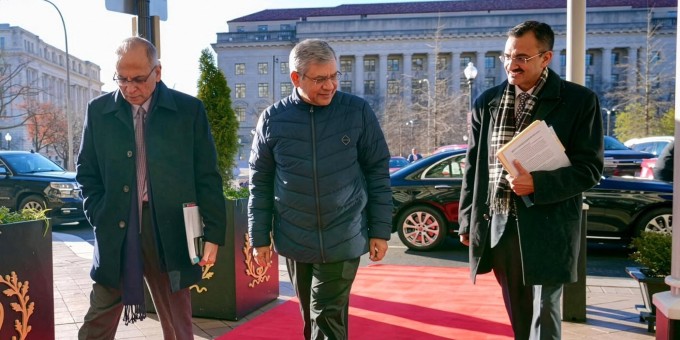
Union Minister Ashwini Vaishnaw is in Washington DC, representing India at a Group of Seven (G7) Critical Minerals Ministerial meeting convened by the United States on 12 January. India, not a member, has been invited as a strategic partner in the group’s efforts to reduce global dependence on China for rare earth elements and other critical minerals.
The US aims to reduce global reliance on China, which dominates the supply of rare earths. With the exception of Japan, all G7 countries — the United States, Britain, France, Germany, Italy, and Canada, as well as the European Union — depend heavily on Chinese supply.
These materials are essential for electric vehicles, renewable energy, modern electronics, and defence systems. The world’s vulnerability to this dependence became starkly apparent in April 2025, when China retaliated against US tariffs by imposing export controls on rare earths and related magnets.
Japan has diversified its supply chain ever since 2010 when Beijing imposed an export embargo on Japan during a territorial dispute over the Senkaku/Diaoyu Islands. More recently, this month itself, China has imposed controls on “dual-use” items — materials serving both civilian and military purposes — to Japan, further weaponising its monopolistic control over energy transition minerals and their processing.
In June 2024, the G7 agreed on an action plan to secure supply chains independent of China. Finance ministers met virtually again in December. Monday’s ministerial meeting has expanded to include not just India but also Australia, South Korea, and Mexico as partners. According to Reuters, this expanded group represents approximately 60% of global demand for critical minerals.
Pax Silica initiative
According to news reports, India is also likely to join the US-led Pax Silica initiative ahead of the Artificial Intelligence summit New Delhi is hosting on 19-20 February. Sergio Gor, the newly appointed US Ambassador to India, indicated on 12 January that India would be invited to join as a full member of the alliance next month.
Pax Silica — literally “peace and silica” — is a US-led strategy to counter China’s dominance through a diversified supply chain for AI, semiconductors, critical minerals, and related infrastructure. The initiative was launched last year, with Japan, South Korea, Singapore, the Netherlands, the United Kingdom, Israel, and Australia forming what has been described as a strategic “coalition of capabilities”. Qatar and the United Arab Emirates will also join, as per a US government official.
India’s contribution to critical minerals security
India’s National Critical Mineral Mission, while boosting domestic production, also looks at acquiring foreign assets, including through G2G routes. During its G20 Presidency, India ensured critical minerals were explicitly recognised in the leaders’ text as essential for clean energy transitions and economic resilience.
At the 2025 G20 summit, Prime Minister Narendra Modi proposed the G20 Critical Minerals Circularity Initiative to accelerate recycling, urban mining, and second-life battery technologies while jointly advancing clean energy supply-chain resilience.
Leave a Reply