- Japan’s January Kanto tender rose for the sixth consecutive month
- South Korea scrap inventories declined 5% as mills resumed operations
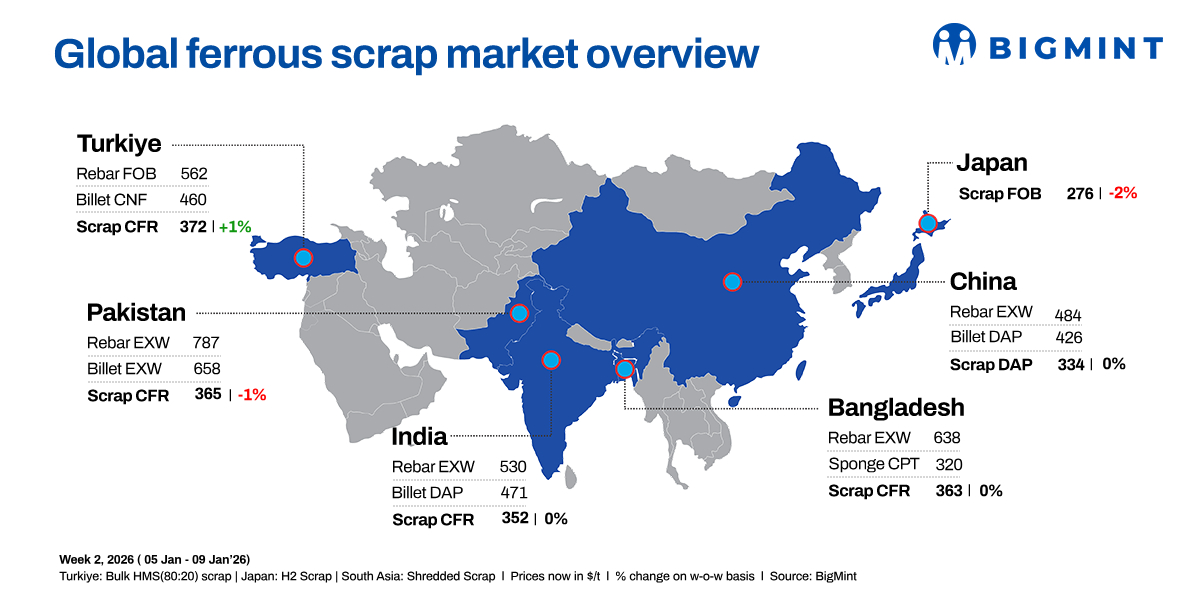
Global ferrous scrap markets remained largely stable w-o-w, with Japan’s Kanto tender rising modestly and South Korea inventories falling. Cautious buying persisted in South Asia and the UAE, while Turkiye and the US saw firm prices amid tight supply.
Turkiye: Deep-sea imported scrap market remians sightly firmer over the week, supported by tight seasonal supply and confident seller sentiment, despite muted rebar demand. Early-week trading was slow due to holidays, with European HMS 80:20 around $365/t CFR and US-origin scrap at $370-372/t CFR with some deals concluded at $365-371/t.
Later in the week, US-origin offers edged up to $375-380/t CFR amid supply tightness and higher freight costs. However, mills remained cautious due to stagnant rebar sales, adopting a wait-and-see approach despite sellers’ expectations of further price gains.
India: Imported scrap market remained slow, as better steel demand failed to trigger buying amid largely unworkable offers. EU/UK shredded stayed near $355/t CFR, while HMS 80:20 held at $330-335/t CFR.
German busheling was quoted at $365-375/t CFR, with limited confirmations around $370/t. Despite lower Australian offers, buyers stayed cautious and price-sensitive, restricting trade activity.
About 3,000-3,500 t of imported scrap was reported, including around 1,000-1,500 t of HMS 80:20, along with additional LMS and NTP.
Pakistan: Pakistan’s imported scrap market remained muted and selective during the week, as buyers showed limited appetite amid high export offers and margin pressure. UK- and UAE-origin shredded scrap was indicated around $365-370/t CFR Qasim.
Mills largely focused on workable levels of $362-365/t CFR despite elevated domestic scrap prices near PKR 130,000/t. Stable billet and rebar prices supported finished steel values, but weak import interest and cautious raw material booking kept trading volumes thin.
Bangladesh: Bangladesh’s imported scrap market stayed weak throughout the week, with limited buying appetite and selective procurement. Australian-origin HMS 80:20 was indicated at $325-330/t CFR, HMS 90:10 at $335-340/t, shredded at $358-360/t, and PNS at $362-365/t CFR Chattogram.
Bulk offers, including a 10,000 t HMS 80:20 cargo from Singapore at $355/t CFR, failed to attract interest as buyers targeted lower levels near $350/t.
UAE: The UAE’s scrap market weakened during the second week of 2026, with prices slipping w-o-w amid muted year-end trading and cautious procurement. Processed HMS fell by AED 18/t ($5/t) to around AED 1,130-1,140/t ($308-310/t), while shredded was indicated near AED 1,180-1,190/t ($321-324/t) DAP Abu Dhabi.
Buying from India and Pakistan stayed selective, with high export offers and VAT uncertainty delaying activity, keeping market sentiment subdued and cautious.
Japan: Japan H2 scrap assessment fell by JPY 750/t ($5/t) w-o-w to JPY 43,550/t ($276/t) FOB Tokyo Bay amid competitive offers and weak buying. Vietnam-bound offers softened to $325-330/t CFR, with thin deep-sea activity due to wide bid-offer gaps.
Japan’s January 2026 Kanto scrap tender rose for the sixth consecutive month, with H2 awarded at JPY 46,771/t ($296/t) FAS-the highest since May 2023. Weak export demand kept Kanto scrap prices stable despite modest underlying gains.
Tokyo Steel revised scrap purchase prices for the second time this month, effective 10 January 2026. Post-revision, H2 prices ranged between JPY 43,500-44,500/t across its plants, with Takamatsu remaining suspended amid selective adjustments.
US: Ferrous scrap exports remained muted post-holidays, but prices firmed amid tight shredded supply. FOB East Coast HMS 80:20 rose to $347/t and shredded to $367/t, with CFR Turkey, Vietnam, and Bangladesh showing modest gains.
South Korea: South Korea’s ferrous scrap inventories fell 5% w-o-w to 929,000 t as Hyundai and Dongkuk Steel resumed operations. Stronger mill activity and low winter scrap generation may keep inventories under pressure.
Leave a Reply