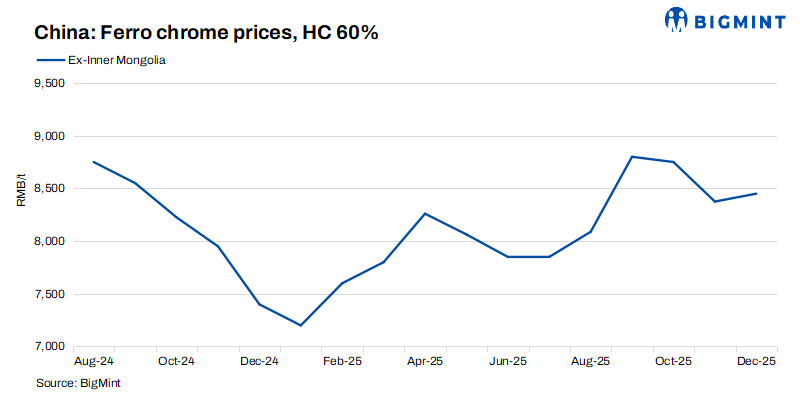
- Supply-side uncertainty provides cost support
- New energy demand boosts prices
China’s high-carbon ferro chrome prices inched up by RMB 100/t ($14/t) w-o-w as on 23 December 2025 to RMB 8,290-8,700/t ($1,179-1,238 /t) exw, including taxes.
Meanwhile, medium-carbon ferro chrome prices inched up by RMB 200/t ($28/t) w-o-w to RMB 12,600-12,800/t ($1,793-1,821/t) exw, including taxes.
Ferro chrome prices witnessed a slight upward trend, supported by higher raw material costs and ongoing supply-side uncertainty. However, seasonal weakness in stainless steel demand and cautious downstream buying continued to cap further price gains.
Market recap
Raw material market trends
The divergence between domestic and international chromium ore prices persisted. While South African concentrate futures remained stable, spot market traders offered discounts on weak downstream buying interest.
Meanwhile, a modest rise in coking coal prices increased smelting costs, and the ongoing structural shortage of chromium ore continued to provide cost-side support.
Ongoing policy disruptions in South Africa increased global supply uncertainty, leading some companies to build inventories in advance and slowing the reduction of port stocks.
Downstream market trends
The stainless steel market has entered its seasonal off-peak period, with steel mills expecting production cuts. This is putting pressure on high-carbon ferro chrome prices.
In contrast, demand for high-end products remains steady, with high-temperature alloy demand supporting medium-carbon ferro chrome prices and new energy battery procurement boosting low-carbon ferro chrome prices.
Stricter carbon quota policies are driving a shift toward high-purity ferro chrome, and cautious procurement is limiting short-term price gains. Although traders are offering discounts to move inventory, cost support is restricting the downside.
Outlook
Ferro chrome prices are expected to remain rangebound, as high raw material costs and supply uncertainty are likely to provide support, while weak seasonal demand is expected to limit upside potential.
(With inputs from CBC)
Leave a Reply