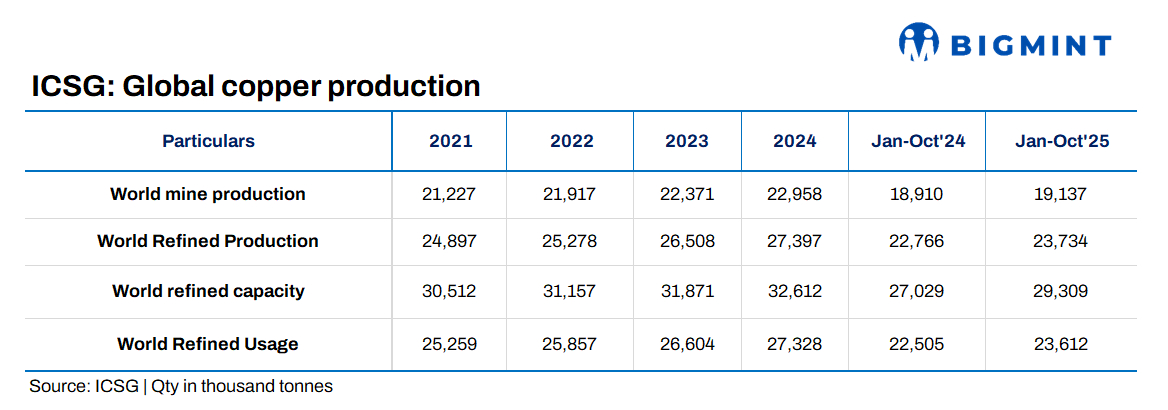
- China and DRC anchor global production growth
- Chilean refined copper production declines sharply
The International Copper Study Group (ICSG) has reported preliminary data for January-October 2025, showing that global refined copper production grew by around 4.4% y-o-y, supported by a 4% rise in primary production (from ores via electrolytic and electrowinning processes) and a 5.6% increase in secondary production (from scrap).
Regional trends in refined copper production
Growth in global refined copper production during the period under review continued to be underpinned by China and the Democratic Republic of Congo (DRC). Together, these two producers accounting for around 57% of global output, are estimated to have recorded a combined production increase of about 9% (China +9.3%, DRC +7.8%). Excluding China and the DRC, global refined copper output declined by approximately 1.6%.
In Asia, excluding China, refined copper production is assessed to have fallen by 3.2%, largely reflecting weaker output in Japan and the Philippines. Japan’s production dropped by 6.4% due to maintenance shutdowns, while output in the Philippines plunged by 70% following the closure of the Pasar refinery.
In Indonesia, the Amman and Manyar smelter/refinery complexes commenced operations in March and July, respectively; however, overall production was constrained by operational challenges at Amman and after the Grasberg mine incident. India, by contrast, recorded a strong 20% rise in refined copper output on improved operating capacity utilisation and the ramp-up of Adani’s refinery.
Chilean refined copper production declined by 10% during the period. Electrolytic output from concentrates fell by 16%, impacted by smelter maintenance shutdowns, while electrowinning (SX-EW) production decreased by 7.5%.
Global secondary refined copper production, derived from scrap, increased by 5.6%, with the growth largely driven by higher output in China.
Copper mine output up
Preliminary data indicates that global copper mine production increased by about 1.9% over the first 10 months of 2025. Concentrate output rose by 0.7%, while solvent extraction-electrowinning (SX-EW) production increased by 3.2%. Overall growth was supported by additional output from projects ramping up to capacity and improved performance at several operating mines. However, lower ore grades and disruptions at major operations–including the Kamoa incident in May and the Grasberg incident in September–continued to constrain stronger global growth.
Chile’s copper mine output declined marginally by 0.7%. Higher production at Escondida, Centinela, Mantos Copper and Codelco was more than offset by reductions, mainly at Collahuasi, Los Pelambres and Quebrada Blanca.
In Peru, copper mine production increased by around 3%, driven by higher output at Las Bambas, Toromocho, Quellaveco and Marcobre. These gains more than compensated for production declines at Cerro Verde, Antamina and Antapaccay.
The Democratic Republic of Congo (DRC) recorded an estimated 7% increase in mine production, supported by expansions at Kamoa (prior to the incident), Tenke/Kisanfu and several smaller operations. Kamoa’s output rose by 31% in the first half of the year but fell sharply by 39% in the third quarter following a seismic event.
Mongolia’s copper concentrate production grew by about 35%, reflecting the ongoing ramp-up of the Oyu Tolgoi underground project.
Meanwhile, Indonesian copper mine production fell steeply by 38%. The decline was driven by lower output at Batu Hijau due to mine sequencing, significantly reduced production at Grasberg following a planned major maintenance programme earlier in the year, and the suspension of mining activities after a severe mud rush incident on 8 September.
Refined copper usage grows
Preliminary data suggests that global apparent refined copper usage increased by around 5.5% over the first 10 months of 2025.
China’s apparent refined copper demand (excluding changes in bonded and unreported stocks) is estimated to have risen by approximately 7.5%. Despite this demand growth, China’s net refined copper imports declined by about 5%, as refined copper imports edged down by 0.3% while exports surged by 29%. China continues to account for roughly 58% of total world refined copper usage.
Refined copper consumption outside China increased by around 1.7%. Growth in several Asian and MENA markets helped offset weaker demand conditions in the EU and Japan.
Market surplus rises
Preliminary world refined copper balance shows an apparent surplus of about 122,000 t over the first 10 months of 2025. Adjusting for estimated changes in Chinese bonded inventories, the refined copper balance indicates a market surplus of around 191,000 t.
Copper prices
China’s bonded copper stocks are estimated to have increased by around 69,000 t compared with end-2024 levels.
Combined copper stocks at the major metal exchanges (LME, COMEX and SHFE) totalled 646,851 t at end-November, up 216,623 t (+41%) from December 2024. Stocks declined on the LME (-111,925 t) and increased at COMEX (+304,790 t) and SHFE (+23,758 t).
The average LME cash price for November stood at $10,800.78/t, up 1% from October’s average of $10,696.02/t.
The 2025 high was $11,816/t on 12 December, while the low was $8,539/t on 9 April.
The year-to-date average price is $9,873.14/t, around 7.9% higher than the 2024 annual average.
Leave a Reply