- Short-term drivers, rather than structural shifts, behind recent rise in Baltic index
- Simandou’s impact on freights likely to be net-neutral despite trade flow shifts
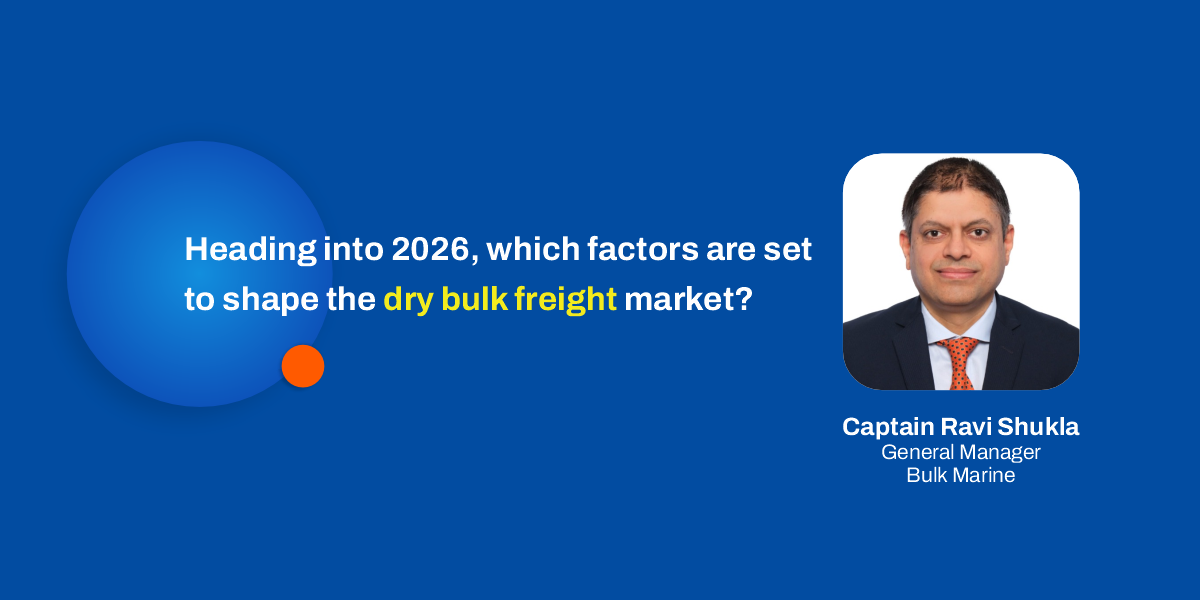
Global dry bulk markets are facing a period of heightened volatility, shaped by shifting trade flows, geopolitical risks, uneven demand recovery, and evolving regulatory pressures. While the recent uptick in the Baltic Dry Index has lifted sentiment, structural challenges remain. This interview with Captain Ravi Shukla, General Manager, Bulk Marine, explores the key forces expected to influence freight markets in 2026 — from China’s policy stance and Pacific basin oversupply to Capesize earnings, Simandou’s impact, and India’s coal import dynamics — offering insights into what lies ahead for the dry bulk sector.
Q1. What are the key drivers behind the rise of the Baltic Dry Index to a nearly two-year high in the first week of December 2025? Is this a short-term rally or a sign of deeper structural improvement?
A. The recent rise of the Baltic Dry Index can be attributed to several factors, including short-term demand, seasonality factors, and trade flow disruptions.
Key drivers include heightened iron ore shipments from Brazil and Australia, growing bauxite exports from West Africa, increased coal and grain exports from various regions, trade flow disruptions (Red Sea issues), geopolitical risks (US-China trade war), seasonality, and the absorption of vessels due to longer tonne-mile demand.
While the surge fosters optimism, we believe this is short-term rather than a great structural improvement. We should examine China’s consumption data to draw inferences. China’s domestic consumption is not picking up, which is a cause for concern.
Q2. Rising freights and lower fixtures seem to have contributed to an oversupply in the Pacific Basin. Do you expect this imbalance to ease soon?
A. The oversupply in the Pacific Basin is due to slow demand growth and the continuous supply of new vessels.
The economic recovery in major importing countries remains uneven, with continued pressure on various commodities exacerbating the imbalance. Unless there is a marked increase in consumption or a reduction in fleet sizes due to a decrease in orders and demolition of aged vessels, the oversupply scenario is likely to persist.
According to the latest newbuilding data reports, bulker deliveries are expected to reach a six-year high in 2026. Further complicating matters, macroeconomic uncertainties, and potential disruptions in global trade may delay any meaningful recovery in demand. Consequently, it appears that this oversupply issue may persist as a prolonged challenge in the Pacific Basin.
Q3. How crucial is Beijing’s policy response for bulk demand and freight direction this year?
A. China’s policy response will be pivotal in determining bulk demand and freight directions through 2026, especially given the country’s status as a leading consumer of raw materials.
If the government implements more aggressive fiscal stimulus or infrastructure spending, along with its efforts to spur domestic consumption, it could significantly boost industrial activity, thereby increasing demand for bulk imports.
However, delays in implementing such policies could further suppress demand, placing additional pressure on freights. Furthermore, domestic economic reforms and shifts towards renewable energy will play a critical role in shaping demand dynamics.
In this context, stakeholders must remain vigilant about changes in policy, as they will significantly influence both market sentiment and freight patterns in the years to come.
Q4. What are your expectations for Capesize earnings given the slowing global iron ore trade?
A. As we move towards 2026, Capesize earnings are expected to be challenged by a slowdown in global iron ore trade, particularly influenced by shifting consumption patterns in China.
While there may be occasional spikes in demand, particularly linked to seasonal factors or policy stimulus and the upcoming push from Guinea’s Simandou project, along with robust West African Bauxite movement, the overall trajectory suggests continued pressure on earnings.
Considering these factors, earnings may not see substantial improvements; instead, the market could experience volatility, with operators needing to adapt quickly to changing supply and demand conditions.
However, one of the key factors that can keep the Capesize segment from falling to very low levels of earnings is the thin order book for these vessels.
Q5. How could the commissioning of Simandou reshape tonne-mile demand and trade patterns?
A. The commissioning of the Simandou iron ore project is expected to significantly reshape tonne-mile demand, as it introduces a new source of high-grade iron ore to the global market. This could lead to a partial redirection of flows previously dominated by Australia and Brazil, thereby altering traditional shipping routes and increasing average haul distances, as well as longer ballast legs.
This shift may increase demand for larger vessels, particularly Capesize vessels, as operators seek to capitalise on longer distances for cost efficiency. However, the impact will largely depend on operational efficiency and market pricing strategies. Consequently, Simandou has the potential to redefine trade patterns and lead to greater competition among suppliers in the iron ore market. Additionally, a possible move by China’s central iron ore procurement agency, the state-owned China Mineral Resources Group (CMRG), to consolidate fragmented purchases could impact the trade flow dynamics.
Q6. Do you view the impact of Simandou on freight as neutral or net-positive?
A. Our general view is that Simandou’s impact on freight rates will be potentially net-neutral rather than overtly positive. While the project could disrupt existing trade flows by displacing some Australian iron ore shipments, it might not increase overall trade volumes sufficiently to drive up freight rates. Instead, it could result in a more competitive market, with price adjustments exerting a stabilising effect on rates. This means that while freight dynamics may shift, existing players must adjust strategies accordingly without counting on significant rate increases. Thus, the long-term effect of Simandou on freight will likely hinge on broader market conditions and demand elasticity.
Q7. What are the shipping costs from Guinea to China, and what are the implications for shipowners and charterers?
A. Shipping costs from Guinea to China (north) currently roughly stand around the lower end of $30/tonne (t) levels on a FIOST basis, considering a 20,000 t/day load and 30,000 t/day discharge rate and Proforma Disbursement Accounts (PDAs) of around $200,000 total at bends.
Implications for shipowners include longer waiting periods due to operational inefficiencies, cargo liquefaction risks associated with rain-affected cargoes, demurrage settlement risks, and the inability to plan fleet deployment due to delays at the loading port.
Implications for charterers include higher shipment costs due to excessive demurrage, vessel waiting, and supply chain risks. Delay in loading can lead to delays in material delivery, resulting in production delays and reputational risks. Additionally, there may be challenges in procuring vessels due to increased competition among charterers loading Brazilian iron ore versus West African iron ore and bauxite, as well as competition from those seeking to load Canadian iron ore from locations such as Seven Islands and Port Cartier.
Q8. How might a weaker Indian rupee influence India’s coal import appetite?
A. The depreciation of the Indian rupee could have significant implications for India’s coal import appetite. As the rupee weakens against major currencies, the cost of importing coal rises, making international purchases less economically viable compared to boosting domestic production. While increasing coal prices on the global market exacerbate this situation, factors such as energy security and demand growth may still compel India to maintain a level of imports, particularly to meet peak demand during periods of high consumption. So, it will be a balancing act between cost concerns and the necessity for energy stability.
Q9. Can India’s coal import demand remain resilient despite rising domestic production?
A. Despite the increase in domestic coal production, India’s import demand is likely to remain resilient, driven by a steady rise in energy consumption and economic growth. We need to see the demand basis for each sector and grade of coal.
- Thermal coal — India’s domestic thermal coal has high ash content, so thermal coal imports from countries as South Africa and Indonesia will remain resilient.
- Coking coal — This is required for steel mills, and India lacks sufficient domestic reserves, so its demand will always remain.
Q10. How are fuel dynamics influencing vessel deployment decisions amid volatility in the global oil market?
A. Fuel dynamics significantly influence vessel deployment decisions by making fuel costs a primary driver of operational strategy. This leads to adjustments in vessel speed, route planning, bunkering strategies, and even fleet composition.
Key influences include the following:
- Speed management (slow steaming): Since fuel consumption has an exponential relationship with speed, slow steaming can reduce fuel consumption by a large percentage, thus lowering costs. However, this results in longer transit times, which can lead to increased hire and laycan concerns. A balance needs to be sought.
Route and bunkering optimisation: Shipping companies actively optimise routes not just for the shortest distance but also to leverage fuel price differences across various ports. - Technological advancements: Investment in fuel-efficient technologies and alternative fuels are leading the way for improved hull designs, aerodynamic enhancements, engine optimisation, and the adoption of dual-fuel engines (e.g., LNG and methanol) to reduce dependence on traditional, volatile fossil fuels.
- Risk management: Shipping companies utilise financial instruments, such as fuel hedging contracts, to secure future fuel prices and safeguard themselves against sudden price fluctuations, thereby enabling more stable planning and deployment decisions. In essence, fuel price volatility drives the need for dynamic and integrated decision-making frameworks that jointly optimise speed, routes, refuelling, and fleet size to balance operational costs, schedule reliability, and regulatory compliance.
Q11. Is slow steaming materially tightening effective supply with the current fleet size?
A. The practice of slow steaming contributes to effective tightening of supply. However, we should bear in mind the following:
- The existing dry bulk fleet has already come to slow speeds in order to comply with the IMO 2020 regulations for Energy Efficiency Existing Ship Index (EEXI) and Carbon Intensity Indicator (CII).
- The newer ships are already fuel efficient, and their speeds are trimmed and comparable to slow steaming done by other vessels.
- The influx of dry bulk vessels would be at a six-year peak in 2026.
- Easing of the Red Sea crisis.
The above factors suggest that a tightening of fleet supply may not be solely due to slow steaming. Thus, while slow steaming has an influence, it is not the sole factor driving market dynamics. Chinese demand, trade wars, and geopolitical factors have a greater influence on tonnage supply than slow steaming alone these days.
Q12. Are charterers sharing the burden of rising compliance costs from environmental regulations?
A. Apart from standard charterers who face ESG compliance risks, other charterers often do not fully share the burden of rising compliance costs associated with environmental regulations. As regulations become more stringent, especially concerning emissions, many shipowners find themselves absorbing these increased operational costs without a corresponding adjustment in freight rates. While some charterers may negotiate higher rates to account for these expenses, this is more the exception than the norm. The disparity in cost-sharing can lead to a re-evaluation of contract terms as owners seek to ensure profitability in light of rising scrutiny on environmental performance. As the maritime industry evolves, the sharing of compliance costs may become a critical point in negotiations between shipowners and charterers.
Q13. Upcoming mandatory special surveys are expected to take bulker vessels out of service for drydocking and may accelerate scrapping of some older ships facing high compliance costs. What supply tightening do you anticipate due to special surveys on bulk carriers?
A. The anticipated wave of special surveys for bulk carriers built during the 2011-2012 cycle is expected to moderate the supply tightening. However, special surveys alone will largely not affect the supply side. Rightship age criteria, New Class rules with an increased focus on ballast tank inspections and coatings, will also contribute to the effect. We should bear in mind that the supply highs of 2026 will effectively counter the supply pullout due to special surveys.
Q14. How did China’s temporary halt on US soybean purchases during October-November affect Panamax demand on the US-China route?
A. China’s temporary halt on US soybean purchases had immediate repercussions for Panamax demand along the US-China route, resulting in decreased freight activity and potential rate reductions. This has disrupted seasonal shipping flows.
Seasonally, around 12 million tonnes (mnt) of soybeans move from the US to China between October and November. This is approximately 120 billion tonne-miles, or roughly 12% of the total Panamax demand. This is around 180-190 Panamax voyages. The removal of such a large number of Panamax voyages from the market will cause oversupply, thereby weakening the Panamax freight market sentiment.
Note: The above are the views of the author and should not be used for investment decisions.
Leave a Reply