- Japan’s low emissions provide competitive edge
- Increasing surcharge will encourage verified reporting
Japan Metal Daily: The European Commission on 17 December published detailed implementation regulations for the Carbon Border Adjustment Mechanism (CBAM), which will be fully implemented from January 2026. The CBAM framework, covering products such as steel and aluminium, requires importers into the European Union (EU) to report carbon dioxide (CO₂) emissions embedded in covered products.
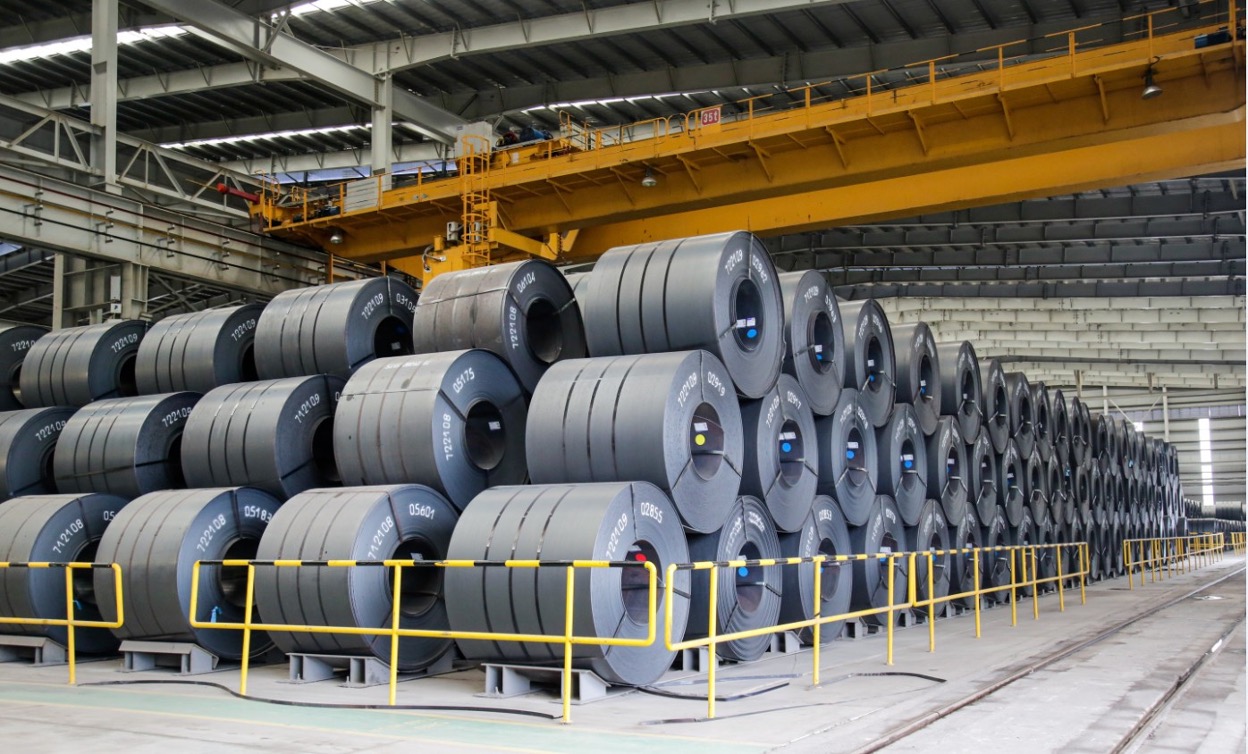
Under the implementing regulations, the European Commission released country- and product-specific default emission values to enable simplified reporting. For hot-rolled coil (HRC), Japan’s deemed emission intensity has been set at 2.1 tonnes (t) of CO₂ equivalent per tonne of steel, placing Japan in a comparatively favourable position among major East Asian steel exporters. South Korea’s default value stands slightly higher at 2.118 t, while China’s is significantly higher at 3.187 t per tonne of steel.
CBAM requires EU importers to report emissions on a product-by-product basis. Importers may choose between using either the default values or verified actual measurements, with calculation methodologies outlined in the regulations.
However, this choice carries important cost implications. If importers rely on default values, a “surcharge rate” will apply from the first year of reporting. For Japan’s hot-rolled coil, the default emission intensity will gradually increase to 2.31 t in 2026, 2.52 t in 2027, and 2.73 t in 2028.
Sources note that default values are intentionally set higher than actual emissions as a punitive measure to encourage the submission of verified data. While reporting actual emissions is likely to be more cost-effective over time, it involves additional expenses, including third-party verification. Japanese steelmakers are therefore expected to carefully assess the trade-offs before determining their reporting strategy.
Under the CBAM framework, tariff-equivalent levies will be calculated based on product-specific emissions, with the final levy amount influenced not only by reported emissions but also by the carbon pricing mechanisms in the exporting country. This design ensures alignment with the EU’s carbon pricing regime and avoids double carbon taxation.
Outlook
The full-scale implementation of the EU CBAM from January 2026 will reshape global steel trade, with carbon emissions influencing import costs. Japanese steel exporters can maintain competitiveness by using verified emissions reporting, avoiding rising default-value surcharges. Though initial compliance costs may increase, verified reporting offers long-term savings, market predictability, and incentives for cleaner production.
Note: This article is published in accordance with a content exchange agreement between Japan Metal Daily and BigMint.
Leave a Reply