- HBA rises across grades on improving Asian demand
- Firm outlook despite weather, energy price risks
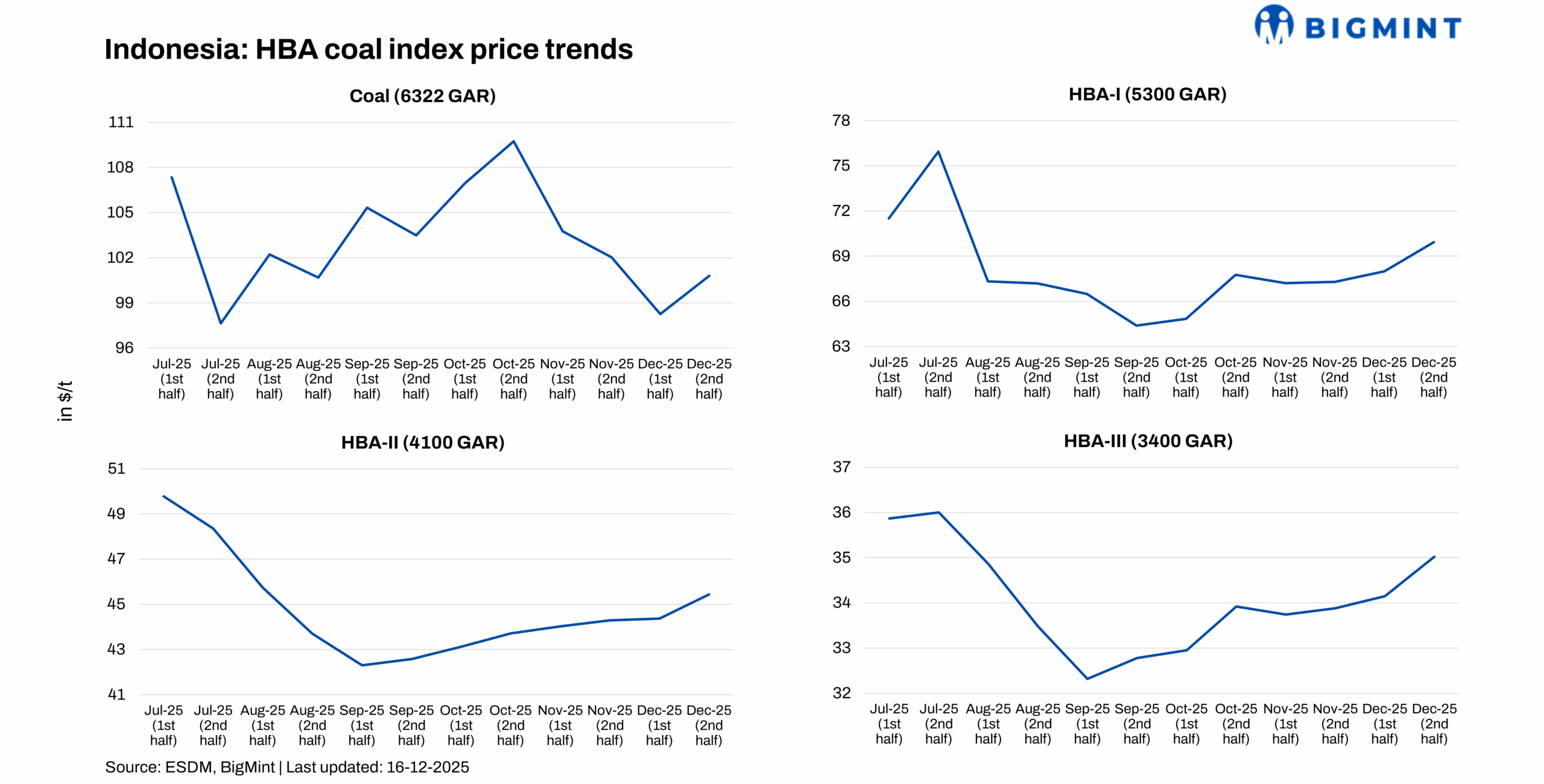
Indonesia’s benchmark coal prices (HBA), as released by the Ministry of Energy and Mineral Resources (ESDM), registered a clear upward trend in the second half of December 2025. The latest revision reflects firmer regional demand, evolving fuel economics across Asia, and measured supply discipline. Price gains were recorded across all calorific value (CV) categories, reinforcing a cautiously optimistic sentiment in the regional coal market.
High-CV coal regains momentum
High-CV coal (6,322 kcal/kg GAR) witnessed a notable rebound, rising 2.6% to $100.81/t as compared to the first half of Dec’25.This increase marks a shift away from the earlier subdued trend, indicating improving market confidence.
The uptrend was largely supported by increasing seaborne buying interest from Asia, where steady industrial activity and replacement demand lifted procurement levels.
Mid-CV prices hit multi-month high
Mid-calorific coal (5,300 kcal/kg GAR) recorded the sharpest rise among the grades, climbing 2.9% to $69.93/t. This assessment represents a five-month high, underscoring resilient demand fundamentals.
Improved offtake from Asian steelmakers and manufacturing units contributed to price strength, while consistent buying interest kept the market balanced. The performance of mid-CV coal reflects its versatility across both power and industrial applications.
Low-CV coal sustains significant gains
Low-calorific value coal continued its upward movement into mid-December. Prices for 4,100 kcal/kg GAR coal increased 2.4% to $45.44/t, while the 3,400 kcal/kg GAR grade rose 2.5% to $35.02/t.
Strong domestic demand from Indonesian utilities remained a key driver, as power producers prioritised cost efficiency amid elevated prices of alternative fuels. Low-CV coal continues to play a stabilising role in the energy mix, particularly for price-sensitive buyers.
Outlook
Looking ahead, Indonesia’s HBA prices are expected to remain firm supported by steady Asian demand and limited downside risks. However, any sharp movements in global energy prices, weather-driven demand shifts, or policy interventions could influence market direction. Overall, sentiment remains cautiously positive as buyers balance affordability with supply security.
Leave a Reply