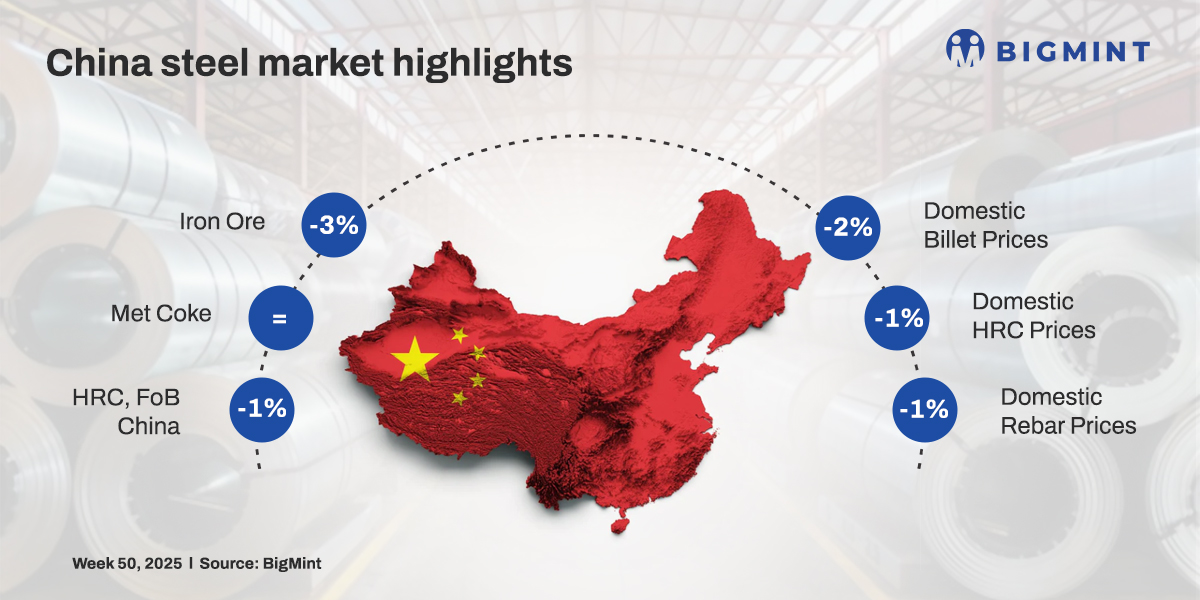
- HRC and rebar prices decline marginally
- Raw material prices fall w-o-w
China’s steel market saw a modest downturn this week led by a decline in SHFE futures. Domestic HRC and rebar prices edged down slightly w-o-w, while raw materials, including iron ore, billets, and coking coal, also posted marginal declines.
China’s steel exports reached 9.98 million tonnes (mnt) in November 2025, up by 7.6% y-o-y from 9.27 mnt a year earlier, according to the General Administration of Customs. This brought the total exports for January-November 2025 to 107.71 mnt, a 6.7% rise from 101.29 mnt in the same period last year. Additionally, on a m-o-m basis, steel exports edged up by 2% against 9.78 mnt recorded in October 2025.
1. Iron ore spot prices dip w-o-w: Iron ore fines benchmark prices fell by $2/dmt to $105/dmt CFR China on 12 Dec w-o-w. Asian seaborne prices softened on weak liquidity, while port-stock levels also slipped despite improved buying interest focused on mid-grade material and mill restocking. The 65%-62% Fe spread widened further alongside deeper discounts. In the near term, mills are expected to prioritise cost-effective procurement strategies.
Iron ore inventories at major Chinese ports were recorded at 142.8 mnt on 11 December, surging by 1.4 mnt w-o-w, as per data published by SteelHome.
a) Spot pellet premium stable w-o-w: Spot pellet premium for Fe 65% grade pellet remained firm at $17.8/t CFR China on 10 December.
b) Spot lump premium dips w-o-w: Spot lump premium dropped by $0.015/dmtu w-o-w to $0.055/dmtu on 12 December.
2. China’s met coke prices decline w-o-w: China’s coke market entered a second round of price declines, pressured by constrained coking coal supply due to safety inspections and year-end mining restrictions. Weak procurement, rising inventories, muted auction activity, and logistical delays dampened market sentiment, while steel mills’ blast furnace maintenance curtailed hot metal output, softening demand and maintaining downward price pressure.
In contrast, Australian PHCC prices increased by $5/t w-o-w to $210/t FOB, and BigMint’s PHCC index rose $3/t to $227/t CNF Paradip on 12 Dec 2025, supported by stable seaborne market fundamentals.
3. Billet prices inch down w-o-w: Chinese billet and rebar prices weakened from 5 December to the week ended 12 December amid volatile but broadly soft market conditions.
Billet fell by RMB 60/t to RMB 2,940/t, while SHFE rebar declined by RMB 69/t to RMB 3,038/t. Early support from lower steel output quickly faded as weak winter demand, falling coke prices, and subdued export activity weighed on sentiment.
A brief rebound on 10 December was short-lived. The US Fed’s 25 bps rate cut had little impact, while news of export quota controls further dampened confidence. Mills trimmed allocations to stabilise prices, but limited stocking and policy uncertainty kept the outlook cautious.
4. Domestic HRC prices inch down w-o-w: Domestic HRC prices in China declined slightly w-o-w, with offers falling by RMB 40/t ($6/t) to RMB 3,070/t ($435/t) on 12 December from RMB 3,110/t ($441/t) on 5 December. This drop was largely driven by the fall in SHFE futures, which declined by RMB 73/t ($10/t) w-o-w to RMB 3,244/t ($460/t) on 12 December from RMB 3,317/t ($470/t) a week earlier. Overall demand in the region remained weak, as buyers stayed cautious amid weak consumption and ongoing uncertainty over the introduction of steel export licenses by Chinese authorities.
The Chinese government is expected to implement a steel export license mechanism starting 1 January 2026. The mechanism is anticipated to help regulate steel exports and curb trading of cargoes not paying value-added tax (VAT), contributing to a cautious market sentiment.
Meanwhile, China’s HRC export offers posted a small decline of $5/t w-o-w, reaching around $470/t FOB on 12 December compared with $475/t FOB the previous week.
Baosteel, the world’s leading steel manufacturer, has raised its HRC prices by RMB 100/t ($14/t) m-o-m for January sales after keeping it stable for three consecutive months. This rise in prices is attributed to an increase in SHFE HRC futures by RMB 36/t ($5/t) m-o-m to RMB 3,277/t ($464/t) from RMB 3,241/t ($459/t) earlier. Moreover, prices of hot-dip galvanised also increased by RMB 100/t ($14/t) m-o-m.
5. Rebar prices drop w-o-w: China’s rebar prices declined w-o-w by RMB 40/t ($6/t) to RMB 3,120/t ($442/t) from RMB 3,160 ($448/t) on 5 December, as market participants grew cautious amid concerns over a potential drop in steel exports driven by a possible implementation of a steel export licence system.
Moreover, SHFE rebar futures (January 2026 contract) fell by RMB 61/t ($9/t) w-o-w to RMB 3,083/t ($437/t), compared with RMB 3,144/t ($446/t) on 5 December. However, seasonal slowdown in demand has kept the overall market sentiment subdued.
China’s Shagang Steel has kept its long steel prices unchanged for mid-Dec’25 sales, with no price revisions announced since 11 Sep’25. Prices of rebars, coiled rebars, and wire rods are as follows:
- Rebars (16-25 mm): RMB 3,450/t ($489/t)
- Coiled rebars (8-10 mm): RMB 3,560/t ($504/t)
- Wire rods (6-10 mm): RMB 3,470/t ($492/t)

Outlook
In the near term, China’s steel market is likely to remain volatile, with any upward movement hinging on a meaningful improvement in demand after the seasonal slowdown Uncertainty over potential steel export restrictions is expected to keep market sentiment cautious, and overall confidence is likely to remain subdued until official announcements are made and clearer signs of recovery emerge.
Leave a Reply