- US HMS 80:20 prices inch up to 8-month high in Turkiye
- UAE prices rebound, but trading activity remains quiet
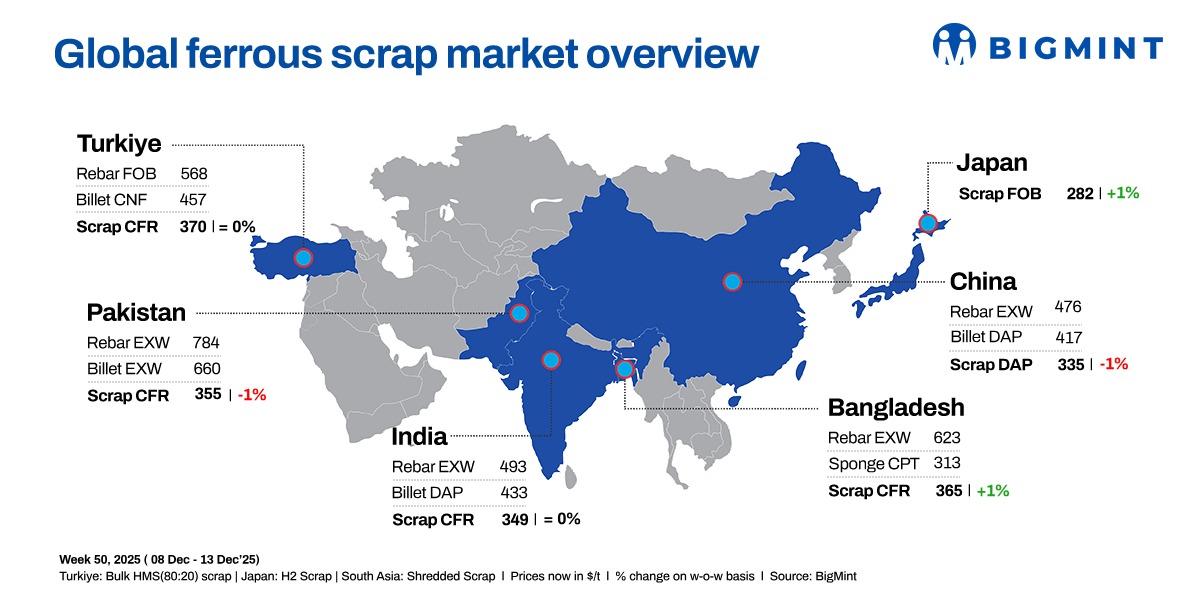
Global ferrous scrap markets remained mixed this week (8-13 December). Benchmark HMS 80:20 prices in Turkiye rose to an 8-month high despite muted demand. India, Pakistan, and Bangladesh witnessed lacklustre trading activity, while prices rebounded by $11/t w-o-w in the UAE. China’s Shagang Steel reduced purchase prices, while Japanese export prices declined w-o-w even as offers inched up following the Kanto tender. Strategic investments in South Korea and recycling alliances in Japan were also announced, which are expected to shape long-term supply and demand dynamics.
Turkiye: Imported deep-sea scrap prices remained mostly stable w-o-w, amid limited deal activity and cautious buying. Notably, US-origin bulk HMS 80:20 prices rose marginally by $1/t w-o-w to $370/t CFR, an 8-month high last seen in April. EU- and UK-origin HMS 80:20 prices also saw minimal changes.
Market sentiment was mixed, with sellers targeting firmer levels while buyers stayed selective, covering mainly January-February needs. Tight supply in the US and Europe and higher freights supported prices, while margin pressure, soft rebar demand, high import costs, and uncertainty over construction activity kept Turkish mills from aggressively booking, leaving the market direction uncertain.
India: India’s imported scrap market stayed weak, with cautious buying and selective bookings. Early winter restocking inquiries had little impact, as high inventories and weak finished steel demand restrained activity. Mills showed low interest across HMS, shredded, busheling, and PNS, keeping trade thin. UK and Europe-origin shredded was at $347-349/t CFR and HMS 80:20 near $317-319/t.
Domestic scrap remained more attractive than imports, limiting overseas purchases. The rupee’s sharp fall to near-record lows against the US dollar raised import costs, forcing buyers to hold off purchases unless urgently needed. As a result, sentiment stayed cautious by the week’s end, with no immediate trigger for a near-term recovery.
Approximately 3,000 t of imported scrap arrived in India compared to 8,000 t last week. This included around 1,500-2,000 t of HMS 80:20 from Africa at roughly $326/t CFR Mundra and about 1,000 t of tin-can bales from the UK and Australia at an average of around $263/t CFR Chennai.
Pakistan: Pakistan’s imported scrap market remained sluggish, as falling domestic rebar prices squeezed margins, while weak steel demand and high offers from sellers kept buyers cautious. Furnaces ran at reduced rates, limiting raw material intake. Despite potential infrastructure-led demand, sentiment stayed quiet and cautious.
EU-origin shredded offers hovered in the mid-$350s/t CFR, with workable levels near $350/t, and UAE HMS 80:20 was quoted at around $338-340/t CFR.
Bangladesh: Imported scrap demand in Bangladesh remained subdued, with weak buying amid average finished steel demand. Containerised cargoes dominated, but bids stayed below offers, limiting deals. The persistent gap between bids and offers, weak downstream rebar demand, and dull domestic sentiment kept trading thin and the market cautious.
Australian HMS and shredded traded around $330-365/t CFR, while Singapore PNS offers held near $380/t CFR, above workable levels.
Japan: H2 export prices firmed up after the Kanto tender on 10 December, though spot assessments edged higher w-o-w on 12 December. BigMint assessed H2 at JPY 44,000/t FOB Tokyo Bay, up by JPY 300/t ($2/t, 1%), while offers to Vietnam remained stable w-o-w at $325-328/t CFR. December’s tender cleared higher, prompting some sellers to test stronger offers, though Vietnam mills kept bids range-bound.
Japan’s December Kanto scrap export tender saw a modest rise of JPY 728/t ($5/t) m-o-m. A 15,000-t H2 cargo was awarded via a Japanese trader to a Vietnam-based mill at JPY 45,688/t ($292/t) FAS, equivalent to about $330-333/t CFR Vietnam and roughly $355/t CFR Chattogram. The December Kanto tender marked its fifth consecutive monthly increase, with the winning price reaching its highest in 14 months since August last year.
Tricycle and Toyota Tsusho announced a partnership to expand scrap recycling via ReSACO, enhancing collection, sorting, and trading efficiency while supporting circular supply chains and carbon-neutral goals.
China: Shagang Steel reduced HMS (6-10 mm) scrap prices by RMB 30/t ($5/t) to RMB 2,360/t ($334) on 11 December from RMB 2,390/t ($339) on 24 November. This marks the company’s first price revision this month.
South Korea: Hyundai Steel has announced plans to invest KRW 170 billion ($116 million) by 2032 to secure high-grade steel scrap for producing low-carbon steel. The programme includes new shredders, upgraded sorting lines, a Gyeonggi facility, and partnerships with local scrap processors.
UAE: Domestic scrap prices rebounded, with the domestic index rising AED 39/t ($11/t) w-o-w to AED 1,160/t ($316/t). Despite this, trading remained quiet. Billet sales also slowed, with Chinese offers easing by $4-6/t w-o-w to $455-458/t CFR. Overall market sentiment was muted amid steady but cautious demand.
Leave a Reply