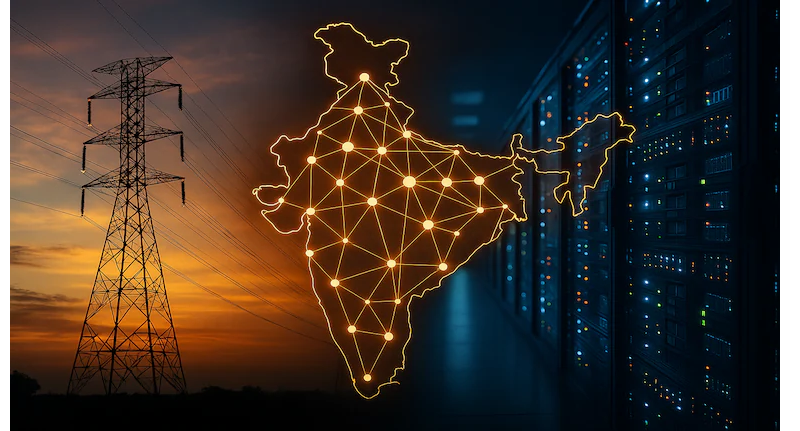
- India targets 874 GW by 2032 across thermal, hydro/nuclear, renewables, and storage
- Peak demand nearly met in 2024-25, backed by major transmission expansion
A decade of soaring power demand and India’s response
Peak electricity demand has increased significantly over the past five years, driven by industrial growth, expanding digital infrastructure, rising transport electrification and higher residential consumption, the Ministry of Power said in a written reply in Parliament. However, despite this sustained demand surge, the demand-supply gap has narrowed substantially owing to accelerated capacity additions. In FY 2024-25, unmet demand declined to just 2 MW, effectively indicating a near–zero shortfall.
The 874 GW roadmap: India’s capacity vision for 2031-32
The National Electricity Plan (NEP) projects India will need 874 GW of installed capacity by FY 2032, across thermal, hydro, nuclear, solar, wind, hybrid systems and energy storage.
To stay ahead of rising peak load, India has rolled out a detailed Resource Adequacy Planning (RAP) framework. All States, working with the Central Electricity Authority (CEA), are now mandated to create rolling 10-year plans covering both generation and procurement. States have been advised to initiate contracting and creation of new capacity immediately, across all sources from coal to solar to nuclear.
The most ambitious thermal build-out in two decades
India’s projected thermal power requirement for 2034-35 stands at 307,000 MW, compared with an installed capacity of 211,855 MW as of 31 March 2023, indicating a minimum additional requirement of about 97,000 MW. To address this, the Centre has mobilised its strongest thermal expansion pipeline since the 2010-2012 build cycle. As of November 2025, 16,560 MW has been commissioned since April 2023, while 40,345 MW is under construction (including 4,845 MW of revived stressed projects), 22,920 MW has been awarded and is in pre-construction, and 24,020 MW has been identified as candidate projects together forming an active pipeline of 87,285 MW.
Hydro, Nuclear and Renewable power: India’s diversified capacity push
India is also accelerating clean baseload capacity, with 13,223.5 MW of hydroelectric projects under construction and an additional 4,274 MW planned for commissioning by 2031-32. In parallel, the country is undertaking its largest-ever nuclear expansion, comprising 6,600 MW currently under construction for completion by 2029–30 and 7,000 MW at the planning or approval stage, underscoring a strategic shift toward dependable, non-carbon baseload generation.
India’s gigantic renewable energy pipeline
As of December 2025, India has over 208 GW of renewable capacity in the pipeline – excluding rooftop and distributed systems – with 156,900 MW under construction (69,180 MW solar, 29,650 MW wind and 57,630 MW hybrid) and 51,420 MW in planning for completion by 2029-30 (36,530 MW solar and 13,090 MW hybrid). This rapid expansion is supported by enabling policies including 100% FDI under the automatic route, transmission charge waivers for renewable and green hydrogen projects, Standard Bidding Guidelines for solar, wind, hybrid and FDRE, as well as key schemes such as the Solar Parks Scheme, PM-KUSUM, PM Surya Ghar Muft Bijli, the High-Efficiency PV Module Scheme and PM-JANMAN solar initiatives.
Energy Storage: Pumped storage and battery systems scaling rapidly
The transition to high RE penetration requires firming capacity. As per the government’s update: India is rapidly scaling energy storage to support higher renewable penetration, with 11,870 MW of pumped storage projects under construction and 6,580 MW (39,480 MWh) already concurred for implementation, alongside 25,407.54 MW of battery energy storage systems under bidding or construction. This combined storage pipeline of nearly 36 GW is critical to delivering firm, dispatchable renewable power by 2030.
Transmission: A 10-year plan bigger than the golden quadrilateral
Transmission remains central to India’s renewable-centric power system, with the National Electricity Plan estimating the addition of 1,91,474 km of new transmission lines and 1,274 GVA of transformation capacity at 220 kV and above between 2022-23 and 2031-32. This expansion is being driven by renewable evacuation needs under the Green Energy Corridor, dedicated transmission systems for offshore wind, interstate charge waivers to promote timely commissioning, and strengthened intrastate networks designed to manage rising variability.
Structural reform: Creating a renewable-heavy, flexible grid
Key initiatives outlined in the PIB release include the notified RPO and RCO trajectory through 2029-30 with compliance penalties, the launch of the Green Term Ahead Market, a national offshore wind strategy, the PLI scheme for solar module manufacturing, and the development of Solar Parks and Ultra-Mega RE projects to streamline land and transmission readiness. Together, these measures strengthen the pace, bankability and reliability of India’s energy transition.
The bigger story: India’s power system is transforming on all fronts
India’s capacity expansion roadmap for 2031-32, as outlined in the National Electricity Plan, targets 874 GW of installed capacity supported by a major 97 GW thermal revival for baseload stability, around 31 GW of new hydro and nuclear capacity for seasonal firm power, a 208+ GW renewable pipeline under construction and planning, and nearly 36 GW of energy storage to integrate variable generation, alongside 1.9 lakh km of new transmission lines to strengthen national power flows. These additions are already translating into system reliability, with peak demand of 249,856 MW in 2024-25 being met almost fully, leaving a negligible shortfall of just 2 MW.
Conclusion: A once-in-a-generation power sector transformation
The Ministry of Power’s PIB release outlines an unprecedented expansion of India’s power sector by 2032, with over 800 GW of combined clean and thermal capacity, a significantly strengthened transmission network, large-scale energy storage, and a more competitive renewable market enabled by supportive policies. This integrated build-out across generation, storage, transmission and regulation is designed to meet rising peak demand while advancing India’s climate, industrial and reliability goals.
Leave a Reply