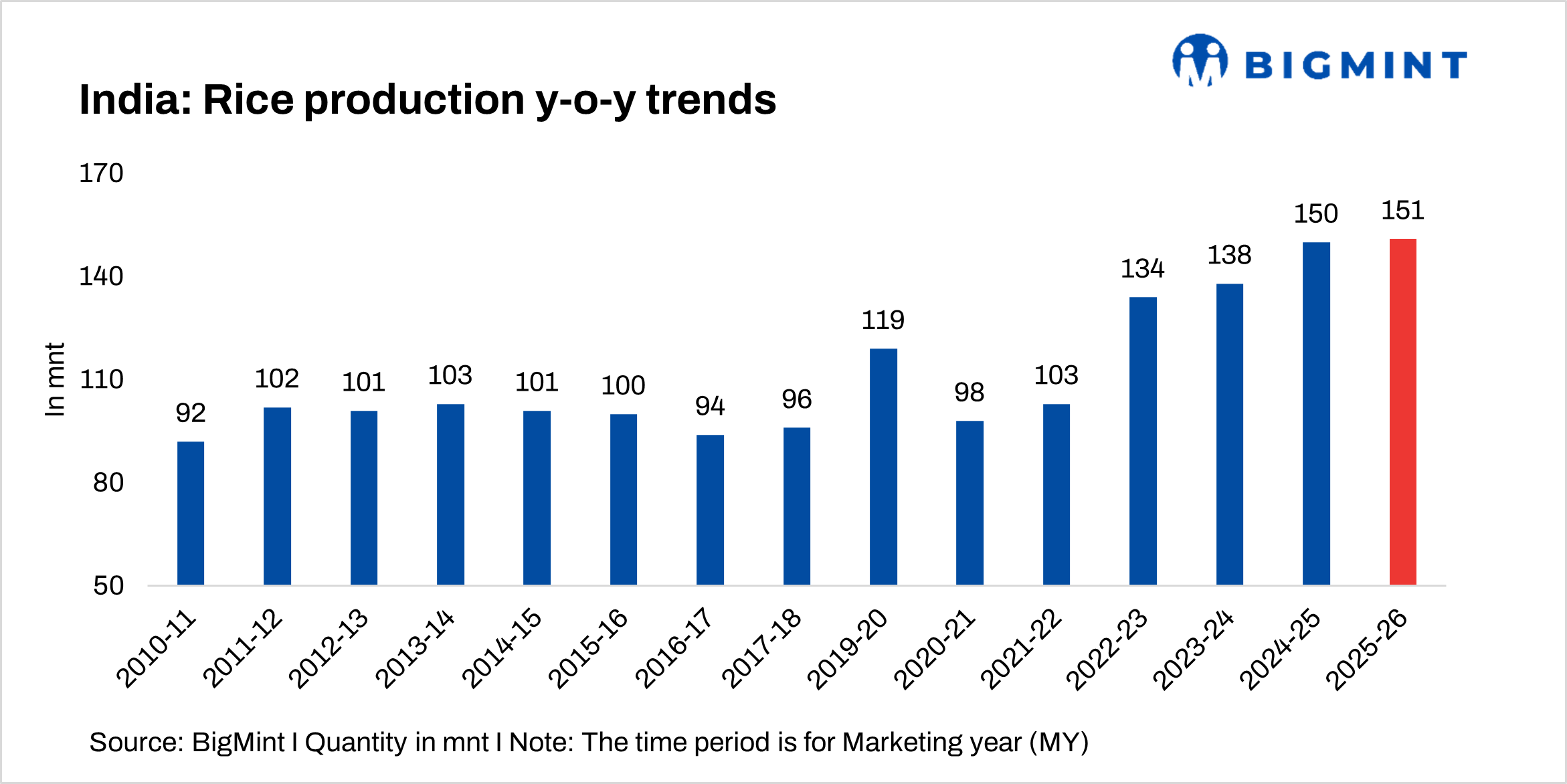
- Higher planted area and crop economics underpin output surge
- Global market watches for potential impact on export policy
India’s rice production is set to reach an all-time high of 152 million tonnes in the 2025–26 crop year, propelled by a wider planted area and a decisive shift by farmers from cotton to paddy. The U.S. Department of Agriculture (USDA) said the expansion reflects growers’ preference for rice this season, supported by steadier yields, lower cultivation costs and more favourable procurement prospects. Satellite imagery used by the agency confirms a broad increase in acreage and the strong vegetative growth that has shaped yield potential.
Weather stability strengthens crop performance
The USDA attributed the bumper outlook to relatively stable monsoon patterns and timely field operations across major producing states. Even rainfall distribution improved transplanting windows and reduced early-season stress, while improved seed varieties in eastern and southern regions helped lift yields further. The agency noted that conditions this year were among the most favourable since India posted its previous record harvest.
Farmers shift away from cotton on market signals
The move from cotton toward paddy played a central role in the scale of the acreage gains. Cotton prices remained volatile through the early kharif months, while rising pest-management costs and inconsistent fibre demand pushed farmers toward crops with stronger support mechanisms. Rice offered a lower-risk option due to minimum support price guarantees, more predictable yields and lower input requirements, reinforcing the transition observed across key producing regions.
Policy context shapes planting decisions
Market participants are monitoring how the government will manage larger rice supplies, with attention on the Food Corporation of India’s procurement strategy and buffer stock management. Elevated public inventories in recent years have shaped export-policy decisions, and this year’s record output may again influence whether export restrictions are maintained, eased or adjusted in the coming months.
Implications for global trade and prices
India’s position as the world’s largest rice exporter gives the record crop global significance. Importing nations in Africa, the Middle East and South Asia are closely watching whether additional volumes will be available for shipment. Traders say any policy relaxation could soften international prices, while a continuation of curbs would keep global markets tight despite India’s ample domestic supply.
Domestic demand anchors the supply balance
Stable household consumption and steady demand from processors for parboiled and broken rice are expected to absorb part of the output increase. However, a significantly larger crop may weigh on mandi prices during peak arrivals unless procurement volumes rise proportionately.
Outlook
The strong outlook for rice production contrasts with weaker projections for oilseeds, where production is expected to fall amid reduced planting. Wheat, by comparison, is on track for higher output, supported by early sowing progress and favourable soil moisture. These mixed trends highlight uneven crop economics across the broader agricultural landscape, with rice emerging as the most resilient performer for 2025–26. If the sustainability of this year’s acreage gains will depend on price trends and cost dynamics heading into the next season. If mandi prices soften under the weight of surplus supply, farmers may reassess the extent of their shift toward rice. For now, India’s record output sets a strong baseline for domestic food security and shapes global expectations for the year ahead.
Leave a Reply