- China boosts steel exports as demand weakens
- US manufacturing expands despite softer PMI reading
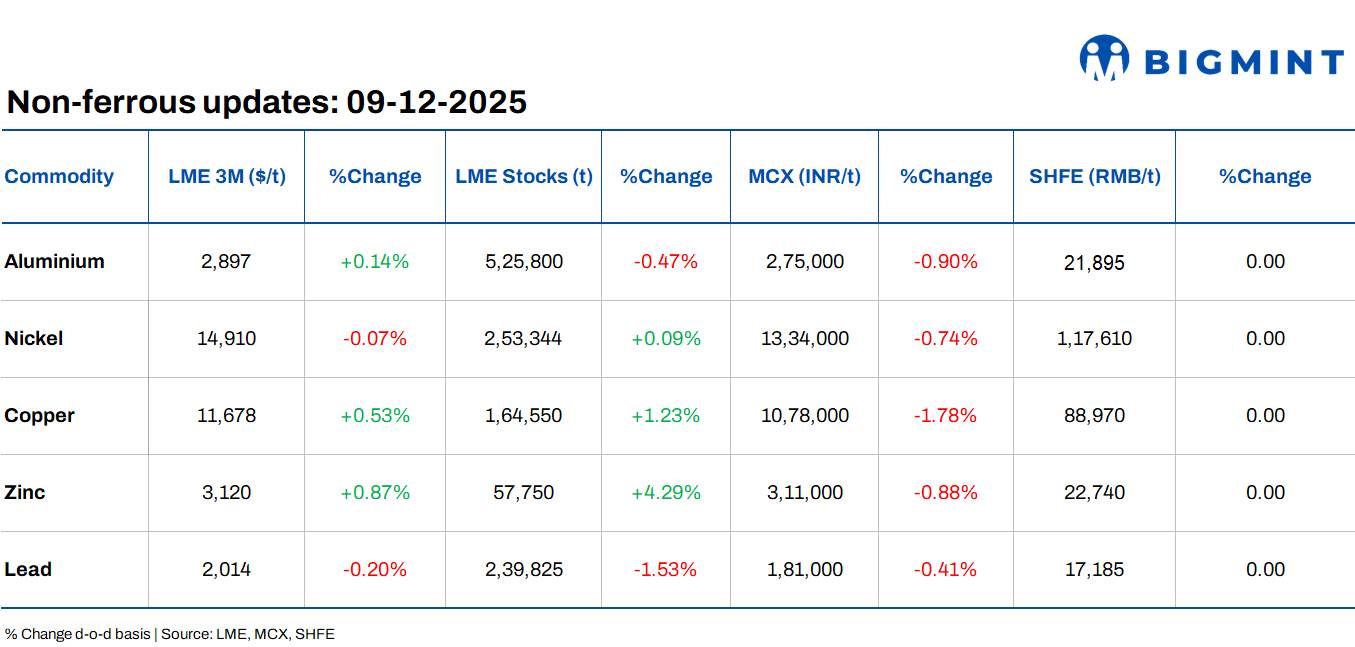
Base metals traded mixed on the London Metal Exchange (LME), with zinc leading the gains as prices rose 0.87% to $3,120/t. Aluminium and copper also firmed slightly, increasing 0.14% to $2,897/t and 0.53% to $11,678/t respectively. Nickel edged down 0.07% to $14,910/t, while lead slipped 0.20% to $2,014/t.
LME warehouse inventories reflected a similarly varied trend. Zinc stocks recorded the strongest build, rising 4.29% to 57,750 t. Copper inventories increased 1.23% to 164,550 t, while nickel stocks saw a mild uptick of 0.09%. In contrast, aluminium stocks fell 0.47%, and lead inventories dropped 1.53%, indicating tighter availability in the lead segment.
Domestic market overview
In Indias non-ferrous markets, BigMint assessed copper armature scrap at INR 997,000/t ex-Delhi, up INR 29,000/t (1.2%) d-o-d. Aluminium Tense scrap prices increased by INR 3,000/t w-o-w, stood at INR 193,000/t ex-Delhi and INR 188,000/t ex-Chennai, up by INR 3,000/t d-o-d.

Other market updates
China steel exports rise as aluminium shipments decline
China’s steel exports have surged this year as weak domestic demand driven by a prolonged slowdown in property construction pushed mills to redirect output overseas. Shipments rose 6.7% in the first 11 months and are set to hit a record near 117 million tonnes, supported by competitive pricing amid low domestic steel rates. In contrast, aluminium exports fell 9.2% as stronger demand from China’s manufacturing and energy sectors kept more metal at home, tightening global supplies and driving LME prices sharply higher. With Beijing maintaining strict output caps for both metals, steel exports will likely stay elevated until local demand improves, while aluminium markets may face further supply tightness ahead.
US manufacturing growth holds steady despite softer PMI reading
US manufacturing activity continued to expand in November even as the S&P Global Manufacturing PMI eased slightly to 52.2 from 52.5 in October. New orders increased on the back of stronger demand from both existing and new clients, though export orders declined for a fifth straight month due to tariff pressures. Input costs continued rising, but firms passed on less of these increases, keeping selling price inflation near its lowest level this year. Production grew while sluggish sales pushed finished goods inventories to a record pace of accumulation. Employment strengthened as firms prepared for higher future output, despite worsening supplier delivery times linked to tariff-related import delays. Business confidence improved to its highest level since June, supported by investment plans and the end of the federal government shutdown.
Oil dips as markets track Ukraine talks and US rate decision
Oil prices inched lower on Tuesday, extending the previous session’s decline as traders monitored developments in Ukraine peace negotiations, rising supply concerns, and the US Federal Reserve’s upcoming rate decision. Analysts noted that prices are likely to remain rangebound until clarity emerges from peace talks, which could either tighten or ease Russian supply risks. Meanwhile, discussions within the G7 and EU on replacing the Russian oil price cap with a maritime services ban added to geopolitical uncertainty. With the IEA’s December report expected to highlight surplus risks for 2026 and markets pricing in an 87% chance of a US rate cut, sentiment remains cautious despite the potential for short-term support.
Leave a Reply