- Guinea shipments fall on weather, regulatory issues
- Indonesian exports steady despite partial ban impact
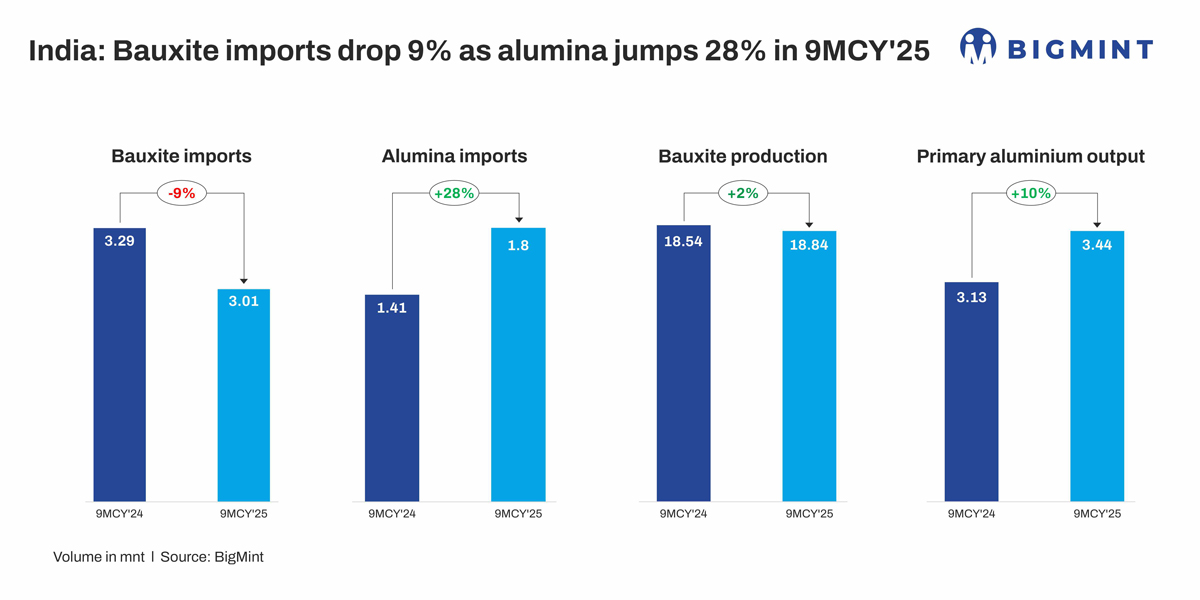
India’s bauxite imports declined 9% y-o-y in the first nine months of 2025 (9MCY’25), falling to 3.01 million tonnes (mnt) from 3.29 mnt in the same period last year. The reduction coincides with a modest 2% rise in domestic bauxite production, which reached 18.84 mnt, indicating improved output from key mining regions.
India’s bauxite imports fell in 9MCY’25 mainly because domestic mining improved across key states supported by better mine planning and smoother logistics. Policy efforts to boost self-reliance in mineral production also helped increase local availability. At the same time, factors such as fluctuating freight costs and periodic supply uncertainties in major exporting nations reduced the incentive to import raw bauxite.
Alumina imports
In contrast to bauxite, alumina imports increased 28% y-o-y to 1.8 mnt, highlighting a growing dependence on higher-value imported material. This shift suggests that producers are compensating for grade limitations in local bauxite or addressing process optimisation requirements at a time of firm demand. The higher availability of alumina has supported a 10% rise in primary aluminium production, which reached 3.44 mnt during the period.
Alumina imports rose as Indian aluminium producers increasingly required high-purity, consistent feedstock to support expanding metal production. Much of India’s domestic bauxite has lower alumina content and higher impurities, making it less efficient for refining. Imported alumina, which offers uniform quality and higher yield, has become essential for optimising refinery operations and meeting the growing needs of the aluminium sector.
Global market dynamics further reinforced this shift. Importers faced supply risks from countries like Guinea due to political and logistical disruptions, prompting greater reliance on alumina that is readily available and competitively priced. As primary aluminium output continues to increase, securing stable, high-grade alumina has become a strategic priority for producers, driving the rise in alumina imports despite lower raw bauxite shipments.
Bauxite production mixed across states, Gujarat leads growth
India’s state-wise bauxite output in 9MCY’25 shows a varied performance across major producing regions. Gujarat recorded the strongest growth at 17%, with production rising from 1.49 mnt to 1.75 mnt, and Chhattisgarh followed with a 9% increase. Madhya Pradesh posted a modest 5% rise, reflecting steady improvement. In contrast, Jharkhand saw a 4% decline, and Maharashtra slipped by 1%, indicating softer regional activity. Odisha, the country’s largest producer, saw production remaining flat, with output holding at around 13.57 mnt. Overall, India’s total bauxite production edged up by 2% y-o-y, signalling stable national output despite mixed state-level trends.

Country-wise bauxite, alumina imports
India’s bauxite and alumina imports registered a modest 2% increase y-o-y in 9MCY’25, rising to 4.8 mnt from 4.7 mnt in the same period last year. The overall rise came despite a 14% drop in shipments from Guinea, the country’s largest supplier, whose volumes fell from 3.18 mnt to 2.72 mnt.
Guinea’s bauxite exports to India fell by 14% y-o-y during January-September 2025, despite the country recording strong overall export growth. The decline was driven by heavy rains that disrupted mining and port operations, reducing monthly shipments in Q3. Additionally, regulatory uncertainty in Guinea — including licence revocations and pressure on miners to build local alumina refineries-contributed to supply irregularities. With Chinese companies controlling over half of Guinea’s exports and absorbing larger volumes to meet rising domestic aluminium demand, availability for Indian buyers tightened further resulting in lower shipments to India during the period.
Indonesia’s shipments to India held steady at 0.82 mn t, showing no y-o-y change, while imports from China climbed to 0.20 mnt, a 43% increase. In contrast, volumes from Vietnam slipped 24% to 0.19 mn t. The most significant shift came from the ‘Others’ category, where supplies jumped 181% to 0.87 mnt, reflecting stronger diversification in sourcing.
Indonesia’s bauxite exports to India stayed steady at 0.82 million tonnes in Jan-Sept 2025, even after the 2023 export ban, mainly because some older contracts and specific exemptions are still being honoured. The flow has also continued because Indonesia’s own alumina capacity hasn’t grown fast enough to absorb all the ore mined — several refineries in Kalimantan are delayed, leaving surplus material in the system. This gap has allowed limited shipments to India to continue during the transition.
India defies raw material supply challenges, primary aluminium output rises
Despite raw material volatility, India’s primary aluminium production remained strong. Output in 9MCY’25 increased by 10% y-o-y to 3.44 mnt, up from 3.13 mnt in the same period last year.
Vedanta recorded growth of 15% in output to 1.54 mnt, while Balco and Nalco posted gains of 9% and 8%, producing 0.49 mnt and 0.39 mnt, respectively. Hindalco recorded the sharpest increase, with output rising more than fourfold to 4.05 mnt in 9MCY’25.
Outlook
India’s bauxite imports are expected to stay soft as domestic output improves, while alumina imports will likely remain firm due to strong aluminium production and the need for high-grade, consistent feedstock. Overall, the market outlook points to steady bauxite availability and continued reliance on imported alumina.
Leave a Reply