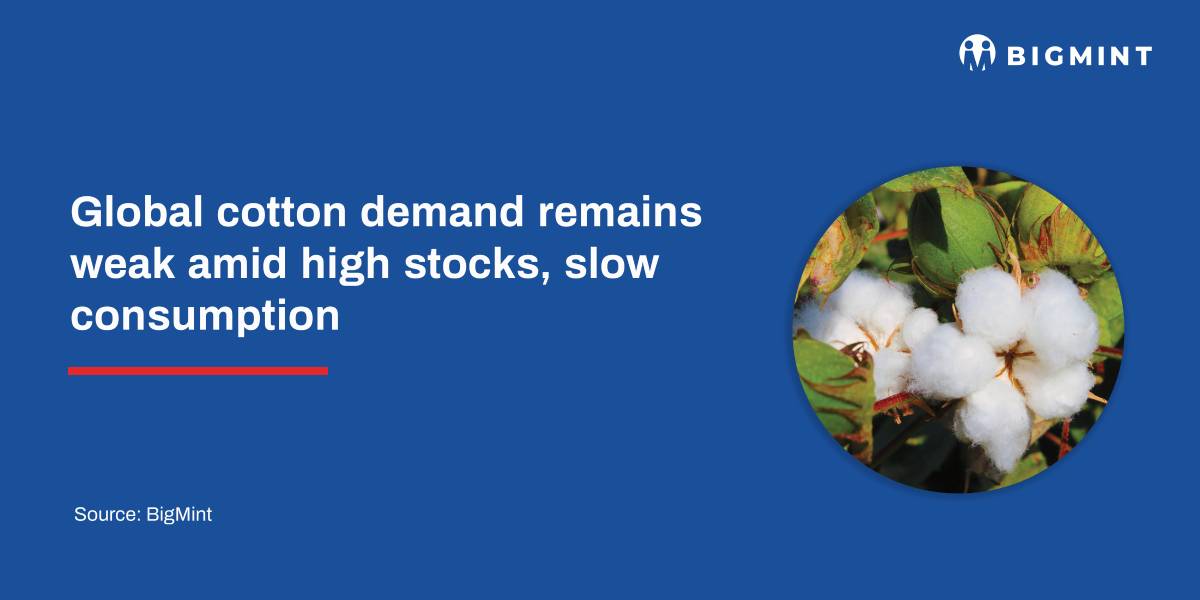
- WASDE shows no improvement in global demand
- Cotlook, ICE and Gujarat prices reflect a demand-constrained market
Global cotton demand remains under pressure, with agriculture information company FarmProgress confirming that consumption has still not returned to pre-COVID-19 levels (122 million bales). The latest WASDE report from the US Department of Agriculture for September–November 2025 shows no meaningful rise in global mill use, leaving the market stuck in a low-demand cycle. For ginners, spinning millers, and brokers, this means continued price stagnation despite only moderate supply adjustments.
Cotton demand has struggled since the disruption in 2019–20 due to the pandemic, and structural recovery remains slow. For 2025-26, global production is projected at about 117 million bales, and mill use at 117.8 million bales, indicating only a marginal demand improvement. However, global stocks remain heavy at about 78 million bales (last year 74 million bales), keeping the market oversupplied and limiting any upward price movement.
Price benchmarks clearly reflect this weak consumption environment. The Cotlook A Index currently stands near USD 1.657/kg, sharply lower than USD 1.797/kg last year — a 7.8% y-o-y decline — signalling persistent lack of downstream demand. ICE Cotton futures remain in a tight 63–65 ¢/lb range, showing traders’ hesitation to price in any meaningful demand revival. With no visible consumption catalyst, speculative activity also remains muted.
In India, Gujarat’s physical markets continue to mirror global softness, with 75-grade cotton fetching between ₹52,300–52,900 per candy, 73-grade selling at between ₹50,200–50,500, and lower grades selling at between ₹48,000–48,500. Yarn demand remains weak, restricting spinning millers’ buying momentum and keeping spreads narrow. While the minimum support price (MSP) offers psychological support, mandi prices continue to fluctuate within a limited band.
Outlook
Looking ahead, a price recovery depends entirely on consumption revival. If apparel demand in the US and Europe improves in early 2026 and China steps up spinning activity, capacity utilisation at mills will rise. A rebound in denim and knitwear orders may help spinning millers increase production and support upstream buying. But if global macroeconomic sentiment remains soft, high stocks will persist, and cotton will continue trading sideways with limited upside for ginners and spinning millers.
For traders, the key indicators to watch remain: retail apparel sales in the US, China’s yarn output, ICE net long/short positions, and any signs of restocking from major textile hubs. Until these shift, the cotton prices will stay constrained by limited demand and heavy supplies.
Leave a Reply