- Simandou’s ramp-up becomes key 2026 supply driver
- Australia, Brazil add capacity despite earlier disruptions
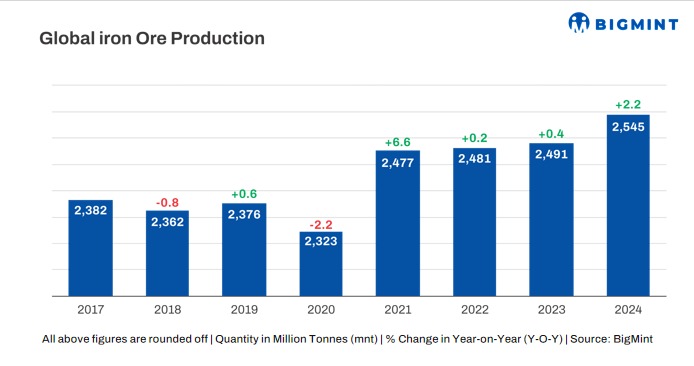
Mysteel Global: Global iron ore supply is expected to increase to a record high of nearly 2.68 billion tonnes in 2026, supported by the newly commissioned Simandou project in West Africa and continued capacity expansions at mines in Australia and Brazil, according to Mysteel’s latest forecast.
Total iron ore output worldwide this year is estimated at 2.61 billion tonnes, higher by 32.98 million tonnes from 2024, according to Mysteel’s tracking of global iron ore mine production.
Despite the increase, the total would be lower than expected, primarily because operations at the world’s top iron ore producer, Australia, were impacted by several cyclones in the first quarter of this year, as reported. The slower-than-expected ramp-up of new capacity in other countries has also constrained growth, Mysteel added.
Looking ahead to 2026, global iron ore output is seen reaching 2.68 billion tonnes throughout the year, with an on-year increase of 65 million tonnes that will nearly double this year’s growth, Mysteel forecast. More than 90% of the increment is expected to come from Africa, Oceania (mainly Australia), South America and South Asia (mainly India).
Africa: A major emerging growth driver
The recent commissioning of the long-awaited Simandou iron ore project in Guinea, West Africa, has created a new force in global iron ore supply. Designed with a full capacity of 120 million tonnes/year, the project is poised to become a key future source of iron ore supply, especially of high-grade ore.
Given a gradual ramp-up period of 30 months, Mysteel estimates that Simandou will produce 22 million tonnes in 2026, up by 20.2 million tonnes from this year and an increase that will account for nearly 31% of the potential growth of iron ore production worldwide.
Other African nations, including Sierra Leone and Liberia, will also contribute to iron ore production growth with steady progress being made in local iron ore projects. In Sierra Leone, a magnetite beneficiation plant at the Tonkolili mine site was completed in April, enabling a processing capacity of 30 million tonnes/year. Two months later, ArcelorMittal opened a new concentrator in Liberia with a capacity of 20 million tonnes/year, marking a milestone of the company’s Phase II Project in the country.
Australia: Still a dominant producer
As the world’s leading iron ore exporter, Australia is home to several mining giants. The country’s iron ore production in 2026 is likely to reach 985.9 million tonnes, up by 16.8 million tonnes on year, Mysteel forecast.
Specifically, Rio Tinto and Fortescue Metals Group (FMG) are expected to increase their production by 3 million and 1.9 million tonnes, respectively. Rio Tinto’s growth will mainly reflect the firm’s recovery from weather-related disruptions in Q1 this year, as gains from capacity replacement plans will be limited. FMG, meanwhile, will benefit from the ongoing ramp-up of its Iron Bridge project in Western Australia’s Pilbara region.
As for BHP, production faces significant uncertainty due to its stalled pricing negotiations with China Mineral Resource Group (CMRG), a state-owned Chinese trading company. If the talks fail, restrictions on BHP’s products advocated by CMRG could curb the miner’s production growth.
Other non-mainstream miners in Australia will continue to expand their capacity. Notably, Mineral Resources’ Onslow Iron project reached full capacity during the second half of this year, which will support on-year production growth in the first half of 2026.
South America: Brazil shows strong momentum
Brazil, the world’s second largest iron ore producer, is gathering momentum through ongoing capacity expansions at Vale, Companhia Siderúrgica Nacional (CSN), the country’s largest fully integrated steel producer, and Samarco, a joint venture between Vale and BHP.
Mysteel predicts that Brazil’s iron ore production will increase to 489.3 million tonnes in 2026, up by 5.1 million tonnes from this year.
In addition, iron ore supply growth will also occur in Peru and Venezuela. In Peru, Shougang Hierro Peru was forced to suspend its mining operations for about two months this year due to an accident at its San Nicolás port facilities, and smooth operations next year will bring about higher output. Venezuela’s iron ore production, on the other hand, will be mainly driven by new capacity projects.
India: Steel-led production growth
To meet the demand of robust domestic steel production, India is expected to increase its iron ore output by 8 million tonnes on year to 295 million tonnes in 2026, Mysteel estimated.
Lloyd Metals & Energy Ltd., an Indian supplier of iron ore, direct reduced iron and pellets, received an environmental clearance this June to more than double iron ore capacity at the Surjagarh mine in Maharashtra to 26 million tonnes/year, as reported. Meanwhile, India’s largest state-owned iron ore miner, NMDC Limited, is aggressively boosting its output with an eye to achieving 100 million tonnes/year of output by 2030. Its iron ore output during April-September, or the first half year of the fiscal year 2025-26 (FY26), already increased by 27.1% on year to 22.2 million tonnes, as reported.
Overall, global iron ore supply is on pace to increase further in the coming year, yet factors like weather disruption, geopolitical risks and production costs could result in slower growth than expected. Significantly, production enthusiasm among miners is strongly influenced by iron ore prices, which means weakening ore prices will cause miners to reduce output if they suffer severe financial losses, Mysteel warns.
For example, if prices for 62% Fe iron ore fall to $80/dmt next year, global output might total 2.65 billion tonnes, up by just 34.68 million tonnes on year, Mysteel estimated.
Note: This article has been written in accordance with a content exchange agreement between Mysteel Global and BigMint.
Leave a Reply