- Renewables are rising faster than the grid can handle
- India balancing coal stability with rapid clean energy growth
In October and November 2025, India’s power sector quietly slipped into one of the most transformative moments in its modern history. Not with grand announcements or dramatic disruptions but through a series of contrasting events that together reveal a system evolving faster than anyone anticipated.
A stunning collapse in coal-fired power demand. Hydro reservoirs overflowing with post-monsoon water. Wind farms and solar parks generating more power than transmission lines could carry. Imported-coal giants like CGPL Mundra once indispensable shutting down entirely.
And beneath this, a series of structural shifts: the push toward digital grids, state-level tariff freezes, cross-state renewable alliances, self-sufficient coal mining, and a booming freight system driven by coal itself.
This is the story of India’s energy ecosystem at a crossroads where coal’s dominance is being challenged not by ideology, but by operational realities, infrastructure constraints, and the changing mathematics of the power sector.
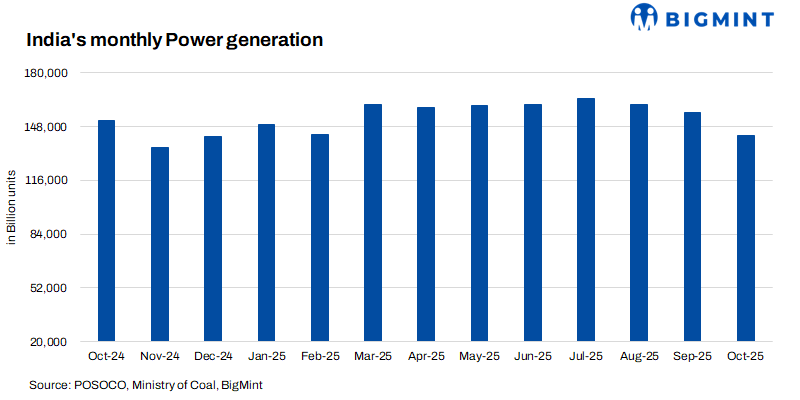
- The coal slowdown no one predicted: By the first week of October, POSOCO’s national load curve began telling a surprising story. Daily demand had collapsed to 181-206 GW, far below typical pre-winter levels. With cooler weather, subdued industry output, and low agricultural pumping loads, DISCOMs began quietly dialling down their most expensive generation source: coal. Central Electricity Authority (CEA) outage reports for October-November show one phrase repeating like a refrain across dozens of thermal stations.
“RSD/Low Schedule”: Units at Wanakbori, Gandhinagar, Panipat, Ropar, Kothagudem, Yadadri, Suratgarh, Sabarmati, Rajiv Gandhi TPS, and several others sat idle for days or weeks not due to breakdowns or coal shortages, but simply because the grid did not need them. Even more symbolic was the silence at Tata Power’s CGPL Mundra, the country’s largest imported-coal thermal plant. It has been offline since July 2025, generating zero electricity in October.
For a plant that once propped up western India’s baseload, the message was clear: high-cost coal has lost its seat at the head of the table. - Hydro and renewables flood the grid: Hydropower surged dramatically after a strong monsoon.
State hydro: +27% y-o-y
Central hydro: +5% y-o-y
Simultaneously, India’s solar and wind output touched new highs.
Khavda’s massive renewable complex pushed strong generation through October. Even when 528 MW of wind output dropped offline due to a grid fault, the system absorbed it without strain showing how crowded the midday renewable corridor has become. By mid-October, India had more renewable power than the grid could move. And this led to a new problem. - Solar wastage: It’s strange to think that a time would come when India would have more power than its grid could carry. While the thermal plants idled, solar farms were forced to curtail their output because transmission networks could not evacuate the power.
Solar “wastage”-as industry experts call it-is now one of India’s most urgent energy challenges. The problem is not capacity; it is connectivity. India has no shortage of sunlight. It has a shortage of wires.
Transmission line construction lags behind the pace of renewable expansion. As a result:
• Solar projects lose revenue
• DISCOMs lose low-cost power
• Investors lose confidence
• Renewable targets get harder to meet
This is where the coal slowdown becomes intertwined with a larger structural story: India is generating more clean power than its grid can carry. And that realisation is pushing the nation toward its next major transformation. - Rise of the digital grid – big leap forward: India is now accelerating a long-planned but slow-moving shift toward a digital, intelligent power grid.
The traditional, linear “generate → transmit → consume” model cannot handle the new reality of intermittent solar and wind, flexible demand, and widespread distributed energy resources.
The new vision includes:
Smart meters: Two-way communication, real-time consumption data, demand shaping, and remote disconnections to reduce losses.
PMUs and advanced sensors: Phasor Measurement Units allow real-time visibility of grid health, preventing cascading failures.
Data analytics and AI: For forecasting demand, optimising transmission loads, and carrying out predictive maintenance.
Automation: Auto-reclosers, fault-isolation systems, and self-healing grids will cut outage times drastically. Digitalisation is no longer a luxury it is the only way to absorb the renewable surge and prevent future solar wastage. This is the essential “invisible infrastructure” that will allow India’s clean power ambitions to scale. - New alliances – Rajasthan & SCCL’s 2300 MW hybrid project: One of the most intriguing developments of late 2025 is the Rajasthan–SCCL hybrid renewable JV, combining solar and wind into a 2300 MW project. This alliance is significant for three reasons:
Interstate collaboration: A coal-rich state-owned miner from Telangana investing in solar-heavy Rajasthan is a major leap from regional silos to national cooperation.
Coal companies entering renewables: SCCL’s investment is a clear signal. Even traditional coal PSUs now view renewables as essential to their long-term survival.
Hybrid models are the future: Wind + solar + storage can deliver round-the-clock power, something coal once dominated. This JV could become a template for India’s next generation of renewable expansion. - Coal is down but the Railways are running hot: Even as thermal plants idled in October-November, India’s Railways hit a freight record, crossing 1 billion tonnes transported in just 238 days-26 days faster than last year.
The paradox? Coal still drove this achievement. Rail freight data reveals that coal remains the backbone of India’s bulk logistics. Even with declining generation during certain periods, coal evacuation from mines to sidings continues aggressively especially as utilities rebuild inventories and industries stockpile fuel for winter.
It reveals something important: Coal is losing grid share, but not relevance. - DVC goes vertical – 50 MTPA captive coal production: Damodar Valley Corporation’s decision to ramp up captive coal output to 50 mnt/per annum marks another strategic inflection:
• Greater energy security
• Reduced dependence on Coal India
• Lower generation costs
• Higher reliability for thermal units
DVC is essentially building a vertically integrated coal supply chain—mirroring strategies once seen in China’s power sector.
Even as India transitions, many utilities are reinforcing core thermal capabilities to remain cost-competitive and self-reliant. - What this moment really means for India’s energy future: October-November will be remembered as an extraordinary moment not because coal collapsed but because everything else rose.
Hydro, solar, wind and freight surged.
Digital grid reforms accelerated.
Coal miners diversified into renewables.
States froze tariffs while expanding green projects.
Captive coal output jumped.
It is the multi-directional, simultaneous evolution of India’s energy sector that makes this period historic.
Coal is no longer the unchallenged backbone.
It is now one pillar among many still strong, still critical, but no longer singular.
The system India is building is more complex, more resilient, and more diversified than ever before. - Coal renewables paradox – A new India is emerging: Today, India stands at a point where:
• Coal plants sit idle from low demand
• Solar power goes unused from grid congestion
• Railways move record coal volumes
• States invest aggressively in hybrid renewables
• Discoms freeze tariffs
• Utilities secure their own coal mines
• The government ends the imported coal mandate
• Digital grids become the urgent need of the hour
This is not contradiction; it is transition. India is not phasing out coal. India is not slowing renewables. India is doing both in parallel, in tension, and in remarkable coordination.
It is this dual-speed evolution that defines India’s energy future: a system where coal ensures stability but renewables drive growth; where digital grids unlock solar potential; where public policy, state politics, and industrial economics collide and co-operate in real time. And in the middle of it all, October-November 2025 stands as the moment the future finally announced itself.
Leave a Reply