- Rising stainless steel production boosts scrap imports
- India’s stainless steel billet, ferro nickel imports plunge
India’s stainless steel scrap imports rose sharply in 10MCY’25 (January-October 2025), supported by firm demand from domestic stainless steel producers, rising consumption in end-use sectors, and favourable price parity between imported and domestic scrap. Prices of imported scrap have also plunged to a record low during this period, facilitating increased intake.
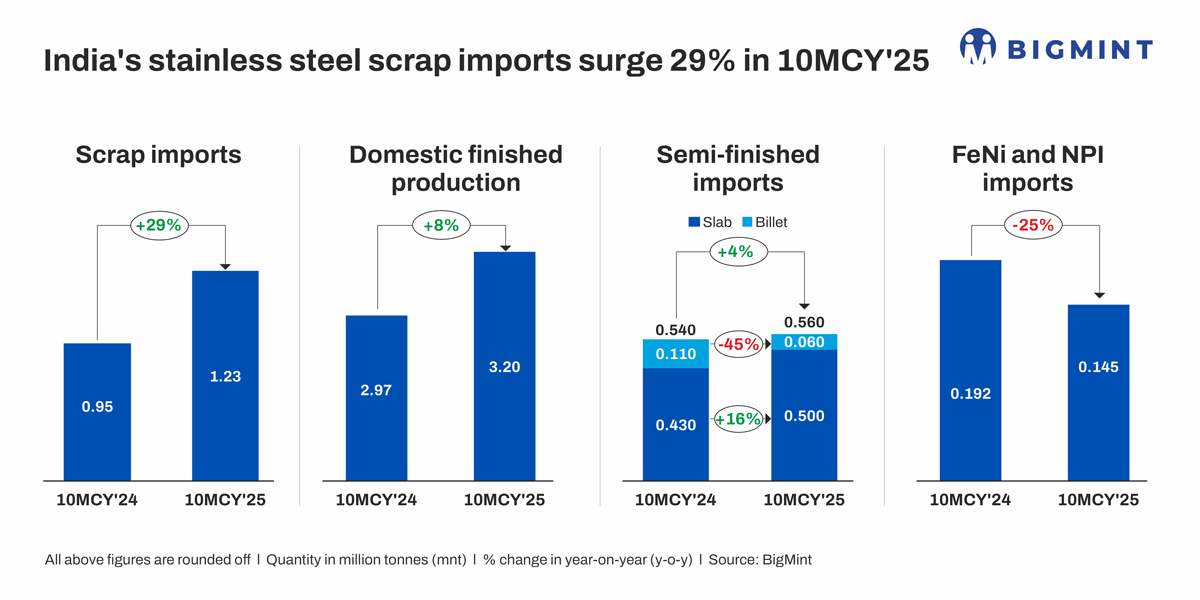
Total imports stood at 1.23 million tonnes (mnt), up 29% y-o-y from 0.95 mnt in the same period last year.
Series & grade-wise imports
Growth was led by higher arrivals of 300-series, particularly 304-grade scrap, as mills continued to focus on producing high-nickel austenitic grades.

300-series scrap imports rose 39% y-o-y to 0.88 mnt from 0.63 mnt last year, with 304 grade imports at 0.43 mnt and 316 grade at 0.11 mnt. 200-series, 400-series, and other grades also showed steady improvement amid wider melting requirements. Zurik scrap arrivals increased by 18% y-o-y to 0.24 mnt, while non-Zurik imports climbed up by 30% to 0.99 mnt during the period.
The shift indicates broad-based growth across stainless steel grades, particularly those used in kitchenware, industrial equipment, and automotive components.
Country-wise arrivals
The US remained the leading supplier with 163,000 t, up 7% y-o-y in 10MCY’25, while imports from Thailand rose 9% to 94,500 t and Vietnam saw a 17% increase to 94,600 t. Notable volumes were also sourced from Malaysia, South Korea, and the UK, reflecting buyers’ efforts to diversify their import base.

Key drivers behind India’s rising stainless steel scrap imports
Domestic stainless steel production climbs up: India’s stainless steel production continued to expand, reinforcing the need for higher scrap imports. Domestic output reached 2.18 mnt in 10MCY’25, up 21% y-o-y from 1.80 mnt last year. Production of finished flats stood at 1.49 mnt and finished longs stood at 0.68 mnt in January-October 2025.
Scrap prices decline: Lower stainless steel scrap prices resulted in increased imports during January-October 2025. Imported stainless scrap prices averaged $1,280-1,300/t in 10MCY’25, down by $120-140/t y-o-y. Domestic stainless scrap prices also softened by INR 60,000-70,000/t y-o-y to INR 111,000-115,000/t.
In fact, imported scrap prices have fallen steadily during the review period, hitting an all-time low of around $1,220-1,230/t CFR Mundra in November 2025.
Semi-finished imports show mixed trends: Stainless steel billet imports declined sharply by 46% y-o-y to 63,000 t during the same period, against 116,000 t last year. This significant drop in billet imports reflects a shift in sourcing and production patterns within the Indian stainless steel industry.
Conversely, India’s imports of stainless steel slabs stood at 0.50 mnt in 10MCY’25, up by 15% from 0.43 mnt last year.
Ferro nickel imports shrink: India’s ferro nickel imports dropped significantly by 25% y-o-y in 10MCY’25, reaching 0.14 mnt against 0.19 mnt in the year-ago period. Ferro nickel is a substitute for stainless steel scrap.
Indonesia, a leading ferro nickel supplier, reduced its shipments to India by 42% y-o-y to 0.10 mnt in January-October 2025. Lower ferro nickel shipments further reinforced scrap-based melting.
However, imports of nickel pig iron (NPI, Ni 14-16%) stood at 2,000 t in 10MCY’25, a significant increase against 650 t last year.
Outlook
Stainless steel scrap imports are expected to trend higher in the coming months as mills ramp up output to meet rising demand across construction, railways, consumer durables, and infrastructure.
Growing capacity expansions, stronger utilisation rates, and continued preference for scrap over NPI — amid Indonesian supply constraints and BIS-linked sourcing advantages — will keep import demand elevated.
Diversification of sourcing destinations is also likely to continue as Indian buyers seek stability amid fluctuating global scrap availability and shifting trade flows. Overall, import volumes are set to remain robust, aligning with India’s expanding stainless steel production base.
Leave a Reply