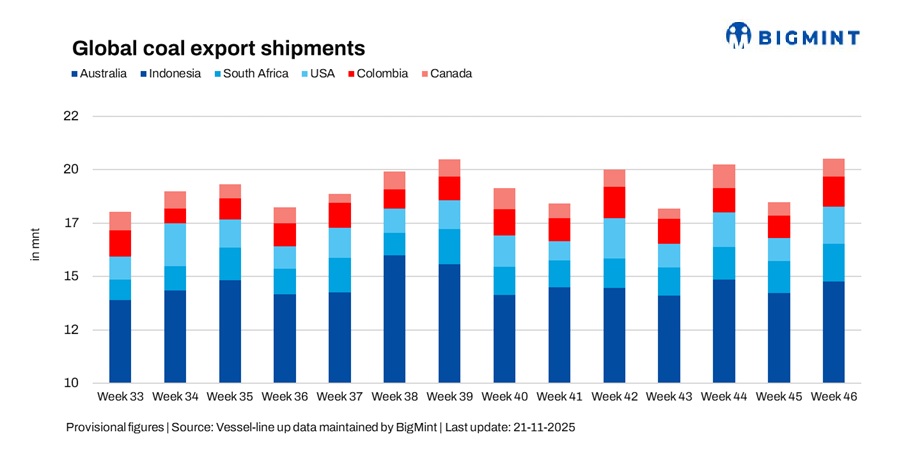
- Australia, South Africa, US drive gains on improved operational stability
- Firmer freight sentiment, tighter tonnage support export momentum
Global seaborne coal exports rose 10.6% w-o-w to 20.09 million tonnes (mnt) in week 46 (8-14 November 2025), from 18.16 mnt in week 45 (1-7 November), according to BigMint’s vessel line-up data. The recovery was led by higher shipments from Australia, South Africa, the US, Colombia, and Canada, while Indonesia saw only a modest improvement after last week’s slowdown.
The strong uptick in volumes reflected improved buying interest from India following early-November weakness, better weather conditions across key load regions, and stronger freight market sentiment that encouraged fresh fixtures. Tighter vessel availability in the Pacific, combined with a general upswing in Panamax and Supramax sentiment, helped sustain vessel fixing activity, lifting overall shipment momentum during the week.
Country-wise trends
Australian shipments strengthen on steady operations
Australia’s coal exports rose 4.9% w-o-w to 7.69 mnt in week 46 from 7.33 mnt a week earlier, supported by steady operations and improved rail flow across major terminals. Loadings increased at Newcastle (3.24 mnt), DBCT (1.48 mnt), and Gladstone (1.41 mnt), as miners maintained stable output under favourable weather conditions. Glencore led shipments with 1.03 mnt, while Japan (1.97 mnt) and China (1.67 mnt) emerged as the leading importers during the week.
Firm demand from northeast Asia, coupled with a pick-up in Indian inquiries, supported fixture activity across major load regions. Strengthening Pacific freight sentiment encouraged owners to position more tonnage into Australian employment, improving vessel availability and aiding smoother shipment flow through the week. Meanwhile, South Korea’s plan to phase out coal by 2040 is expected to reduce Australia’s thermal coal exports but also open significant opportunities for expanding shipments of critical minerals, green iron, aluminium, and other clean energy commodities.
Indonesian shipments see mild recovery
Indonesia’s coal exports inched up by 2.4% w-o-w to 6.89 mnt in week 46 from 6.73 mnt in week 45. The recovery remained modest as vessel nominations were slow to pick up following last week’s post-festive demand softness. Loadings at key hubs such as Bunati (1.16 mnt), Taboneo (0.79 mnt) and Samarinda (0.77 mnt) recorded only marginal improvement, with uneven Indian buying interest and competition from Australian cargoes keeping Indonesian shipments largely range-bound. China remained the major importer at 2.26 mnt, followed by India (1.00 mnt) and South Korea (0.64 mnt).
Minor congestion relief and improving weather along India’s east coast helped stabilise flows, enabling smoother vessel movement compared with the previous week. However, despite better operational conditions, overall export momentum stayed subdued as subdued spot procurement and moderate cargo nominations limited a stronger rebound.

South African shipments rebound strongly
South Africa’s coal exports rose 18.1% w-o-w to 1.69 mnt in week 46 from 1.43 mnt in week 45, supported by steadier operations at Richards Bay. Improved rail scheduling and better cargo availability helped accelerate loading activity through the week, allowing exporters to recover from earlier logistical bottlenecks. India emerged as the largest importer, taking 0.81 mnt of South African coal, reflecting a partial rebound in buying interest after last week’s slowdown.
Indian demand showed early signs of revival, which helped support fixtures, although most trade continued to be driven by long-term commitments rather than spot tenders. Additionally, the mining sector still faces high electricity costs, weak rail reforms, and falling output in key minerals such as iron ore, signalling that although mining is slowly recovering, it remains under pressure despite some operational improvements.
Colombian shipments jump as terminal activity normalises
Colombia’s coal exports recovered by 32% w-o-w to 1.33 mnt in week 46 from 1.00 mnt in week 45 as operational activity normalised across major terminals. Loadings strengthened at Puerto Nuevo (0.64 mnt) and Puerto Bolivar (0.57 mnt), with miners ramping up shipments after earlier slowdowns. Prodeco Group (0.64 mnt) and Cerrejon Mines (0.57 mnt) remained the principal shippers during the week.
Demand from Turkiye (0.21 mnt) improved moderately, while select European buyers returned to the market as freight levels stabilised and voyage economics became more favourable. Although intermittent weather-related disruptions persisted, improved vessel scheduling and better terminal coordination supported smoother throughput, helping Colombia regain export momentum during the week.
US records strongest weekly export gain
US coal exports jumped sharply by 61.9% w-o-w to 1.68 mnt in week 46 from 1.04 mnt in week 45, marking the strongest weekly gain among major exporters. Loadings rose significantly at Mobile (0.61 mnt), Norfolk (0.59 mnt), and New Orleans (0.30 mnt), as cargo availability improved across key terminals. Easing congestion in the Atlantic basin also supported faster vessel turnaround, enabling shippers to move larger volumes during the week.
Stronger buying interest from India and Europe aided fixtures, with India emerging as the largest importer at 0.41 mnt, followed by Brazil at 0.29 mnt. The combination of improved port fluidity, increased cargo flow, and firmer demand conditions helped the US regain export momentum after weeks of subdued activity.
Canada boosts coal shipments as weather improves
Canada’s coal exports rose 32.3% w-o-w to 0.82 mnt, supported by improved rail movements and stronger demand from northeast Asia. Shipments increased across Vancouver (0.33 mnt), Roberts Bank (0.32 mnt), and Prince Rupert (0.17 mnt), as weather disruptions eased. Elk Valley Resources contributed 0.33 mnt, helping push overall volumes higher.
Although weekly cargo flow remained below late-October levels, improved port conditions allowed exporters to clear backlogs and boost shipments. South Korea was the top importer at 0.32 mnt, followed by Japan and China, each taking 0.17 mnt, reflecting steady buying interest in the region.
Panamax, Supramax rates strengthen
Freight market sentiment strengthened notably in week 46, with both Panamax and Supramax segments reflecting an optimistic tone supported by tighter tonnage, firmer Pacific demand, and higher bunker costs. Improved fixture activity on Australia-India, Indonesia-India, and South Africa-India routes boosted owner confidence, while stronger FFA sentiment encouraged owners to hold for higher levels.
Although Indian inquiries were uneven, the freight uptrend encouraged quicker vessel fixing across multiple regions, enabling exporters — especially in Australia, the US, and South Africa — to push more cargoes into the market. The modest but steady rise in freights added cost pressure for buyers but simultaneously improved shipment flow as owners found greater incentive to commit vessels, supporting the rebound in overall exports this week.
Outlook
Global seaborne coal exports are likely to remain steady in the near term, supported by stronger Pacific sentiment, improving Indian demand, and continued operational stability across Australia and South Africa. Indonesian shipments may stay range-bound amid uneven procurement and competitive pressure from Australian cargoes. US and Colombian exports could maintain momentum if Atlantic logistics remain smooth, while Canada’s recovery may continue as rail performance improves.
Freights are expected to remain stable to mildly bullish, which may keep shipment activity supported, although gains could be capped by selective buying from Indian consumers and still-subdued industrial coal demand across key importing regions.
Leave a Reply