- Iron ore output rises 18% in H1FY’26, FY’26 guidance raised
- Pellet production capacity to grow to 4.7 mnt with new plant
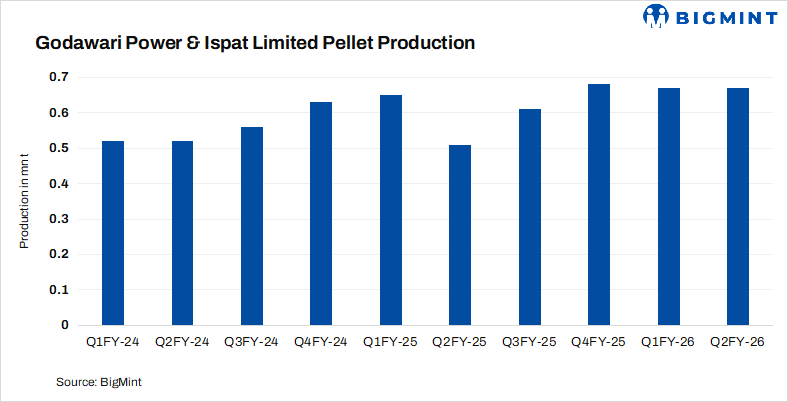
Godawari Power and Ispat Limited (GPIL), central India’s leading integrated steel producer, reported a healthy 22% y-o-y rise in pellet output during H1FY’26, to 1.34 million tonnes (mnt) against 1.16 mnt in H1FY’25, supported by stronger operational efficiency and higher plant utilisation. On a quarterly basis, production remained largely steady, with GPIL manufacturing 667,200 tonnes (t) in Q2FY’26 versus 673,750 t in Q1FY’26.
Iron ore production also maintained an upward trajectory. Output in H1FY’26 reached 1.29 mnt, marking an 18% y-o-y. Production in Q2FY’26 edged up to 648,614 t, marginally higher than the 642,243 t recorded in Q1FY’26, reflecting consistent mining operations.
In contrast, steel billet production saw a slight moderation. GPIL’s billet output in H1FY’26 stood at 230,130 t, representing a 4% decline compared with 240,190 t in H1FY’25.
Notably, the FY’26 iron ore production guidance has been increased to 3 mnt from 2.44 mnt in FY’25.
Highlights
Financial performance
- EBIDTA down y-o-y: The company’s standalone EBITDA was recorded at INR 543 crore in H1FY’26, a 13% drop as against INR 621 crore in the same period last year.
- PAT edges up y-o-y: GPIL’s profit after tax (PAT) increased 6% to INR 449 crore in H1FY’26 from INR 429 crore in H1FY’25. The improvement in profitability was primarily driven by higher sales of pellets and rolled structural products.
Sales, production guidance
- Average sales realisation drops: GPIL’s average sales realisation stood at INR 9,602/t in H1FY’26, a decrease of 9% from INR 10,569/t in H1FY’25. Realisation of almost all products dropped y-o-y, reflecting a soft pricing environment in both domestic and global markets. This included lower iron ore and pellet prices, subdued steel demand, and competitive market conditions, which collectively pulled down the company’s average realisation despite higher sales volumes.
- Decarbonisation initiative: GPIL is transitioning its pellet plant fuel from coal gas to natural gas as part of its decarbonisation plan, targeting a 64% reduction in CO₂ emissions, with infrastructure work already in progress.
Upcoming capacities, projects
- CRM complex and integrated steel expansion: GPIL is moving forward with its major downstream expansion through the development of a 0.7 mnt cold-rolled mill (CRM) complex, which will include pickling lines, cold rolling mills, annealing, galvanising, and colour-coating facilities. The company has already placed major equipment orders, and land acquisition of 452 acres for the CRM and future integrated steel plant (ISP) has been completed. These investments mark a strategic shift towards higher-value steel products and deeper integration across the steel value chain.
- Solar power expansion for captive use: To strengthen its renewable energy footprint, GPIL’s board has approved a large 250 MW solar power project dedicated to captive consumption for the upcoming CRM and ISP facilities. This project builds upon the previously approved 125 MW solar plant, reflecting the company’s increasing reliance on green power to reduce long-term energy costs and enhance sustainability.
- Structural steel rolling mill ramp-up: The company’s recently established structural steel rolling mill has begun contributing to overall production. This is evident from the inclusion of rolled structural products in H1FY’26, recording 46,096 t of output, which was absent in the previous year. This marks GPIL’s expansion into higher-margin structural steel categories and strengthens its presence in construction and infrastructure segments.
- Iron ore mine expansion regulatory progress: GPIL continues to advance the regulatory process for increasing the Ari Dongri iron ore mine capacity from 2.35 mnt to 6 mnt. The public hearing for the expansion has been completed, and the company expects to secure the final environmental clearance by December 2025. Once approved, this expansion will significantly enhance raw material security and support future capacity growth. Additionally, the new pellet plant under construction is set to boost total capacity to 4.7 mnt.
- Diversification through Jammu Pigments acquisition: GPIL has completed the acquisition of Jammu Pigments Ltd, a company engaged in lead recycling and zinc production. This move marks a strategic diversification into the non-ferrous metals segment, broadening GPIL’s portfolio beyond iron and steel and potentially enhancing future revenue stability.
Leave a Reply