- Guinea plans to build 5-6 alumina refineries by 2030
- High export dependence on China causes concerns
Guinea is set to fast-track the development of alumina refineries and iron ore pellet plants in a bid to end decades of raw ore exports, Mines Minister Bouna Sylla announced. The initiative comes as the country prepares for its first iron ore shipments from the giant Simandou mine, marking a new phase in Guinea’s industrialisation strategy.
In-country processing of alumina and iron ore could transform Guinea’s economy by creating industrial jobs, enhancing value addition, and reducing exposure to volatile global commodity prices.
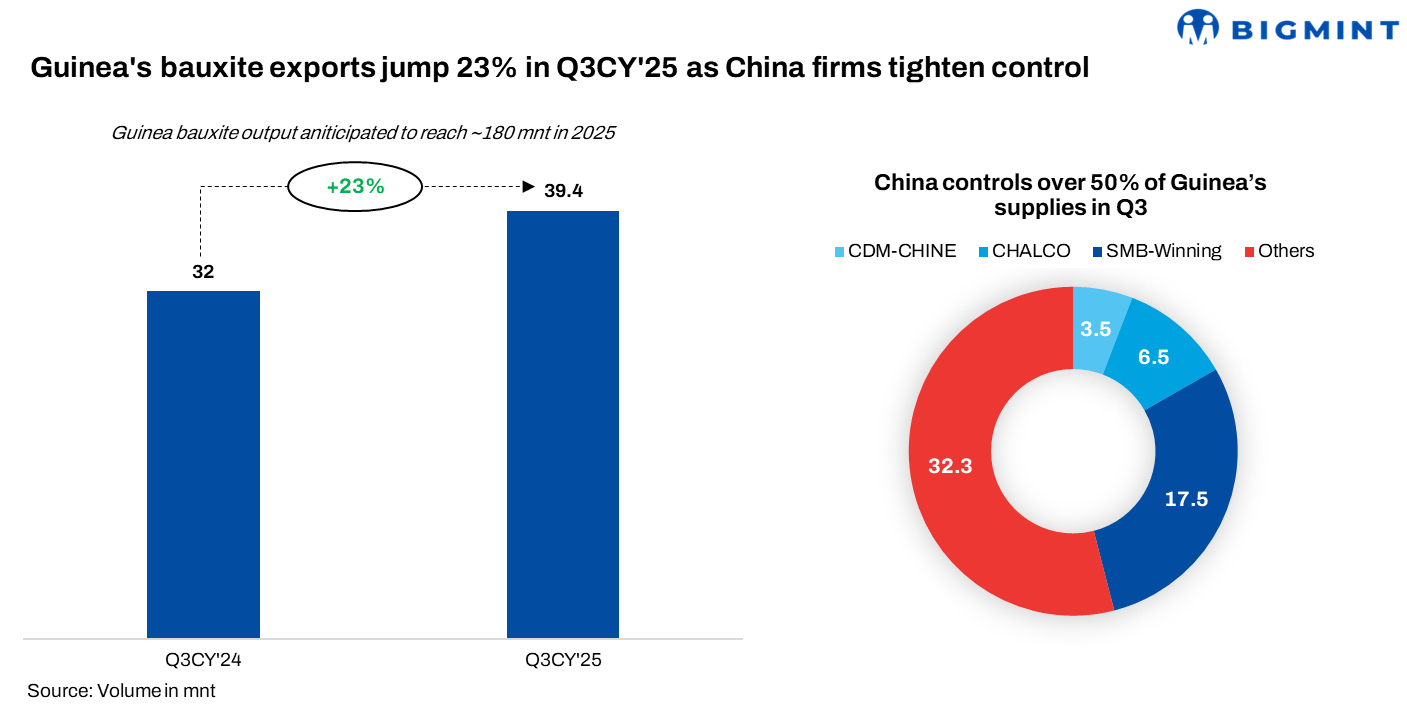
Guinea’s bauxite exports jumped 23% y-o-y in Q3CY’25 to 39.4 mnt, overcoming seasonal disruptions such as heavy rains. Despite challenges, Guinea remained a top global supplier, with output projected above 180 mnt annually. Chinese firms control 54% of these exports, led by SMB-Winning, CHALCO, and CDM-CHINE, reinforcing China’s strong influence over Guinea’s bauxite supply amid the country’s push to expand domestic alumina refining capacity.
Ambitious alumina expansion plan
Currently, Guinea exports about 60% of its bauxite — a key aluminium feedstock — to China. To move up the value chain, Conakry has signed its first alumina refinery deal with China’s state-owned SPIC, with construction underway and completion due by the end of 2027.
Talks for additional plants are advancing with Chinalco and France’s Alteo, while discussions continue with Compagnie des Bauxites de Guinée (CBG) and Alcoa. “We are the biggest bauxite producer in the world now… but we do not have any refineries built since colonial times. That will change,” Sylla said.
Guinea plans to build five to six refineries by 2030, targeting a total alumina processing capacity of around 7 million tonnes (mnt) per year. The government recently revoked a bauxite concession held by a unit of Emirates Global Aluminium after it failed to build a promised alumina refinery — a move signalling stricter enforcement of local processing commitments.
However, it is noted that this shift will not immediately reduce China’s reliance on Guinea, as exports may simply transition from raw bauxite to processed alumina.
Iron ore value addition next on the agenda
In parallel with its alumina push, Guinea is also advancing domestic iron ore processing. Under new agreements, Rio Tinto and Winning Consortium Simandou (WCS) — developers of the massive Simandou deposit — are required to conduct feasibility studies for a 500,000-t steel plant or a 2-mnt pellet facility within two years of first exports.
If developers fail to meet their obligations, the Guinean government reserves the right to commission the studies through a global engineering firm at the expense of Compagnie du Transguineen, the joint venture managing Simandou’s rail and port services.
Rio Tinto’s Simfer venture has already committed to a feasibility study for a pellet plant to assess production options, a spokesperson confirmed.
Energy investments to power industrial growth
Energy supply remains Guinea’s biggest challenge. To sustain refinery and steel plant operations, the government is actively seeking investments in hydropower, solar, and liquefied natural gas (LNG). A US-backed proposal to import LNG for power plants is also under review.
Sylla emphasised that Guinea’s proximity to Europe and the US gives it a logistics edge over Middle Eastern hubs, making it well-positioned to supply pellets and direct reduced iron (DRI) for the emerging green steel market.
Outlook
By 2030, Guinea aims to become not just the world’s largest bauxite exporter but also a leading regional hub for alumina and iron ore processing. The government’s tougher stance on investor commitments, combined with strategic infrastructure and energy initiatives, could unlock a new era of value-added growth — positioning Guinea as a key player in the global metals supply chain.
Leave a Reply