- Muted market sentiment due to weak demand
- Cautious buying restrains market activity
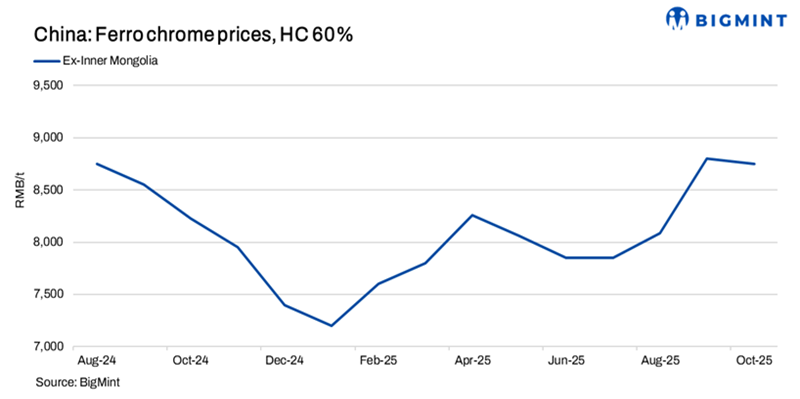
CBC: High-carbon ferro chrome prices inched down by RMB 200/t ($28/t) w-o-w at RMB 8,190-8,600/t ($1,156-1,211/t) exw, including taxes.
Medium-carbon ferro chrome prices inched down by RMB 400/t ($56/t) w-o-w to RMB 13,200 -13,400/t ($1,859-1,888/t) exw, including taxes.
Ferro chrome prices dropped slightly over the week amid weak demand from the stainless steel sector and limited buying interest from steel mills. Sluggish end-user consumption and reduced cost support further dampened market sentiments.
Market recap
Tsingshan keeps tender price flat
Following TISCO’s announcement of unchanged tender prices, Tsingshan has kept its ferro chrome tender prices steady m-o-m at RMB 8,495/t ($1,197/t) DAP, inclusive of taxes, for Nov’25 deliveries. The price stability is supported by firm domestic ferro chrome tags in Oct’25 and steady downstream demand.
Raw material market trends
The chrome ore market remained under pressure, and labor negotiations in South Africa’s key mining regions were at a stalemate, leading to tight port inventories. However, downstream ferro chrome producers were cautious in buying, making it difficult for miners to maintain prices.
Although price changes were minimal across regions, sluggish demand prompted more miners to reduce prices.The decline in cost support further squeezed ferro chrome producers profit margins and dampened their production activity.
End-user market trends
Weak demand from the stainless steel sector remained the key factor behind the drop in ferro chrome prices. Slow end-user consumption kept steel mills cautious, limiting procurement to need-based purchases.
Although demand for medium carbon ferro chrome from the new energy sector persisted, its growth slowed due to policy shifts and market uncertainty. Demand for micro carbon ferro chrome in high-end manufacturing also weakened, resulting in an overall supply-demand imbalance and limiting any price rebound.
Outlook
Ferro chrome prices are likely to remain range-bound in the near term, with any potential change depending on shifts in stainless steel demand.
Leave a Reply