- Bangladesh market subdued due to rains, slow steel sales
- US scrap export prices rise amid some expectations of Turkish demand
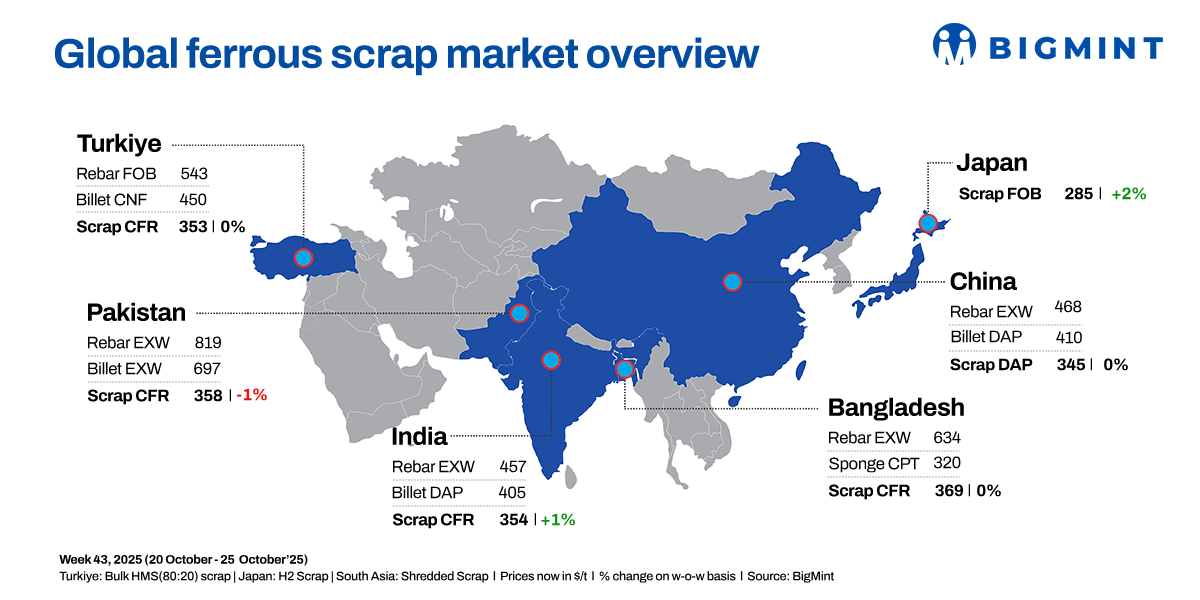
Global imported scrap markets remained largely subdued this week, with weak steel demand, high freight rates, and muted mill activity limiting trade across South Asia, while the US and Japan saw mild gains.
Turkiye: Deep-sea imported scrap prices in Turkiye eased to $350-352/t CFR from $353-355/t last week, as weak steel demand and sluggish rebar sales kept mills cautious. High freight and tight supply limited buyer activity.
Market activity remained muted, with US-origin HMS 80:20 at $352-355/t CFR. European suppliers hesitated below $348-350/t due to high freight and collection costs. Mills may resume selective bookings if rebar demand recovers.
India: India’s imported scrap market remained largely quiet through the week as trading activity was limited by the Diwali holidays and weak steel demand. Buyers and mills stayed mostly inactive, leading to minimal inquiries and slow market movement.
Prices for imported scrap held stable, with European shredded around $354-356/t CFR Nhava Sheva and HMS 80:20 at $323-326/t CFR. Suppliers adopted a wait-and-watch approach as buyers stayed on the sidelines. Market participants expect trading activity to gradually recover once operations resume post-festival.
Additionally, JSW Steel plans to set up a 0.5 mnt/year scrap recycling facility in Chennai to source material from automakers and white goods manufacturers for its Vijayanagar and Kadappa plants.
Pakistan: Pakistan’s imported scrap market remained quiet through the week as weak demand, tight liquidity, and sluggish steel sales continued to weigh on sentiment. UK/EU-origin shredded scrap hovered at $360-362/t CFR Port Qasim, with bids $5-10/t lower than offers. Middle East-origin HMS and PNS traded at $352-355/t, with limited activity as buyers remained cautious.
Bangladesh: The imported ferrous scrap market remained quiet as extended rains and weak finished steel demand kept buying subdued. Mills largely delayed new bookings, managing existing inventories and waiting for clearer demand signals to resume activity. PNS was last heard at $372-374/t CFR Chattogram, with arrivals mainly from Malaysia and Singapore, while Australian shredded held at $368/t.
Japan: H2 scrap export prices inched up in JPY terms but eased by $1/t in dollar value amid JPY depreciation. BigMint assessed H2 at JPY 43,500/t ($284/t) FOB Tokyo Bay, up JPY 650/t w-o-w. Tight supply and a weaker yen supported bids.
Tokyo Steel, in its fifth price revision this month, effective 25 Oct, increased H2 scrap purchase prices by up to JPY 1,000/t ($7/t) w-o-w for Tahara, Nagoya, Kansai, Takamatsu, Utsunomiya, and Tokyo Bay facilities and by JPY 500/t w-o-w for Okayama.
US: Export scrap prices rose w-o-w, supported by stronger domestic flat steel and Turkish buying interest. Market sentiment remained cautious, with participants expecting limited price movement over the next two months.
In October 2025, the RMDAS ferrous scrap index declined across all major grades, with shredded down $11/t to $370/t, prompt industrial composite down $24/t to $401/t, and HMS slightly lower at $336/t, reflecting weak mill demand.
Leave a Reply