- China’s steel output down 3% in 9MCY’25
- Production up 2% in the US, down 5% in Japan
- Turkish steel output sees marginal uptick after soft H1
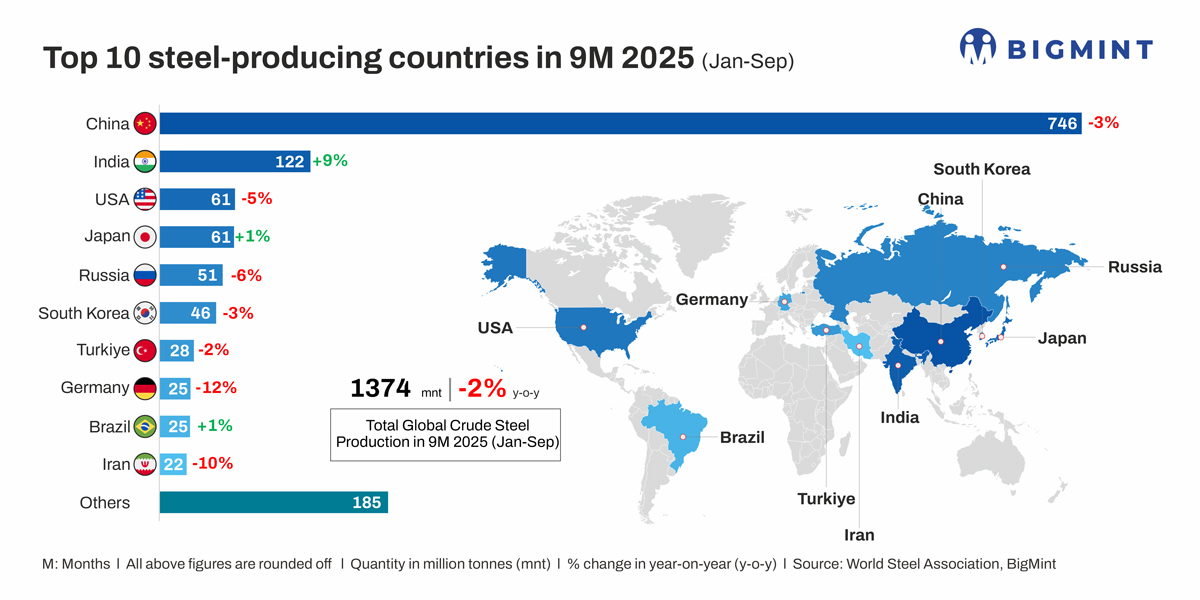
Morning Brief: Global crude steel production in the first nine months of the current year (January-September 2025 or 9MCY’25) reached 1,374 million tonnes (mnt), a decrease of 2% compared with 9MCY’24, as per data recently released by the World Steel Association (WSA). WSA’s data represent around 98% of global steel production, covering as many as 70 countries that report directly to it.
The downtrend in steel production worldwide could be directly traced to China entering a phase of gradual but irreversible decline in steel demand, with key steel-consuming sectors in that country showing persistent weakness. Notably, Chinese steel production fell by over 5% in September to a 21-month low after declining by 9.2% y-o-y in June.
Moreover, tariffs and trade tensions, high inflation and energy prices, and weak export prospects all contributed in equal measure to keeping global steel sector sentiments subdued.
How did top steel-producing countries fare in 9MCY’25?
China’s crude steel output fell by 3% y-o-y to 746 mnt in 9MCY’25. This is due to (1) operation suspensions at certain mills ahead of the military parade on 3 September, (2) shrinking profitability of steelmakers amid declining product prices and firm raw material costs, and (3) weaker demand than expected during the peak season.
Steel consumption in China is set for a marginal decline in CY’25 as the downtrend in the property sector and partial slowdown in infra and construction is unlikely to be wholly compensated by the growth in steel demand from the engineering goods, shipbuilding, appliances and NEV sectors.
As the brightest spot on the global steel map, India’s crude steel production reached 122 mnt in 9MCY’25, an increase of 11% y-o-y. Growth in production was sustained by BF-based capacity additions, as well as expansion of the IF sector. Growth is due to the government’s national infrastructure pipeline, PMAY, rapid urbanisation and capacity expansion undertaken by the primary producers.
The imposition of a 12% safeguard duty on steel imports in mid-April, which naturally boosted the integrated mills that were in desperate need of some sort of protection through an import barrier (particularly due to very soft steel demand globally) boosted steel production.
Japan’s crude steel production fell 5% y-o-y to 61 mnt due to demand for steel declining both domestically and internationally, with the pace of production slowing down for both the blast furnace manufacturers and electric furnace producers, according to the Japan Iron and Steel Federation (JISF). The softening of Asian markets due to increased steel exports from China hit the Japanese steel industry as export demand dampened, thereby impacting manufacturers.
The US recorded total production at 61 mnt in 9MCY’25, up 2% y-o-y as the import tariff on steel boosted the domestic industry, and also due to the fact that market sentiments were upbeat following major acquisitions and strategic investments by key producers. The domestic steel industry is seeking to derive incentives from the IRA and other enabling policies.
However, analysts predict that US trade policies and tariff-related uncertainties are expected to affect downstream demand, with gradually mounting inflationary pressure.
South Korean crude steel production fell by over 3% y-o-y to 46 mnt in 9MCY’25. The major reasons were domestic demand slump, typical to matured economies, diminishing cost-competitiveness of key steel producers such as POSCO, downtrend in the export market amid US tariffs and soft global demand, as well as a high level of steel exports from China.
Turkish steel production rose 1% y-o-y in January-September to 28 mnt. Trade uncertainties, cost pressure due to the hike in energy prices, and competition from China amid the surge in exports of billets were the major factors impacting Turkish steel production. However, sentiments started improving slightly in H2CY’25 with better export prospects to the Middle East.
Russia’s crude steel production decreased by 5% y-o-y to 51 mnt due to falling global steel prices and the decline in steel exports alongside an appreciating currency, drop in demand from domestic construction and energy sectors, and the weight of sanctions on the economy and industry.
Likewise, continued downturn in the manufacturing sector in the EU, high energy prices due to the Russia-Ukraine war, and the ever-present threat of increasing steel imports, despite safeguards, affected steel production in the continent, and especially in Germany which continues to battle the costs of energy transition, while seeking to stay afloat.
Outlook
China’s steel demand will continue its decline in 2025, falling by approximately 2%. This forecast represents a moderation of the downward trend observed since 2021, driven primarily by the ongoing downturn in the housing market, according to WSA. If Chinese steel production in CY’25 edges down by, say, 4-5% y-o-y in H2 (considering the possibility of greater reductions in the latter half of the year due to winter environmental restrictions and government mandates to lower production in certain regions and provinces), global production may edge down further.
While global demand and production will remain flat y-o-y in CY’25, India will show a robust 9% growth. US trade pacts (aimed at moderating the tariff burden) with major partners such as Japan, and possibly India in August will go some way in reviving sentiments in major steel-producing geographies. The EU may witness a marginal recovery in H2 as import volumes shrink and the auto sector gains some kind of a momentum.
Leave a Reply