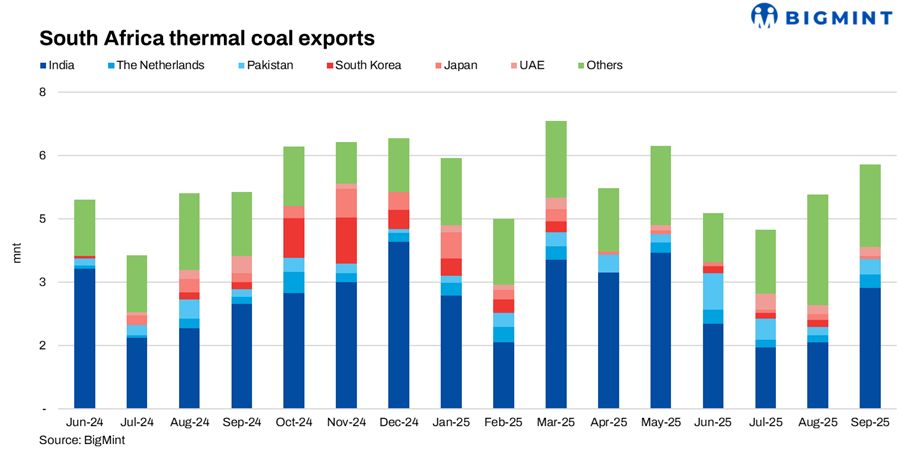
- India receives nearly half of total exports
- Europe shows renewed buying interest
South Africa’s non-coking coal exports rose 14% m-o-m to 5.79 mnt in September 2025 from 5.08 mnt in August, driven mainly by higher shipments to India and the Netherlands.
India remains key buyer
India’s imports climbed up by 51% m-o-m to 2.87 mnt in September from 1.90 mnt in August, maintaining its position as the top destination and accounting for nearly half of total exports. The rise reflects steady coal demand from industries.
European demand strengthens; Asia mixed
European intake increased, led by the Netherlands (0.32 mnt, up 100% m-o-m) and Germany (0.16 mnt, up 14%). Pakistan’s imports rose to 0.35 mnt from 0.20 mnt, while Bangladesh’s volumes halved to 0.13 mnt amid muted buying. Taiwan’s imports fell sharply to 0.08 mnt from 0.49 mnt, and Japan also recorded a decline to 0.08 mnt from 0.21 mnt.
Market overview
In September, South African thermal coal prices in India remained broadly steady compared with August levels. On a CNF basis, RB2 averaged $87.14/t and RB3 $75.41/t, marginally lower than the previous month when RB2 averaged $87.68/t and RB3 hovered around $76-77/t. Prices were more or less firm, reflecting stable freight and balanced seaborne supply rather than any major change in demand. The receding monsoon in India led to restocking from Indian steel mills. At the same time, portside stocks also fell in August. Expectations of a demand spike following the monsoon also led to an increase in bookings.
At Gangavaram, portside prices also remained largely unchanged, with RB2 assessed at INR 8,130/t and RB3 at INR 7,043/t in September compared with INR 8,300/t and INR 7,200/t in August. Market participants highlighted that consistent industrial demand and regular cargo flow kept prices stable, reflecting a period of consolidation after the firm momentum seen in the previous month.
Outlook
Exports are likely to stay firm through October as Indian demand persists, supported by restocking needs and moderate regional demand recovery following the festive season.
Leave a Reply