- Prices climb in China, US, Europe
- Indian trades keep prices supported
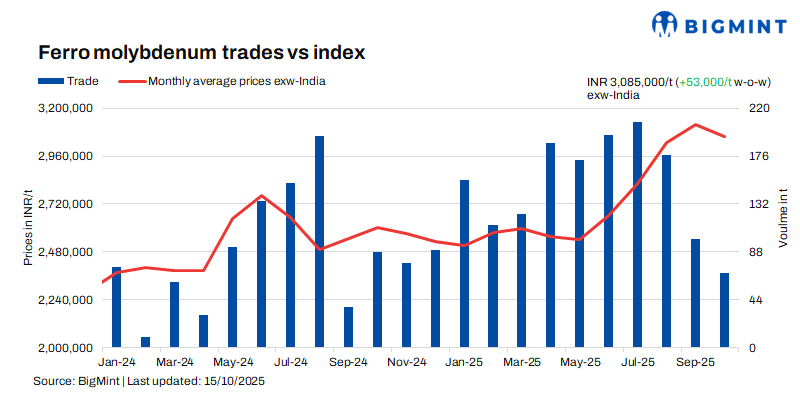
Indian ferro molybdenum prices witnessed an increase of INR 53,000/t ($600/t) as compared to the assessment on 8 October. Prices edged up following the rise in global markets, particularly China, as well as the rise in oxide prices.
Ferro molybdenum prices in India were INR 3,085,000/t ($34,928/t) exw-India, as per BigMint’s assessment on 15 October. Around 30 t of trades were reported last week in the price range of INR 2,900,000-3,100,000/t ($32,833-35,097/t) exw.
Market highlights (9-14 October)
Prices rise across markets: Ferro molybdenum (Mo:60%) prices in China increased by RMB 8,000/t ($1,121/t) w-o-w to RMB 282,500/t ($39,571/t) exw-Inner Mongolia. The ferro molybdenum market showed an upward trend as major steel mills began their October procurement tenders, driving concentrated demand and pushing prices higher. Market activity also improved, with sellers holding firm due to rising costs and demand, reducing low-priced inventories.
In the short term, stable or higher tender prices may strengthen confidence, while weaker bids could create mild downward pressure, though high costs might limit declines.
Prices went up in US and Europe (Mo:70%) as well, inching up by $0.4/kg w-o-w to $58/kg and $57/kg, respectively.
A slight w-o-w uptick was also seen in LME futures, inching up by $0.13/lb to $24.93/lb on 14 October.

Domestic trades support prices amid festivities: Following the rise in global prices, Indian ferro molybdenum sellers also increased their offers. However, inquiries remained limited due to the upcoming festive season, keeping overall activity moderate. Despite this, around 30 t of trades were reported, supporting current price levels. A seller told BigMint, “We are not selling below cost. Our offers are above INR 3,100,000/t ($35,097/t) exw; otherwise, we prefer to wait for the market to move upward.”
Outlook
Ferro molybdenum prices in the coming days are expected to stay rangebound with slight variations. Global trends will continue to have an impact on the Indian market.
Leave a Reply