- Stable domestic stocks, diversified import sources keep market steady
- Bangladesh holds ample reserves ahead of Aman procurement season
India, the largest supplier of rice to Bangladesh, introduced new export norms on 24 September, requiring exporters of all rice varieties except basmati to register their contracts with the Agricultural and Processed Food Products Export Development Authority (APEDA). The directive, issued by the Directorate General of Foreign Trade (DGFT), makes registration mandatory prior to shipment.
The measure aims to tighten monitoring of rice exports and ensure compliance with domestic food security objectives. However, for Bangladesh — which mainly imports non-basmati parboiled rice from India — the change has had minimal impact so far.
Imports from India remain unaffected
Officials from Bangladesh’s Directorate General of Food (DG Food) say the country’s rice market remains stable due to sufficient reserves and access to alternative supply origins. “The registration requirement will not disrupt imports,” said Md. Moniruzzaman, Director of DG Food’s procurement division. “Our contracted suppliers have already completed the necessary registration under the new Indian rule.”
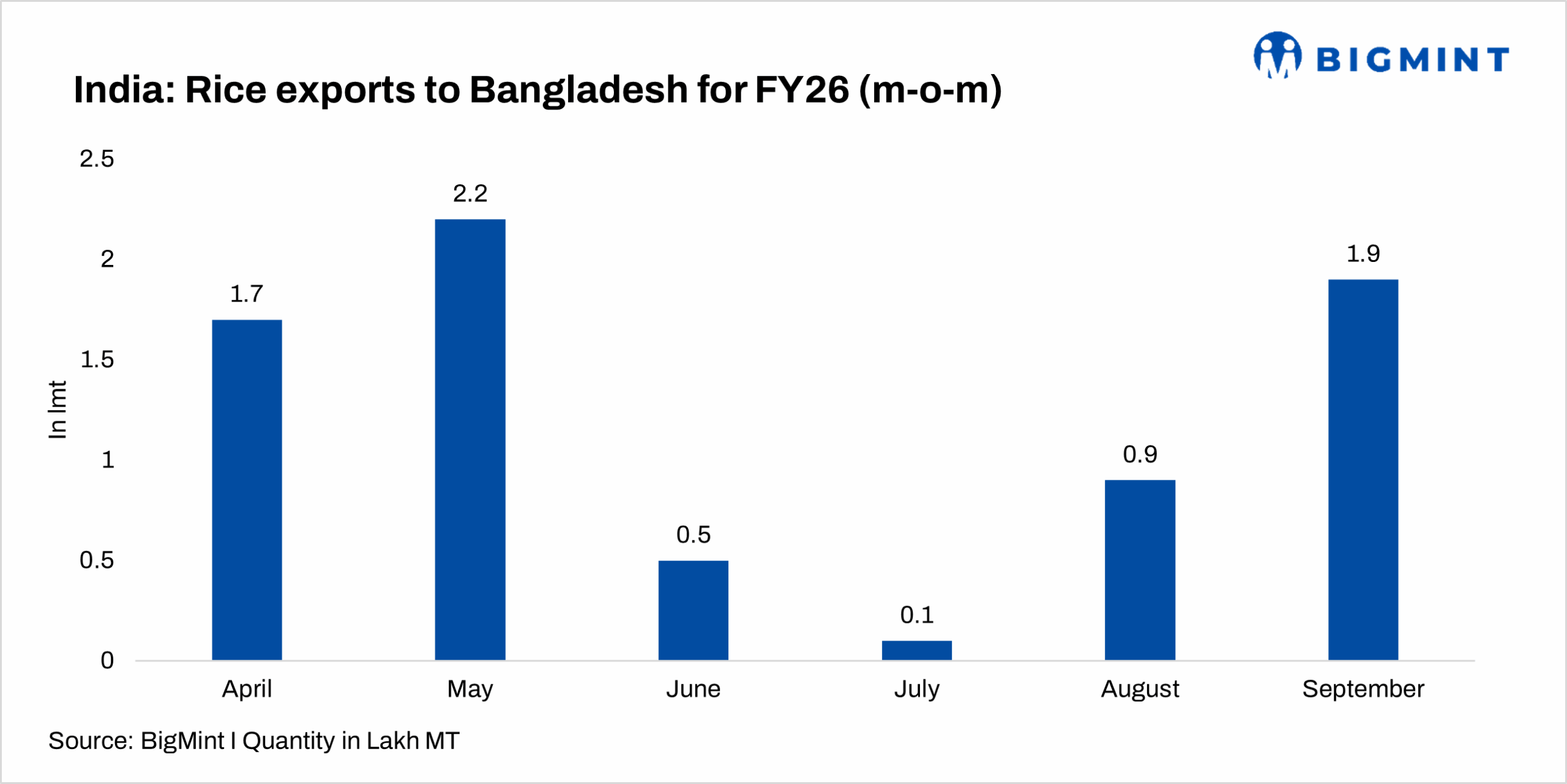
In the last fiscal year, Bangladesh imported around 600,000 t of rice from India, and the target for the current fiscal remains similar. For FY’25, DG Food has set an overall import target of 950,000 t, including 97,000 t of atap (non-parboiled) rice and the rest parboiled.
Private importers also pointed to no disruptions. “We are not facing any difficulties under the new Indian requirements,” said leading importer Chitta Majumdar. “Shipments are proceeding as usual, and the market remains unaffected.”
Domestic stocks remain comfortable
Bangladesh currently holds 1.6 million tonnes (mnt) of rice in government reserves, comfortably above the minimum safe stock level of 1.2 mnt. DG Food data shows that as of March 2025, combined rice and wheat stocks stood at 1.517 mnt, compared with 1.6 mnt a year earlier — a marginal decline attributed to reduced procurement during the 2024 Boro season.
Aman procurement in 2024 also fell short of the target, achieving 79% of the rice target and just 7.5% of the paddy target. Following flood damage to Aman production in August 2024, the government approved the import of 1 mnt of rice to maintain adequate supply.
Reserves are expected to strengthen further once the Aman procurement drive begins after 15 November.
Prices stable in domestic, global markets
Domestic rice prices in Bangladesh have remained stable over the past two months, supported by steady inflows and ample stocks. In Dhaka’s wholesale markets, coarse rice is trading between BDT 60-65/kilogram (kg), while fine rice ranges between BDT 75-80/kg. According to the Trading Corporation of Bangladesh (TCB), coarse rice is priced between BDT 55-65/kg and fine rice between BDT 75-85/kg.
Although prices have nearly doubled since the pre-pandemic period — when coarse rice sold for BDT 30-35/kg — there has been no volatility in recent months, traders said.
In the international market, rice prices have declined sharply from last year’s levels. DG Food data show the average import price has fallen to $359/tonne (t), down $118/t from $477/t a year ago. Myanmar’s export price has also dropped to $376/t from $515/t, while Vietnamese rice is priced at roughly the same level.
Bangladesh has signed a deal to import 100,000 t of rice from Myanmar and plans to finalise a similar agreement with Vietnam next month, expanding its sourcing base beyond India.
Outlook for the coming months
At a recent meeting of the government’s purchase advisory committee, approval was granted to import 50,000 t of rice from India, with another open tender for an additional 50,000 t scheduled for 15 October. Officials said these steps will ensure adequate stocks ahead of the new crop season.
Market observers expect Bangladesh’s rice supply chain to remain stable in the near term, backed by comfortable reserves, diversified import channels, and easing global prices. While India’s new registration rule adds an additional procedural layer for exporters, it has not resulted in any trade disruptions — keeping Bangladesh’s rice market insulated for now.
Leave a Reply