- Typhoon Ragasa, weak demand lead to domestic supply glut
- Chinese HRC export offers to Middle East drop $8/t m-o-m
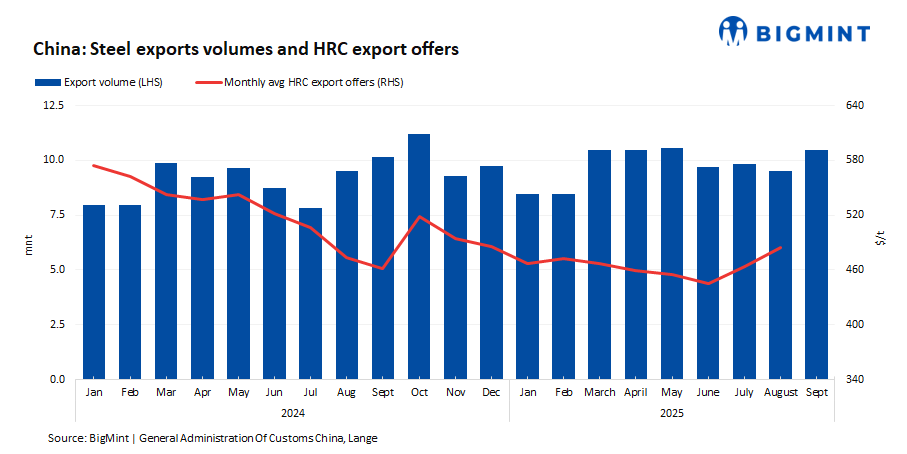
China’s steel exports for September 2025 stood at 10.465 million tonnes (mnt), up by 3.1% y-o-y as compared to 10.15 mnt in September 2024, as per the General Administration of Customs. In January-September 2025, exports rose by 9.2% y-o-y to 87.95 mnt from 80.84 mnt in the same period last year.
Additionally, on a m-o-m basis, steel exports increased by 10% against 9.51 mnt a month ago.
Factors driving China’s steel exports
Sluggish domestic demand: China’s domestic demand for steel remained sluggish, which was exacerbated by the logistics and construction disruptions caused by Super Typhoon Ragasa in Southern and Eastern China, combined with a pessimistic market outlook ahead of the Golden Week holidays. This created a significant oversupply. With production outpacing consumption and both buyers and sellers adopting a wait-and-watch approach that resulted in muted domestic trading, producers sought to offload their excess inventory.
Consequently, this substantial domestic overstock and bearish sentiment led to an increase in export activity, as mills aggressively diverted volumes to international markets to maintain production rates and clear inventory ahead of the National Day holiday from 1-8 October 2025.
Competitive pricing boosts China’s exports: In September, Chinese hot-rolled coil (HRC) offers to the Middle East dropped by $8/t m-o-m to around $506/t CFR UAE, intensifying competition for other exporting countries, while Indian offers to the region were priced higher at approximately $526/t CFR UAE in the same month.
China’s FOB HRC offers for the month stood at $478/t, remaining the most competitive in the market. By comparison, Indian offers were significantly higher at $502/t FOB.
Outlook
In the short term, demand is likely to remain sluggish, with buyers adopting a cautious stance and sellers aiming to clear inventory. However, a post-holiday demand rebound could prompt a shift in focus from exports to the domestic market.
Leave a Reply