- Improved port activity supports export uptrend
- Exports to Japan rise 9%, to China up 5% m-o-m
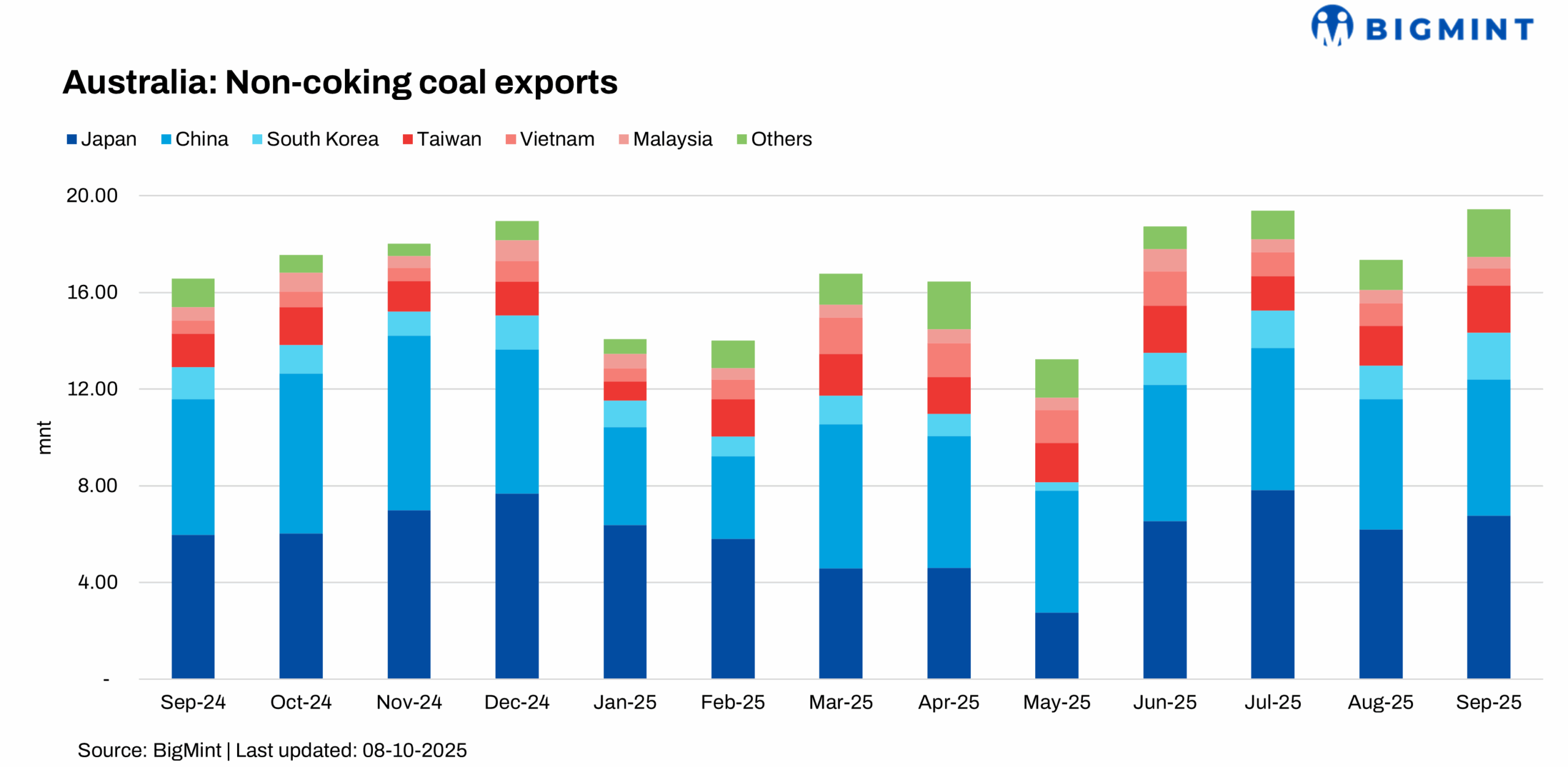
Australia’s non-coking coal exports witnessed a notable rebound in September 2025, driven by firm buying interest from key Asian markets and improved port performance. The country shipped 19.44 million tonnes (mnt) during the month, marking a 12% m-o-m rise from 17.36 mnt in August and a 17.3% y-o-y increase from 16.57 mnt in September 2024. The sharp growth underscores renewed momentum in Asian demand, particularly from major economies such as Japan, China, and South Korea.
Asia drives import growth
Japan remained the largest importer of Australian non-coking coal, registering a 9.1% m-o-m increase in imports to 6.77 mnt, reflecting consistent demand for high-quality thermal coal amid ongoing power sector requirements. China, the second-largest buyer, raised its imports by 4.8% m-o-m to 5.65 mnt, supported by steady industrial activity.
South Korea posted one of the strongest upticks, with imports climbing up by 38.8% m-o-m to 1.92 mnt. Taiwan followed the same trajectory, lifting imports by 18.9% to 1.96 mnt, providing additional support to Australia’s export balance.
However, demand from some Southeast Asian nations softened. Malaysia’s imports fell 11.9% to 0.47 mnt, while Vietnam’s volumes dropped 25.4% to 0.71 mnt, reflecting reduced procurement.
Port performance mirrors export growth
Australia’s coal export activity strengthened in September, supported by higher shipments across major ports. Newcastle Port, the country’s largest coal export terminal, handled 13.76 mnt during the month, marking a 14.7% m-o-m increase, amid improved vessel scheduling and smoother supply chain operations.
Other key ports also reported growth. Abbot Point’s exports rose 4.7% to 1.81 mnt, while Gladstone recorded a 6.2% uptick to 1.8 mnt. Shipments from Brisbane Port grew 16.9% to 0.5 mnt, and Port Kembla surged to 0.45 mnt from 0.18 mnt in August.
However, Dalrymple Bay Coal Terminal (DBCT) registered a 15.7% decline, with exports easing to 1.12 mnt during the month.
Outlook
Looking ahead, Australian non-coking coal exports are likely to remain strong in the near term, supported by steady Asian demand and efficient port operations. Seasonal restocking and energy needs in major importing nations could drive further growth, although weaker demand in smaller markets may temper overall gains.
Leave a Reply