- Weak rebar sales put pressure on mills
- Mills cautious despite modest scrap price gains
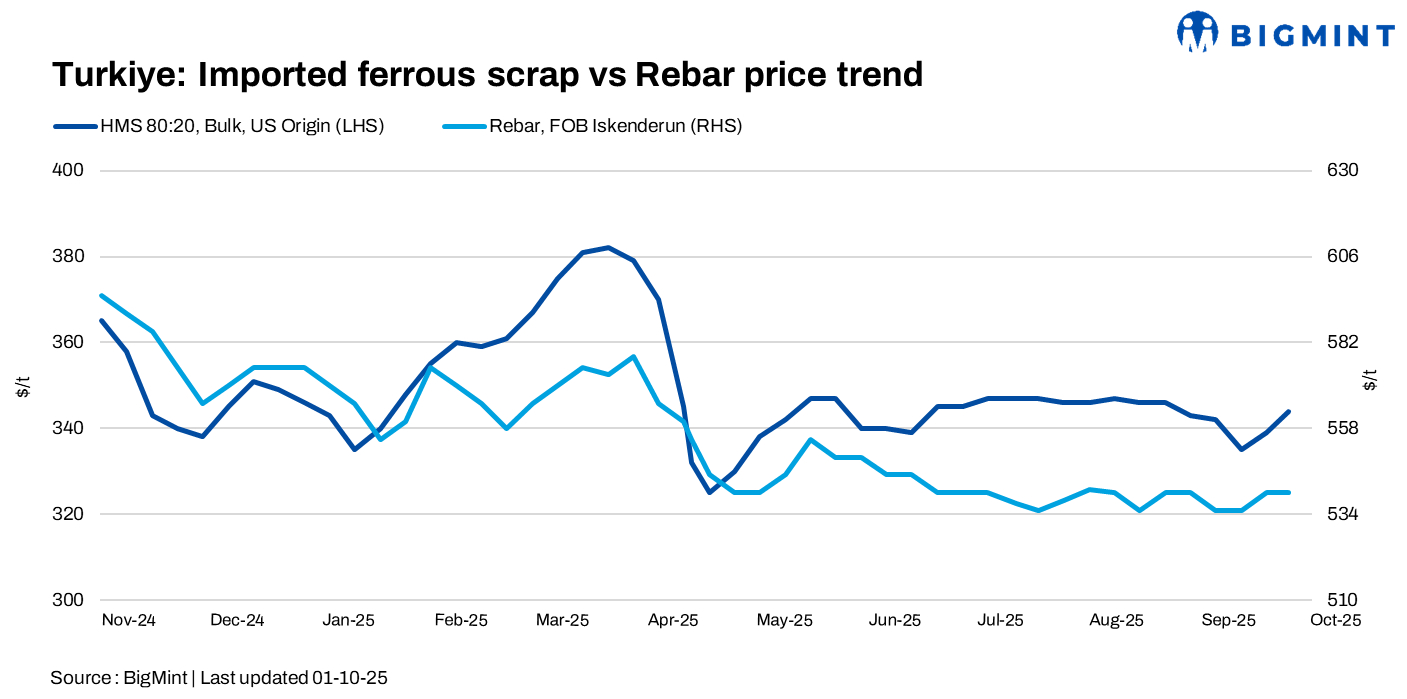
Turkiye’s deep-sea imported ferrous scrap market saw a sudden rise by up to $7/tonne (t) w-o-w, although overall market activity in finished steel remained cautious. Weak rebar sales continued to pressure Turkish mills, with many having largely fulfilled their scrap requirements.
The recent IREPAS is not looking that positive. Freight costs have shot up, and mills are struggling with weak demand, both domestically and for exports.
Eurozone recyclers remain under pressure from volatile foreign exchange and high ocean freight costs. Rising scrap collection costs and currency fluctuations have contributed to the recent price uptick.
In the scrap market, short-term price cooling doesn’t seem likely, as on the supply side, Americans are holding back or offering around $350/t, while European and Baltic sellers are quoting $340-345/t.
Price assessments
- US-origin bulk HMS 80:20 was assessed at $346/t CFR Turkiye, up by $7/t w-o-w.
- Bulk HMS 80:20 from the US East Coast stood at $309/t FOB, up by $3/t w-o-w.
The Turkish rebar-to-scrap spread remained at $195-200/t, with workable rebar offers at $540-545/t FOB, slightly higher than last week’s $535-540/t.
Turkish rebar exporters are under pressure–rising scrap prices and the 25% domestic content rule are squeezing margins. Weak local and export demand, plus competition from the Middle East, North Africa, and Asia, is making sales tough. Added import quotas and US duties of 50% have halted exports there. Even Europe is challenging, leaving mills focused on domestic sales amid low construction demand.
Market updates
Around 6-7 cargoes were heard in the last seven days. Steelmakers typically book 20-24 deep-sea scrap cargoes monthly, but only 15-16 deals have been verified so far in September.
Tradable values for US-origin HMS 80:20 were offered at $345/t CFR, and EU-origin at $340/t CFR. Turkish mills held firm amid weak steel demand, while buyers hesitated to meet $350/t CFR seller expectations.
A trader commented that Turkish mills have largely fulfilled their scrap needs, resulting in subdued buying activity and a lack of aggressive market interest.
As per a major scrap exporter, for weeks, Turkish mills were trying to push scrap prices lower, pointing to weak demand for finished steel. Even though rebar prices stayed steady, mills kept rejecting dealer offers and countering with unrealistically low bids. Scrap suppliers, however, stood their ground, and the market was stuck in a deadlock.
Even with interest from big buyers, deals couldn’t move forward because sellers wouldn’t budge. Now, the standoff seems to be over–mills are finally starting to accept sellers’ offers.
Outlook
Participants stayed in a “wait-and-see” mode as mills mostly wrapped up their October purchases. They are keeping an eye on US high-quality scrap prices for October, expected to be lower than September, while looking for signals on near-term trends. Some believe scrap prices could rise further, supported by steady demand.
Leave a Reply