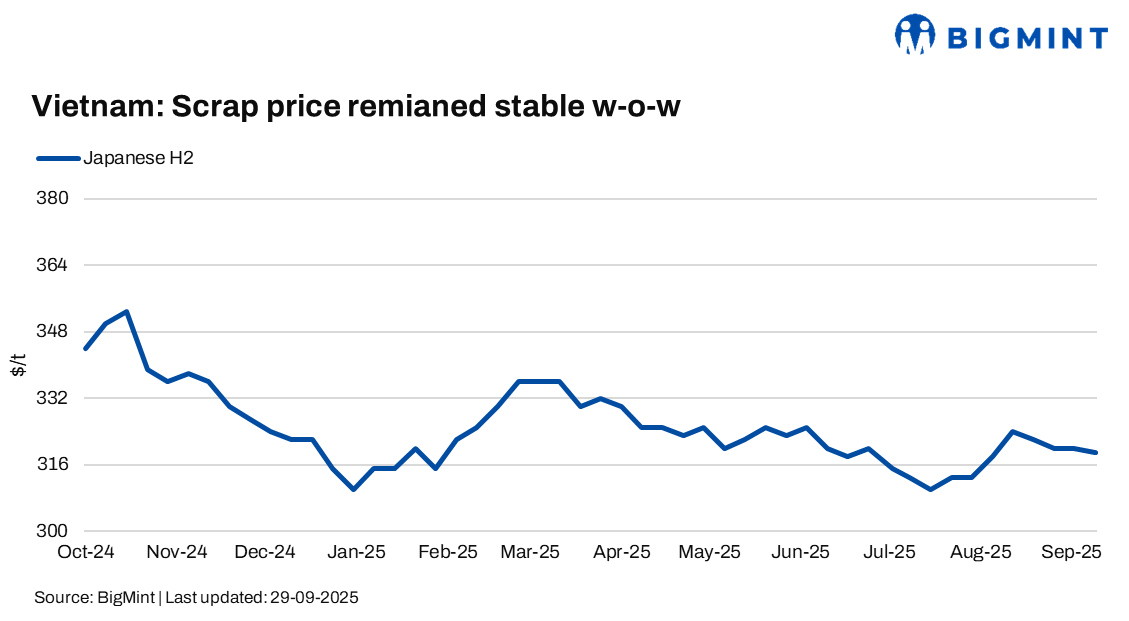
- Wide bid-offer disparities, thin liquidity hinder trading
- Domestic scrap currently meets only 20% of mill demand
Imported ferrous scrap prices in Vietnam remained largely stable w-o-w. Participants indicated that market fundamentals in the deep-sea bulk scrap segment showed minimal change from last week, with supply, demand, and price trends remaining steady.
Buyers mostly adopted a wait-and-watch approach, keeping bids unchanged and inquiries limited. Meanwhile, Japanese suppliers provided limited updates following their return from the Autumnal Equinox holiday.
Weekly assessments
- Japanese H2 scrap was at $319/t CFR, falling by $1/tonne (t) w-o-w.
- US-origin HMS 80:20 bulk stood at $340/t CFR Vietnam, stable w-o-w.
Market updates
A Vietnam-based trader said, “Demand for H2 is stable to rising.” The deep-sea bulk scrap market remained steady, with a wide gap in buyer-seller expectations. US-origin offers were at $350/t CFR and bids at $340/t amid thin liquidity.
A Vietnam-based trader noted that demand for imported scrap was stable despite local mills favouring domestic material, while the wide bid-offer gap hindered deal closure.
A market participant observed that Japanese H2 scrap offers were steady at JPY 41,500-42,000/t ($279-283/t), translating to a CFR range of $320-325/t for Vietnam. Market sentiment was cautious, with buyers maintaining a wait-and-watch stance amid stable supply and limited fresh deals.
According to a major Japanese exporter, a Vietnam-based trader stated that domestic scrap currently satisfies only around 20% of demand, forcing mills to depend on imported material to meet their full feedstock requirements.
HS scrap offers in Vietnam were quoted at $350-355/t CFR, unchanged from the previous week, while buyers placed lower bids near $345/t CFR.
Outlook
Near-term restocking is expected, supported by steady H2 demand and the price advantage of H2 scrap over more expensive deep-sea bulk cargoes. Sentiment remains cautious as buyers await further clarity before committing to deals.
Leave a Reply