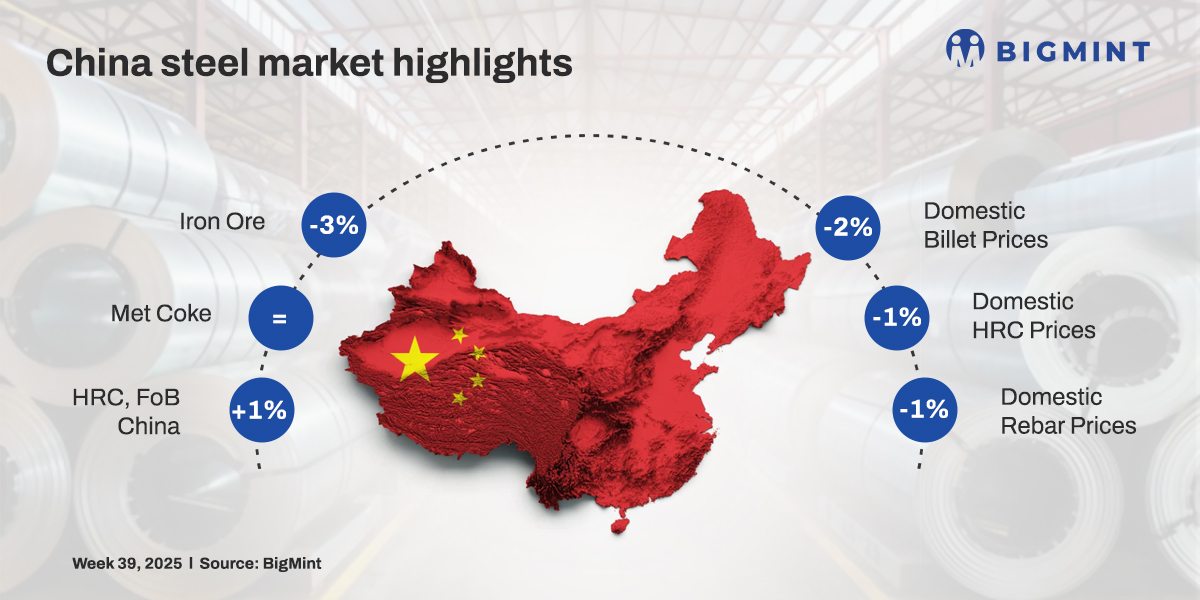
- HRC export offers increase by $5/t w-o-w
- SHFE HRC, rebar futures decline w-o-w
China’s steel market saw continued fluctuations in the week, with weakening macro sentiment and sluggish demand weighing on prices. Demand improvement was slow, reflecting a challenging market environment. Domestic prices of hot-rolled coils (HRCs) and rebars declined, mirroring the downtrend in SHFE futures. Notably, raw material prices displayed a mixed picture, with iron ore tags falling, while coking coal and billet showing an uptrend.
The China Iron and Steel Association (CISA) has announced that the total steel inventory at key Chinese enterprises in mid-September 2025 stood at 15.29 million tonnes (mnt), representing a drop of 530,000 tonnes (t) or 3.4% as compared to 15.82 mnt in early-September.
1. Iron ore spot prices dipped w-o-w: Benchmark iron ore fines spot fell by $3/t w-o-w to $104/dmt CFR China on 26 Sep. The market slipped as sentiment turned cautious after news of a potential 25-50% tariff on Chinese steel imports into Europe. At the same time, tighter mill margins, rising iron ore stocks, and still-high steel inventories added to the pressure on prices.
Iron ore inventory at Chinese ports rose by 0.38 mnt w-o-w to 132.45 mnt on 25 September, as per SteelHome data.
a) Spot pellet premium remains stable w-o-w: The spot pellet premium for Fe 65% grade pellet stayed flat w-o-w at $19.85/t CFR China on 24 September.
b) Spot lump premium falls w-o-w: The spot lump premium inched down w-o-w by $0.02 to $0.1645/dmtu on 26 Sep.
2. Coking coal prices inch up w-o-w: Australian premium HCC prices increased by $1/t w-o-w, reaching $190/t FOB in a recent deal. Meanwhile, China’s met coke market remained largely stable despite rising coal costs. Producers implemented modest price increases of RMB 30-50/t ($4-7/t), but steel mills largely resisted the adjustments. Strong steel production ahead of the holiday period continued to support demand.
3. Billet prices fall w-o-w: Billet prices in Tangshan fell RMB 60/t ($8/t) w-o-w to RMB 2,990/t ($425/t), while SHFE January 2026 rebar futures dropped RMB 71/t ($10/t) to RMB 3,114/t ($443/t).
Ahead of the Golden Week holidays, weak demand and the completion of restocking pushed the market to multi-week lows, with trade and export activity subdued. Mills stayed cautious as inventories remained high, while exports found little traction despite selective offers.
Market participants expect clearer price direction only after the holidays in October, with volume control policies offering some support but sluggish demand continuing to weigh on sentiment.
4. Domestic HRC prices drop w-o-w: China’s domestic HRC offers inched down by RMB 20/t ($3/t) w-o-w to RMB 3,160/t ($443/t) as compared to RMB 3,180/t ($446/t) a week ago, following a drop in SHFE futures. SHFE HRC futures (January 2026 contract) marginally declined by RMB 32/t ($4/t) w-o-w to RMB 3,330/t ($467/t) on 26 September from RMB 3,362/t ($472/t) on 19 September 2025.
Chinese steel HRC prices have declined due to persistent demand weakness, with the expected peak season demand boost in September failing to materialise, leaving prices under pressure.
However, China’s HRC export offers increased by $5/t w-o-w to $485/t FOB against $480/t a week ago.
5. Domestic rebar prices decrease w-o-w: China’s rebar prices were at RMB 3,220/t ($451/t), down by RMB 30/t ($4/t) w-o-w from RMB 3,250/t ($456/t), following a downtrend in SHFE futures. SHFE rebar futures (January 2026 contract) edged down by RMB 19/t ($3/t) w-o-w to RMB 3,139/t ($440/t) on 26 September as of RMB 3,158/t ($443/t) on 19 September 2025.
Super Typhoon Ragasa brought strong winds and heavy rains to Southern and Eastern China’s coastal areas, disrupting logistics and construction work, which weakened demand for rebar. However, in some regions, the impact on end-user demand was minimal, but buyers were cautious, maintaining low procurement rates amid bearish expectations for rebar prices ahead of the National Day holiday from 1-8 October 2025.

Outlook
Steel prices in China are expected to fluctuate narrowly in the near term, influenced by weak domestic demand. Looking ahead, upcoming holidays, particularly the week-long National Day holiday, may lead to a slowdown in construction and manufacturing activity, further impacting demand and keeping prices volatile. The overall market is likely to remain stable in the long run.
Leave a Reply