- Retail sales show growth across most vehicle segments
- GST reduction on vehicles to boost sales, production
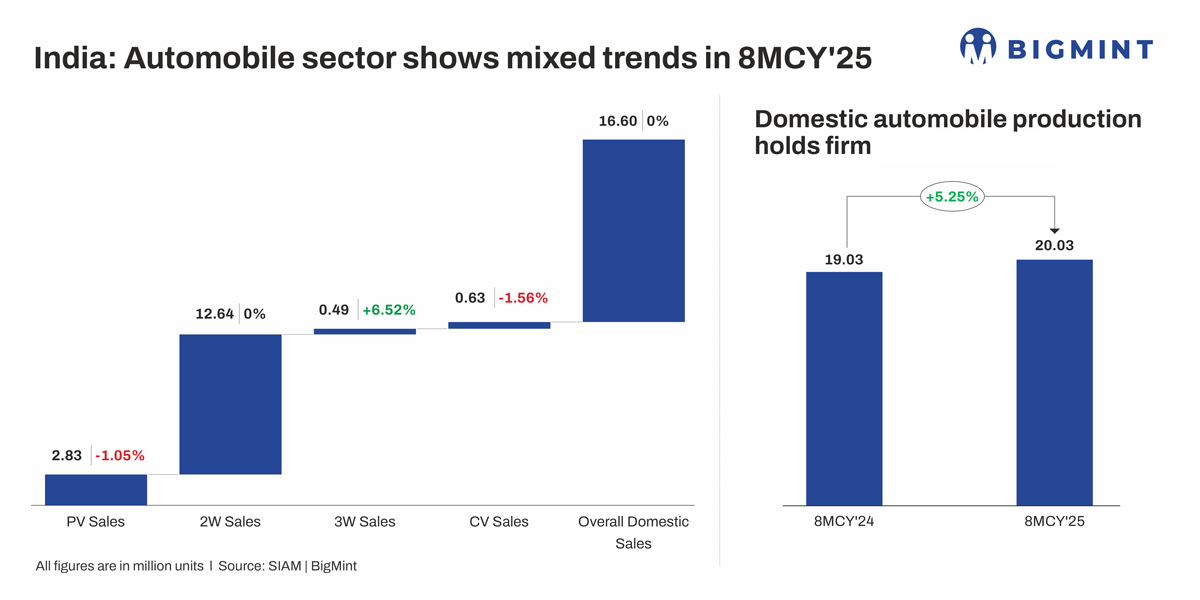
India’s automobile sector showed mixed performance in 8MCY’25 compared to 8MCY’24. As per SIAM OEM data, passenger vehicle sales dipped 1.05% y-o-y to 2.83 million units, while two-wheeler sales remained flat at 12.64 million units. Three-wheeler sales rose 6.52% to 0.49 million units, but commercial (CV) sales declined 1.56% to 0.63 million units. Domestic sales were steady at 16.6 million units, while production climbed up by 5.25% y-o-y to 20.03 million units.
SIAM data showed that passenger vehicle dispatches were slightly lower, as manufacturers moderated supplies to manage elevated dealer inventories amid subdued market demand. Two-wheeler dispatches remained flat, reflecting persistent weakness in the entry-level commuter segment, particularly in the 125-150cc category, despite supply chain stability.
CV dispatches softened due to slower replacement demand, moderated fleet expansion, and constrained financing, while three-wheeler volumes rose, supported by strong demand for last-mile urban mobility solutions. Overall production increased, as OEMs ramped up output ahead of the festive season, aided by improved semiconductor availability and stable component supplies.
Meanwhile, FADA retail sales data reflected stronger growth. Passenger vehicles surged 5.02% y-o-y to 2.72 million units, two-wheelers inched up 1.19% to 11.9 million units, and three-wheelers gained 3.80% to 0.82 million units. CV sales rose 2.99% to 0.69 million units, and tractors jumped 5.08% to 0.62 million units, pushing total retail sales up 2.13% to 16.75 million units.
FADA retail sales reflected stronger consumer traction. Passenger vehicle sales grew due to festive stocking, resilient urban demand, and launches of popular new models. Two-wheelers saw marginal improvement, helped by good rainfall progress and a gradual pick-up in rural consumption. Three-wheelers gained momentum with rising demand for last-mile connectivity in urban centres.

Commercial vehicle sales were supported by infrastructure activity and stable freight movement. Tractor sales strengthened further, driven by robust agricultural demand, ongoing kharif sowing, and higher rural cash flows, reflecting improved rural income and spending capacity.
GST cut on vehicles expected to boost auto sector growth and affordability
The recent GST cut — from 28% to 18% — on small cars, two-wheelers, and commercial vehicles is expected to significantly boost demand in India’s auto sector. Automakers highlighted a 15% rise in inquiries, and analysts project 6-7% CAGR growth from FY’26. This surge, especially in entry-level vehicles, will increase demand for die-cast components, driving consumption of ADC12 alloy.
Following US Fed cuts, RBI may reduce rates by 25 bps in Oct, Dec
The US Federal Reserve’s 25-basis point rate cut on 17 September signals growing labour market stress but is unlikely to significantly boost Indian equities, as the move was largely priced in. However, a cumulative 75-100 bps cut would ease the US dollar and bond yields, potentially triggering foreign capital inflows into emerging markets such as India.
Domestically, the ongoing market rally is supported by reform momentum, especially GST and optimism over a possible US-India trade deal. The RBI is expected to follow the Fed’s move, cutting rates by 25 bps each in October and December, which is again expected to boost market liquidity and consumer demand.
Impact on aluminium ADC12 alloy
Production of ADC12 aluminium ingots remained steady as manufacturers continued to ramp up operations ahead of the festive season. Demand for ADC12, a crucial material in automotive manufacturing, is expected to stay robust, supported by increased festive season activity and heightened consumer spending.
The recent GST reduction on vehicles is providing an additional boost to the automotive sector, encouraging higher production and sales, particularly in entry-level cars where aluminium die-casting is widely used. This policy move is also expected to improve affordability and accelerate vehicle purchases, further sustaining demand for ADC12 alloy.
According to BigMint’s bi-monthly ADC12 assessments for September, prices of ADC12 automobile OEM-grade ingots were at INR 229,000/t in Delhi NCR and INR 231,000/t in Chennai, both on 30-day payment terms.
Outlook
The auto sector is expected to see a gradual recovery by the upcoming quarter, driven by festive demand, rural income gains from a good monsoon, and supportive monetary policy. Passenger vehicles and two-wheelers should see improved traction, while CVs and tractors benefit from infrastructure activity and strong rural cash flows. For ADC12, steady automotive production and GST-driven sales boosts are expected to support stable demand.
Leave a Reply