- Buyers stay wary amid weak steel demand, depreciating VND
- Selective purchases of higher grades may be seen in near term
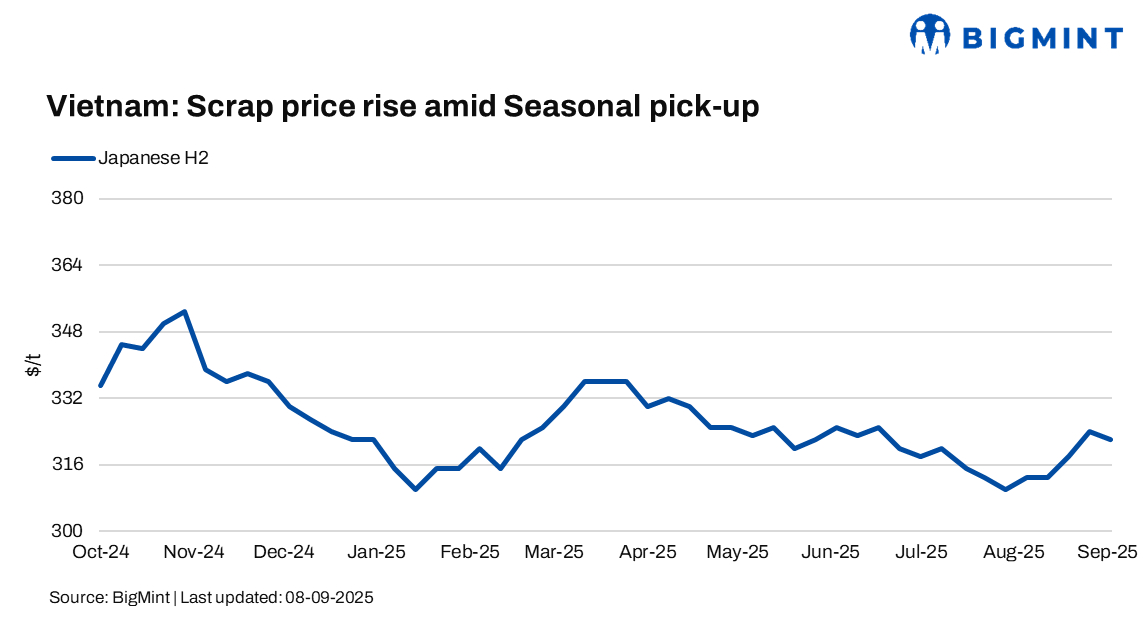
Imported ferrous scrap prices in Vietnam inched down by $2-3/tonne (t) w-o-w as overall market activity remained subdued following the National Day holiday (2 September). Trading gradually resumed, but momentum remained weak amid persistent regional softness.
Adding to caution, the Vietnamese dong hovered near record lows at 26,363/USD.
Weekly assessments
- Japanese H2 scrap was at $322/t CFR, down by $2/t w-o-w.
- US-origin HMS 80:20 bulk stood at $342/t CFR Vietnam, down by $2/t w-o-w.
Recent deals: A Vietnamese buyer reportedly secured 30,000 t of US West Coast scrap, comprising 10,000 t of HMS 80:20 at $340/t CFR and 20,000 t of bonus-grade at $350/t CFR.
Market updates
A Vietnamese trader noted weaker late-week buying interest for Japanese H2 scrap, with demand shifting towards higher-grade materials.
Another trader noted that US-origin deep-sea HMS 80:20 offers in Vietnam were at $342-344/t CFR last week, narrowing by around $5/t from the previous $348-350/t range.
Across Asia, bearish sentiment continued in downstream billet markets, as Chinese steelmakers grappled with high inventories and narrowing profit margins.
US tariff uncertainty fostered caution among major bulk buyers such as Turkiye, affecting Vietnamese buying inquiries for deep-sea cargoes.
However, the Hoa Phat Group raised monthly HRC (SAE1006, non-skin-passed) prices by $10/t m-o-m for October, with southern region prices at $528/t (VND 13,930,000/t) from $518/t, reflecting improved market sentiment.
Outlook
In the near term, Vietnamese scrap demand is expected to remain cautious, as mills grapple with subdued domestic steel consumption, elevated inventory levels, and currency volatility. However, some purchases of higher-grade material may continue, keeping the market selectively active.
Leave a Reply