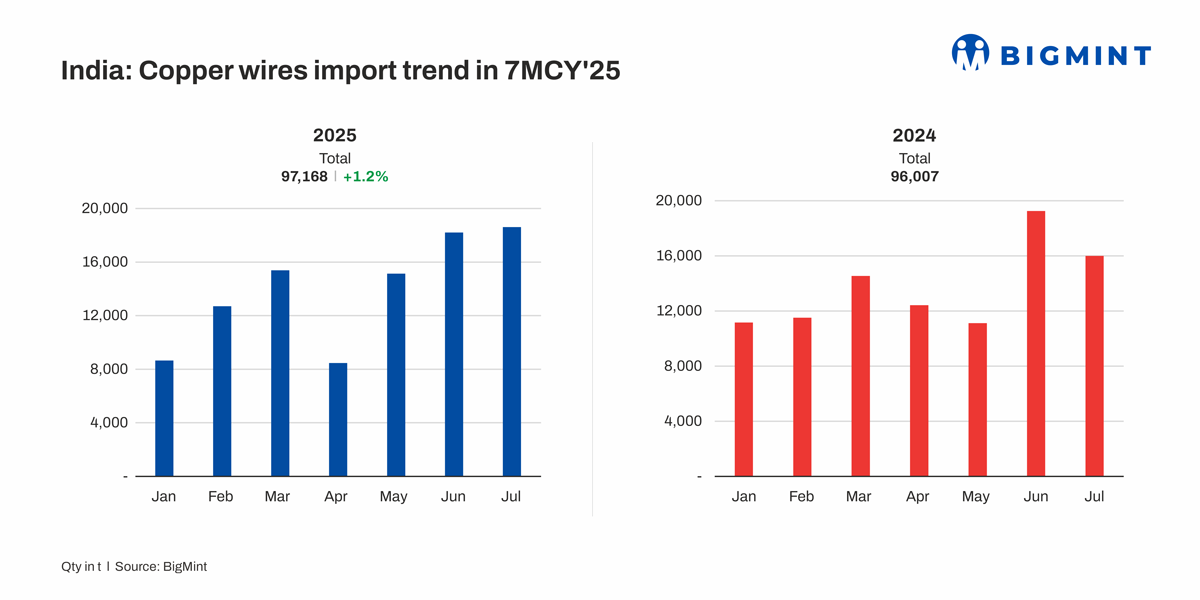
India’s copper wire imports were steady in 7MCY’25, rising just 1% y-o-y to 97,168 t versus 96,007 t last year. Beneath the flat headline number, however, sourcing patterns shifted sharply under the impact of India’s expanded Quality Control Order (QCO) and mandatory Bureau of Indian Standards (BIS) certification.
The UAE emerged as the clear winner, boosting its share to nearly 72% of total imports, up from about 52% in 2024. This surge was supported by rapid BIS approvals, tariff concessions, and regulatory streamlining under the India-UAE CEPA.
UAE dominance reinforced
The UAE consolidated its position as India’s top supplier with volumes up 39% y-o-y to 69,991 t. Its agility in navigating India’s stricter rules, coupled with its role as a key transshipment hub, ensured uninterrupted flows when many other exporters faced compliance delays. Long-standing trade ties and CEPA advantages further reinforced its lead.
China gains ground, Malaysia loses share
China climbed from sixth position in 2024 to become India’s second-largest supplier in 7MCY’25, with shipments up 43% y-o-y to 8,914 t. The shift underscores China’s pivot to higher-value finished copper products and swift regulatory alignment. In contrast, Malaysia’s exports fell 23% y-o-y to 10,213 t, weighed down by slower BIS adoption. Imports from “other” suppliers collapsed 69% y-o-y to 8,051 t, as smaller players struggled to meet India’s stringent quality regime.

Policy backdrop and resilience vs cathodes
India’s QCO for copper products, enforced from 1 December, 2024, mandated BIS certification for both foreign and domestic producers, with phased relief for small and micro firms until April 2025. Suppliers unable to comply-mainly smaller and less-established exporters-were effectively shut out, funneling trade toward larger, compliant players such as those in the UAE and China. Importantly, while cathode shipments slumped 70-90% y-o-y in January-February under QCO, wires remained resilient thanks to staggered timelines, advance stocking by buyers, and available exemptions.
Latest industry developments:
April: The Directorate General of Trade Remedies (DGTR), India, has suggested the imposition of countervailing duties (CVD) between 3.46% and 10.27% on copper wire imports from Vietnam, Thailand, Malaysia, and Indonesia.
March: Kutch Copper, a wholly owned subsidiary company of Adani Enterprises, established a partnership with Praneetha Ventures to produce and distribute metal items, wires, and cables.
February: Ultratech Cement has announced its foray into the wires and cables segment and will invest INR 1,800 crore in establishing a plant in Gujarat within two years as a part of an expansion strategy to strengthen its position in the construction value chain. The plant will be established in the vicinity of Bharuch in Gujarat and is likely to be commissioned by December 2026, UltraTech Cement said in a statement.
Outlook
India’s new copper smelter capacity, notably Adani’s Gujarat facility, is expected to reach full cathode output by late 2025, which could eventually support downstream wire and rod production and gradually reduce import reliance for these products. Until then, wire imports are expected to remain steady, with the UAE and China consolidating share, while Malaysia and smaller origins risk further erosion unless they accelerate compliance.
Leave a Reply